Health
Mother’s diet and environment may disrupt children’s metabolism
UC Santa Cruz microbiologists find links between mother’s diet, environment, and metabolic-disease risk in mice offspring
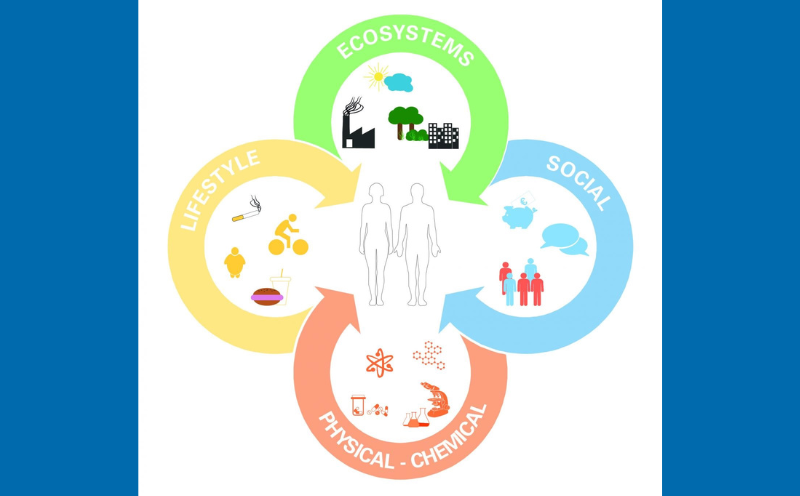
An illustration of the exposome, a concept commonly used in microbiology that represents the cumulative exposures individuals undergo throughout their lives and the resulting health effects.
Credit: University of Luxembourg
Press Contact
A mother’s exposure to factors like high-fat diets and environmental contaminants can impact her offspring’s metabolism, according to new research using lab mice at the University of California, Santa Cruz.
In the lab of microbiology and environmental toxicology professor Raquel Chamorro-Garcia, her team researches how what humans put into the environment can have pervasive effects on our health and that of our children. In this study, they tested the effects of various chemicals commonly found in groundwater and soil that are known to be metabolic disruptors.
“The goal of the study was to compare the effects of three different exposures as a way of representing the complexity of what humans are often exposed to,” said the study’s lead author, Carlos Diaz-Castillo, an associate researcher in the Chamorro-Garcia Lab. According to Diaz-Castillo, the results of the study showed sexual dimorphism, where males and females show different characteristics in the next generation.
The first metabolic disruptor they exposed mice to was human-made obesogen tributyltin (TBT), a chemical associated with multigenerational obesity found in ocean sediment, seafood, and even house dust.
The second disruptor was naturally occurring inorganic arsenic, a chemical typically found in groundwater and soil that has already been shown to increase risk of developing type-2 diabetes. This chemical, which enters the environment through the weathering and erosion of rocks and soil, impacts over 200 million people worldwide, with long-term exposure leading to cardiovascular disease and cancer.
Beyond chemicals, the mice were exposed to the Total Western Diet, a lab-developed nutritional regimen designed for mouse research comprising high amounts of saturated fats and simple sugars. This diet is intended to mimic what half of the U.S. population consumes and is a strong example of a prevalent lifestyle metabolism disruptor.
“Diet is another well known metabolic disruptor for which there’s a little bit of information about effects in the next generations,” Diaz-Castillo said.
Multigenerational implications
Chamorro-Garcia’s lab also studies how multigenerational impacts of environmental exposures differ between adult males and females, and between offspring of different sexes. Just last month, a separate study led by the professor exposed lab mice to pure nicotine and concluded that a father’s tobacco use may raise his children’s risk of developing diabetes.
In this new study, the team exposed female mice to the three metabolic disruptors before pregnancy, then looked at their offspring for signs of changes in metabolism. They gave female mice treated drinking water and the lab diet for three weeks, then mated them with males not exposed to the disruptors. Afterwards, they analyzed the offspring’s gene expression and other factors like weight.
“We typically expose one sex to something, and then we breed them with counterparts of the other sex that had not been exposed,” said Diaz-Castillo. “We generate the first generation descendants, and then we ask, is their metabolism somehow affected?”
Possible link to anorexia
Based on previous research, Diaz-Castillo believed these three disruptors would also impact a female offspring’s metabolism. This study’s findings supported that hypothesis, but the team also encountered two unexpected outcomes.
According to Diaz-Castillo, even though the disruptors were distinct, they found similarities in their effects on the offspring—such as changes in plasma levels of relevant metabolites like insulin, leptin, or ghrelin, and changes in mitochondria function. Beyond these similarities, researchers also found a striking resemblance between the female mice offspring and trends in human individuals with anorexia.
Diaz-Castillo said hallmarks like low weight of adipose tissue (body fat), low leptin plasma levels, and perturbed mitochondrial functions might suggest that the disruptors triggered observable anorexic characteristics not associated with a loss of weight or a disruptive diet, which is commonly referred to as atypical anorexia nervosa.
“Although it is feasible that what we are seeing here is that the exposure to these three metabolic disruptors leads to a predisposition to anorexic phenotypes in the female descendants, it is still early to suggest that this is, in fact, the only explanation for what we are seeing,” Diaz-Castillo explained.
Fundamental insights
Human studies through multiple generations are limited, but it remains clear that environmental factors on mothers can have impacts on offspring. Research on animal models like mice can help us understand the impacts of diet and environment on humans.
“Our research, even if it does not get translated to humans immediately, suggests that certain exposures are potentially detrimental,” Diaz-Castillo said.
Stephanie Aguiar, a Ph.D. student in molecular, cell, and developmental biology at UC Santa Cruz, also co-authored the study, titled “Preconception exposures of female mice to a panel of metabolic disruptors induce sexually dimorphic metabolic perturbations in their offspring.” It was published on April 1 in Frontiers in Endocrinology and received support from campus startup funds and a National Institute of Environmental Health Sciences grant.