Climate & Sustainability
Researchers to measure atmospheric benefits of restored San Francisco Bay wetland
UC Santa Cruz will lend expertise in monitoring tidal marsh carbon levels once a 275-acre South Bay salt pond is converted back to its natural state, as part of a larger environmental campaign by multiple partners to restore lost tidal wetlands to San Francisco Bay.
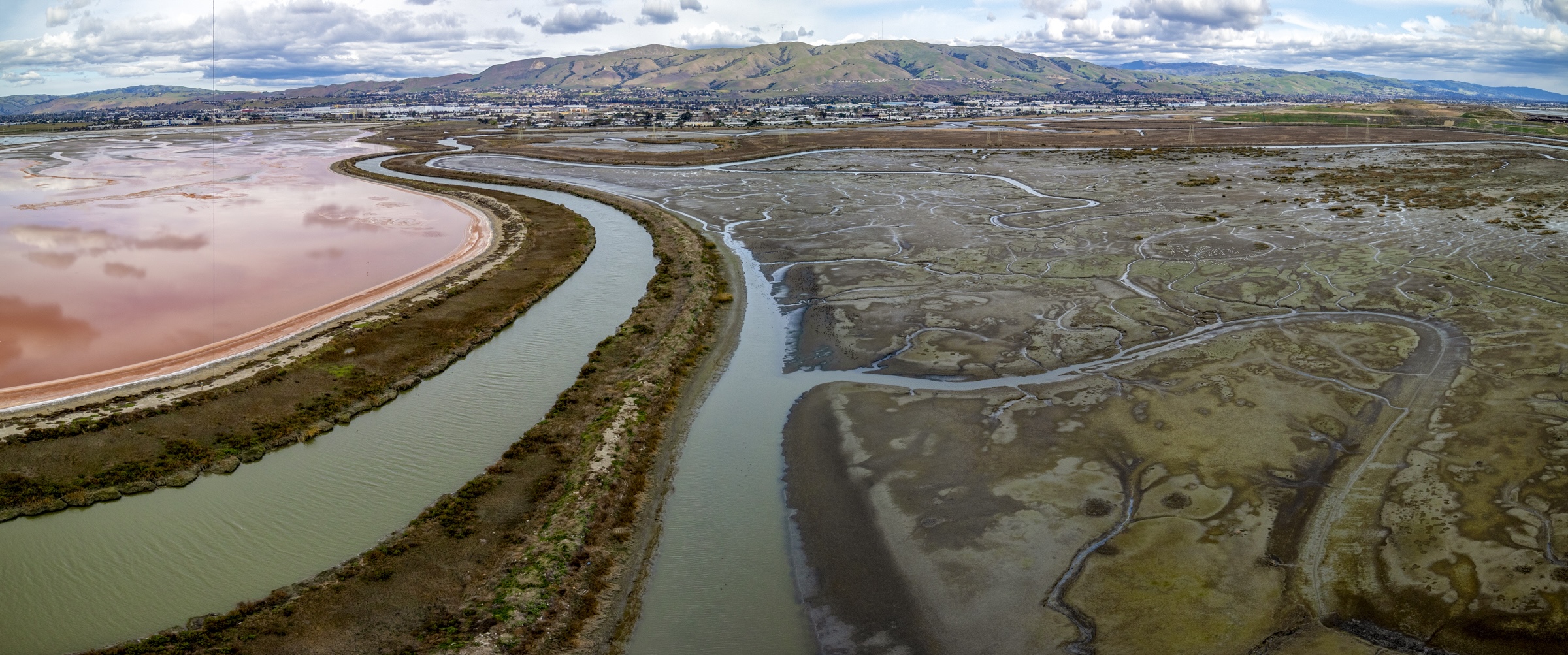
Aerial photo of the former salt ponds in the southern San Francisco Bay acquired by state and federal agencies in 2003 from Cargill, Inc. The pond on the right is in mid-restoration.
Credit: Cris Benton, kite aerial photography
Press Contact
Researchers at the University of California, Santa Cruz, will undertake the campus’s first greenhouse-gas monitoring project in the San Francisco Bay, as part of a collaboration announced on April 14 that will restore a retired 275-acre industrial salt pond back into healthy tidal-marsh habitat.
The carbon-monitoring project will be the largest of its kind for Earth and planetary sciences professor Adina Paytan, whose lab has extensively studied the exchange of carbon dioxide (CO2) and methane (CH4) between the atmosphere and marshes of Elkhorn Slough.
The work in the San Francisco Bay is part of the South Bay Salt Pond Restoration Project, whose ultimate goal is to convert 15,100 acres of commercial salt ponds at the south end of the bay to a mix of tidal marsh, mudflat, and other wetland habitats—making it the largest tidal wetland restoration project on the West Coast.
Construction on this phase is anticipated to begin late in 2026 or in 2027 and conclude in 2028, with the carbon and other monitoring extending for many years beyond that. In addition to habitat restoration, project leaders say this stage of work will also help the city of Mountain View adapt to sea-level rise, while extending recreational open space with the construction of a new public trail, viewing areas, and interpretive signage. Known as Pond A1, the site abuts the city’s popular 750-acre Shoreline Park.
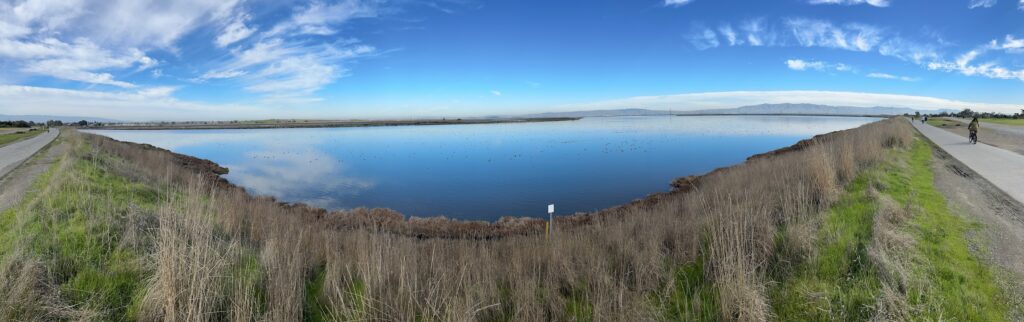
Google, which has called Mountain View home for over 25 years, will fund most of the restoration construction and carbon-sequestration monitoring. “Restoring wetlands is one of the most effective, shovel-ready, and nature-based carbon dioxide removal solutions,” said Paytan, adding that this is the first time her lab’s work has been supported by a high-tech company. “We’re excited to work with Google to progress this approach by revitalizing an ecosystem right here in California.”
Similar marsh-restoration projects in San Francisco Bay have suggested that these high-salinity wetlands have unusually high carbon-sequestration potential and immediate cooling impacts on the atmosphere. However, because only a few studies have addressed these questions, Google’s funding will help expand carbon monitoring to a more comprehensive monitoring framework.
“If we can quantify all the ways these wetlands sequester carbon in soils and the coastal ocean, we can build greater support for this important nature-based climate solution and pave the way for more wetland restoration in San Francisco Bay and beyond,” said Patty Oikawa, professor in California State University, East Bay’s Department of Earth, Environmental and Sustainability Sciences.
Coastal wetlands can be an exceptionally effective weapon in the fight against global warming. They, along with other coastal ecosystems like mangroves, can remove CO2 from the atmosphere and store the carbon in their plants and wetland soils much more efficiently than forests on land—up to 10 times more by some estimates, with carbon staying in the soil for much longer.
Other partners in the Pond A1 restoration include the California State Coastal Conservancy, Ducks Unlimited, UC Berkeley, and the City of Mountain View—reflecting the overall South Bay Salt Pond Restoration Project’s collaborative approach involving federal, state, and local agencies.
Tidal marsh once lined the South Bay, cushioning shores from storms and tides, and providing important habitat for native fish and wildlife. But over the course of the 20th century, approximately 85% of San Francisco Bay wetlands, over 150,000 acres, were lost to development. The South Bay Salt Ponds were acquired in 2003 from Cargill Inc. in a deal brokered by the late Senator Dianne Feinstein, a long-time champion of the restoration effort.