Campus News
UC Santa Cruz advances partnerships in Indonesia, formalizes first 2+2 agreement
UC Santa Cruz faculty and staff traveled to Indonesia in February to sign the campus’s first 2+2 degree agreement with the University of Indonesia and explore additional academic partnerships with universities in Jakarta and Bandung.
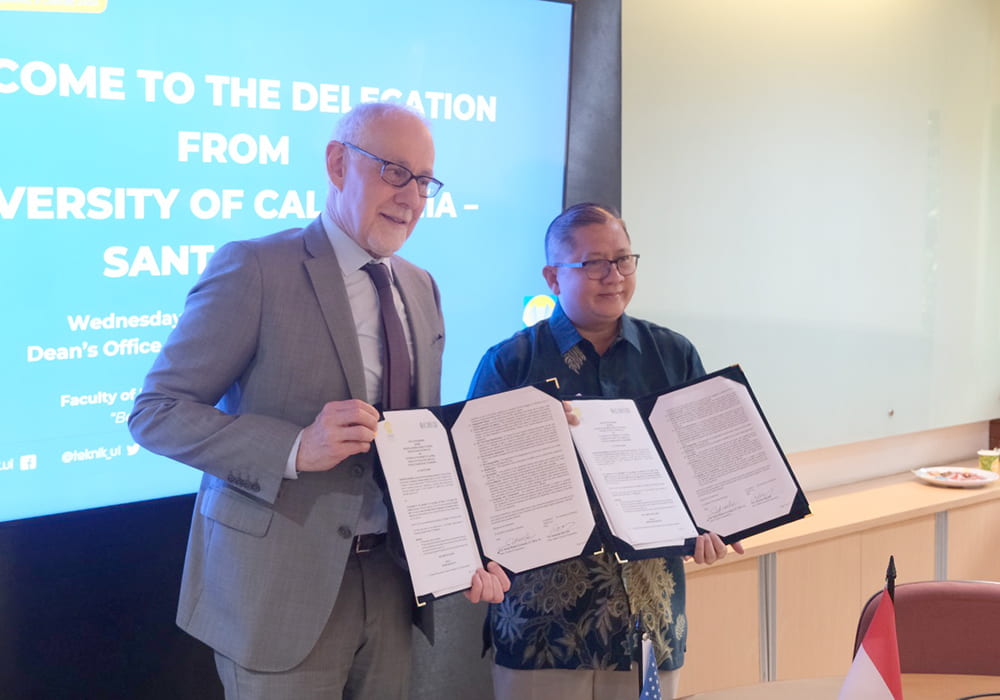
Alexander Wolf, dean of the Baskin School of Engineering at UC Santa Cruz, participates in the signing of a new 2+2 academic agreement during a visit to Indonesia in February.
A delegation of UC Santa Cruz faculty and staff visited Indonesia in February, marking an important continuation of conversations in April 2025, when leaders from the University of Indonesia (UI) visited UC Santa Cruz to sign a general institutional agreement.
The delegation traveled to Jakarta and Bandung to advance and expand 2+2 agreements with Indonesian universities.
Expanding 2+2 Degree and Academic Pathways
While at the University of Indonesia, UC Santa Cruz signed its first formal agreement for a 2+2 degree pathway in Electrical and Computer Engineering and explored opportunities to expand the 2+2 model to additional disciplines. UC Santa Cruz representatives Alexander Wolf, dean of the Baskin School of Engineering, Alan Spearot, professor of Economics, Jim Whitehead, associate dean for undergraduate affairs and professor of Computational Media, and Guido Bordignon, faculty director for Global Engagement and associate professor of Molecular, Cell & Developmental Biology shared overviews of their departments, framing discussions around curriculum alignment and degree requirements.
“Our visit to Indonesia was an important step in turning strong conversations into concrete action,” said Alexander Wolf. “We were able to deepen our engagement with colleagues and advance shared priorities around student mobility and academic collaboration. Initiatives like the 2+2 degree not only expand access to high-quality education but also strengthen the long-term institutional ties that support research collaboration and innovation.”
Following the morning signing ceremony, meetings with the University of Indonesia’s Vice Rector for Academic and Student Affairs and faculty representatives from Computer Science, Economics and Business, and Mathematics and Natural Sciences allowed participants to explore adding additional departments to the 2+2 agreement beyond electrical engineering.
Building New Institutional Partnerships
In Bandung, the delegation met with leaders at the Bandung Institute of Technology (ITB). ITB is consistently ranked as one of Indonesia’s top three universities and enrolls more than 23,000 students, offering strong potential for future academic degree pathways, particularly in engineering and STEM fields. Discussions focused on potential 2+2 degree models and research opportunities for funded graduate students to visit UCSC. The ITB participants were highly enthusiastic about developing 2+2 and 3+1+1 degree pathways, and follow-up Zoom meetings with their faculty have already occurred.
The delegation also visited Padjadjaran University while in Bandung for an introductory meeting with the Office of International Affairs to explore future collaboration across teaching, research, and student exchange.
“Our conversations in Bandung highlighted the strong academic alignment between UC Santa Cruz and our Indonesian counterparts, said Guido Bordignon. “We see strong potential for collaboration for student mobility and research, and we’re excited about building partnerships that foster scientific discovery while giving students meaningful international academic experiences and cultural exchanges.”
Back in Jakarta, the delegation met with leadership from BINUS University, one of Indonesia’s leading private universities, which enrolls more than 40,000 students across multiple campuses. Discussions focused on developing academic degree pathways such as 2+2 undergraduate degrees and 3+1+1 master’s degrees. BINUS has a very robust international program that features these academic pathways, and a strategic internationalization plan that aspires to have 90% of its total student population participate in an international experience before graduating.
Looking Ahead
The visit to Indonesia advanced UC Santa Cruz’s strategic priority of establishing 2+2 and 3+1+1 academic degree pathways to increase international student enrollments through partnerships with universities abroad. These efforts position UC Santa Cruz to deepen academic collaboration in Southeast Asia while increasing enrollment from Indonesia in the coming years.