Social Justice & Community
‘Dignity in the Fields’: report documents conditions and outlines recommendations for Salinas farmworkers
The report provides practical, equity-centered solutions for the challenges that limit both worker well-being and long-term regional prosperity.
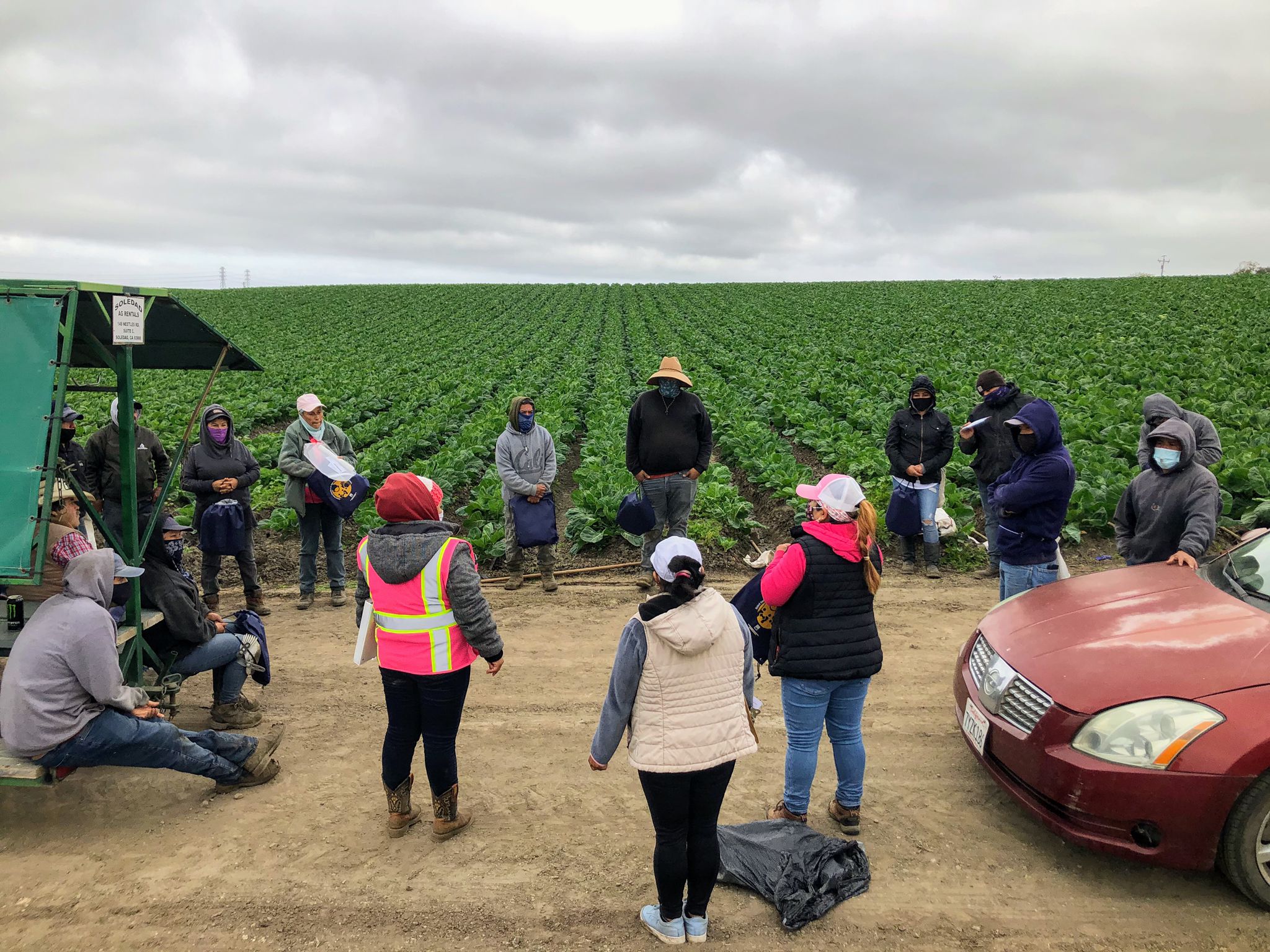
A group of farmworkers speak with CBDIO team members in Monterey County.
Images courtesy of CBDIO.
Press Contact
Key takeaways
- Low wages and unsafe working conditions have persisted over the last decade, while the increase in temporary and seasonal labor and increased immigration enforcement have exacerbated challenges.
- The recent wave of immigration raids throughout California has led to widespread fear amongst workers, with a 2025 study showing that some areas of the state saw up to 70% work absenteeism.
- The use of H-2A visas, which allow U.S. employers to bring foreign nationals to the U.S. for temporary or seasonal agricultural work, has increased five-fold Monterey County in the last decade, intensifying economic and workplace challenges.
Salinas Valley, known as the “salad bowl of the world,” provides food for millions of people and powers a multi-billion dollar agriculture industry. Latino and Indigenous farmworkers’ labor is essential for the prosperity of this region and industry, yet they often face challenges like unsafe working conditions, low wages, and major barriers to housing.
A new report produced by a five-year partnership between the UC Santa Cruz Institute for Social Transformation and the Centro Binacional para el Desarrollo Indígena Oaxaqueño (CBDIO) documents the legal, economic, and housing challenges facing farmworkers and their families. It provides practical, equity-centered solutions for the challenges that limit both worker well-being and long-term regional prosperity.
“Equity is actually good for our economy, and improving farmworkers’ living conditions is really essential for ensuring regional prosperity,” said Chris Benner, report author and a professor of sociology. “The report is intended as a go-to reference material on key conditions facing farmworkers in the region.”
The Salinas Valley is located within Monterey County, and the agriculture industry supports over 20% of jobs in the county. Nearly 74% of the people filling those jobs are foreign born—mostly from Mexico. About 15% are from Indigenous groups in Mexico, and speak primarily their Indigenous language, often speaking Spanish as their second language or not at all. The researchers aimed to include and uplift the challenges and perspectives of those who are particularly marginalized by language barriers.
Throughout the report, community members’ voices are highlighted as they seek to organize to better their working conditions and provide a safe, healthy future for their families. Through CBDIO’s long-standing relationships with Indigenous communities in the region, the report includes quotes directly representing the perspectives of farmworkers, although their names are anonymized due to safety concerns.
“The change I want in my job is for our wages to be increased so that we can save money during the colder months when the strawberry season ends, so we don’t have to be separated from our families and we don’t have to worry about the ever-increasing cost of rent,” said a farmworker who preferred to be identified by their initials “A.N.”
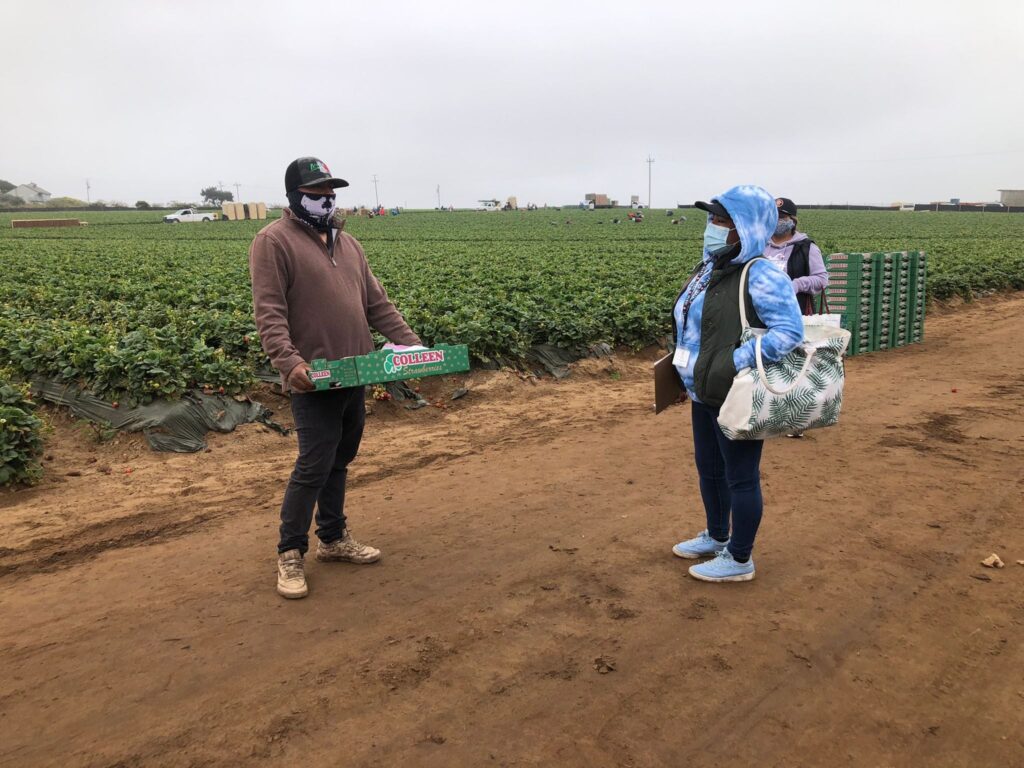
The authors note that these findings around workplace and community challenges are especially relevant in light of the immigration enforcement raids occurring across the country.
“Farmworkers are living in fear every day of being deported,” CBDIO’s Yesica Guzman Rodriguez said. “It’s a huge challenge of being desperately in need of work and the earnings from that, even as low as they are, but also being afraid that ICE could show up at any time and take people.”
Benner and Gabriella Alvarez at the Institute for Social Transformation authored the report in collaboration with Sarait Martinez and Yesica Guzman Rodriguez at CBDIO. The report’s creation was supported by the James Irvine Foundation, which identified Salinas as a focus under their Priority Communities initiative. In partnership with the Community Foundation of Monterey County, they have funded the Salinas Inclusive Economic Development Initiative (SIEDI), a collaboration of community organizations in the region committed to inclusive economic development. This effort seeks to strengthen the regional economy by funding efforts to empower low-wage workers, families, and organizations. UC Santa Cruz is an ongoing research partner for this effort through a range of projects.
Findings
The report examines the precarity and exclusion farmworkers face legally and economically, often because of weak enforcement of protective laws, gaps in federal law, and immigration status. Low wages and unsafe working conditions have persisted over the last decade, while the increase in temporary and seasonal labor and increased immigration enforcement have exacerbated challenges. Overall, farmworkers face a bleak economic outlook, with the 2025 median hourly wage at $18.50.
“It’s the same old routine; everything we save is gone in a month, and then another month starts and we go back to work to save again, but there are days when we don’t work, so we don’t have much left to save,” said “A”, a worker who preferred to be identified by their first initial. “The city where we live is very expensive, and we can’t afford to pay the full rent ourselves.”
Workers experience fear around reporting labor and workplace violations due to their immigration status. The recent wave of raids throughout California have led to widespread fear amongst workers, with a 2025 study showing that some areas of the state saw up to 70% work absenteeism.
One finding that was particularly surprising for Benner was the state and local increase in workers on H-2A visas, which allow U.S. employers to bring foreign nationals to the U.S. for temporary or seasonal agricultural work when local labor is unavailable. The use of H-2A labor in Monterey County has increased five-fold in the last decade.
For these workers whose status in the country is tied completely to their employer, there may be even more fear around reporting unfair wages and workplace safety violations. Additionally, seasonal workers are often hired with the middleman of a labor contractor, which can dilute the responsibility of agricultural companies to maintain working conditions.
“The companies that are actually selling the produce are offloading their responsibility for the people growing, planting, harvesting, and weeding the crops, who are not their legal employees, but they benefit from their labor,” Benner said.
The report also presents the challenges farmworkers face around housing and health. Housing is unaffordable, overcrowded, and often unsafe. Working outside in the fields, workers face pesticide exposure, dangerous heat, and extreme weather events—all exacerbated by climate change—which threaten their safety and stability. The 2023 Pajaro River flood demonstrated this vulnerability, damaging or fully destroying nearly every home in Pajaro, as well as wiping out cropland, and in turn, work.
Recommendations
The report lays out a set of recommendations under five main pillars, all aimed at ensuring dignity, stability, and real opportunity for farmworkers in Salinas Valley:
- Strengthen labor protections for farmworkers (particularly indigenous-language speakers)
- Increase regional immigrant protections, especially during times of enforcement activity
- Improve the quantity, quality and affordability of farmworker housing
- Ensure farmworkers can offer meaningful input into Ag Tech design, training, and implementation
- Advance inclusive immigration protections for farmworkers at the federal and state levels
The authors provided key action steps for each pillar, providing potential next steps for lawmakers, community organizations, and industry stakeholders. They place an emphasis on centering Indigenous voices and leadership in policy design and implementation in order to create real, on-the-ground solutions.