Campus News
About the UC Santa Cruz elephant seal research program
The UC Santa Cruz elephant seal research program began in 1967 when Professor Emeritus Burney Le Boeuf initiated a systematic tagging and censusing project at the Año Nuevo Reserve. This long-term study is housed within the Department of Ecology and Evolutionary Biology (EEB). Currently, the research is spearheaded by Assistant Professor Roxanne Beltran, with significant […]
The UC Santa Cruz elephant seal research program began in 1967 when Professor Emeritus Burney Le Boeuf initiated a systematic tagging and censusing project at the Año Nuevo Reserve. This long-term study is housed within the Department of Ecology and Evolutionary Biology (EEB).
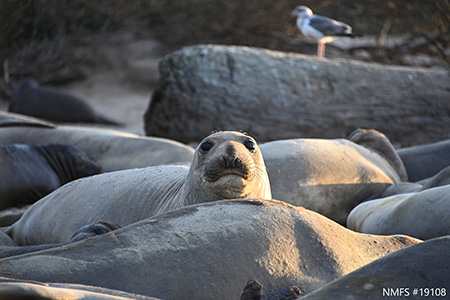
Currently, the research is spearheaded by Assistant Professor Roxanne Beltran, with significant ongoing contributions from Distinguished Professor Daniel Costa, who took over leadership from Le Boeuf. The program focuses on the Northern Elephant Seal (Mirounga angustirostris), a species that rebounded from a hunting-induced bottleneck of fewer than 20 individuals in the late 19th century to a current population of over 210,000. Researchers at UC Santa Cruz have tracked more than 50,000 individual seals over six decades, observing critical life-history traits such as the “supermom” phenomenon, where a mere 6% of females produce more than half the population’s pups. The research program is one of the longest and most extensive studies of a marine mammal on the planet and has resulted in over 500 peer reviewed scientific publications.
Support the research program
Here’s where to donate to the Beltran Lab. Donations will support ongoing research efforts in addition to training the next generation of conservation leaders by providing transformative experiences for undergraduate student researchers.
Primary Research Labs
The Beltran Lab: The current hub for elephant seal ecological demographic research. The lab’s website features live tracking data of tagged seals and detailed project descriptions.
The Costa Lab: Led by Distinguished Professor Dan Costa, this lab focuses on the ecophysiology and movement ecology of marine vertebrates, including extensive biologging work with elephant seals.
Field Sites and Data Archives
Año Nuevo Reserve (UC Natural Reserve System): The primary field site for the program. This site, in partnership with California State Parks, facilitates university-level research, teaching, and outreach activities.
Recent UC Santa Cruz press releases
Foraging Seals Enable Scientists to Measure Fish Abundance (Feb. 2025): A landmark announcement detailing how 60 years of data now allow researchers to use elephant seals as “ecosystem sentinels” to track deep-sea fish populations across the entire Pacific.
Elephant Seals Carry “Genetic Scars” of Near-Extinction (Sept. 2024): This release shared findings from a global genomic study (including UCSC researchers) showing that while the population has rebounded, the 19th-century bottleneck resulted in a significant loss of beneficial genes.
Marine mammal reproduction rests on a precarious tipping point of ocean resources (March 2023): A study of northern elephant seals reveals a threshold at which a small decrease in the amount of prey females can find during foraging migrations could lead to a sudden drop in reproductive success.
Long-Term Study Shows Population Resilience (Oct. 2021): A press release highlighting that a mother seal’s age and experience—not just ocean conditions—are the primary factors in a pup’s health and weaning weight.
Elephant Seal “Supermoms” Produce Most of the Population (Sept. 2019): One of the program’s most viral announcements, revealing that just 6% of females are responsible for more than half of all pups born in the colony over 50 years.
Background videos
- The Elephant Seals of Año Nuevo (PBS)
- How Elephant Seals are Revealing the Ocean’s Secrets (by the Packard Foundation)
- These seals are mapping their changing habitat (by Science Magazine)
Additional resources
- Beltran Lab newsletter sign-up link!
- Link to our live camera on the seal colony.
- Fahlo animal tracking bracelets that can be purchased to help support research and outreach