Campus News
In Memoriam: Todd Newberry
A beloved teacher with a conviction in the power of a liberal arts education, Newberry inspired thousands of students to approach life with both wonder and, most importantly, incisive questions.
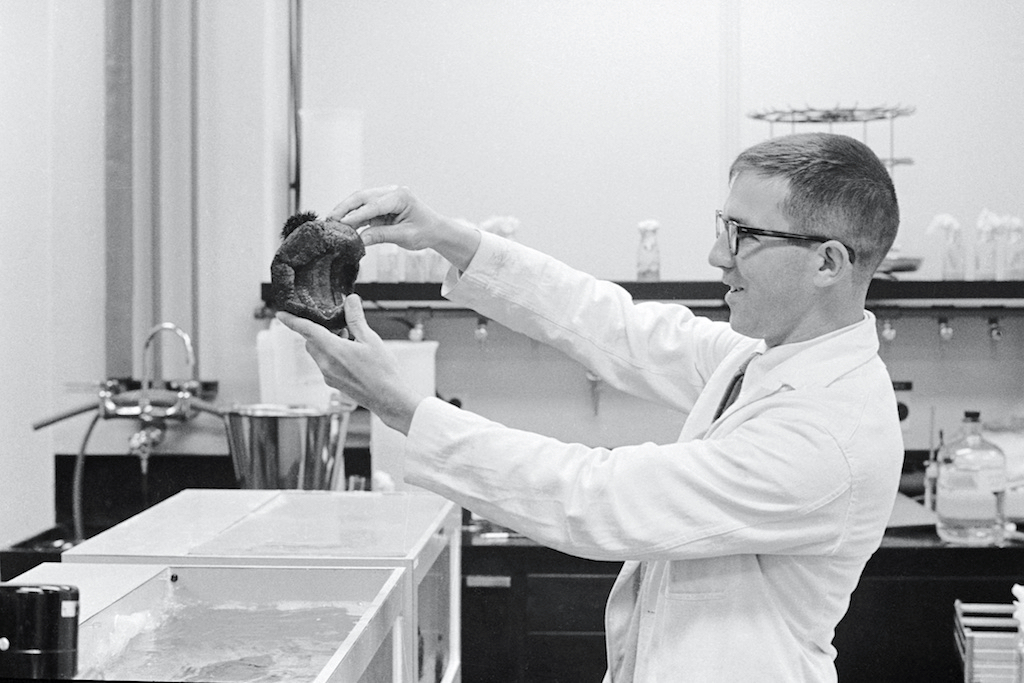
Todd Newberry joined UC Santa Cruz in 1965 after earning a Ph.D. in biology from Stanford. He wrote his dissertation on ascidian tunicates, better known as sea squirts.
Todd Newberry, a professor emeritus of biology and a founding member of the faculty at the University of California, Santa Cruz, died on Feb. 9, 2026. He was 90 years old.
Newberry arrived at UC Santa Cruz in 1965, drawn by the public university’s bold aspiration to provide exceptional undergraduate education on par with the nation’s elite private universities. He described the early years as “exhilarating” and as an “improbable adventure.”
“(UC Santa Cruz) was the educational prize,” Newberry recalled in his 1994 oral history. “If it was going to happen anywhere, it was going to be here in California: The idea of small classes. The idea that a great public university could concentrate on undergraduate education, even transform it.”
A beloved teacher with a conviction in the power of a liberal arts education — his interests spanned sea squirts, birds, art, literature and classical music — Newberry inspired thousands of students to approach life with both wonder and, most importantly, incisive questions. The maxims he wove into his conversations and discussions — some his own, some from thinkers who influenced him — remain with those who learned from him.
Classes with Newberry may have met in UC Santa Cruz buildings, though the learning occurred across the landscape with students observing and learning from the plants and animals found amid the redwoods, in the Arboretum and along the coastline.
Distinguished Professor Gary Griggs, who joined UC Santa Cruz in fall 1968, recalled Newberry as a Renaissance man and an engaging teacher.
A handful of Newberry’s maxims
- Bodies organize space into structures; life cycles organize time into processes.
- To observe without questions is to sleep.
- Questions are our visas into other creatures’ worlds. Notebooks are our passports.
- How to visit the intertidal realm: First put your feet down as low as they can go. Then put your face down where your feet are.
- How we observe determines what we observe.
“He loved the early ideas of Cowell College and the campus,” Griggs said. “He put his energy where he thought he could do the most good.”
Newberry was born in 1935 in Orange, New Jersey. While growing up, he connected with an extraordinary group of birders and studied hawks with them at the Montclair quarry. The experience started a lifelong passion for birdwatching.
While studying for a B.A in biology at Princeton, he entertained pursuing a career in professional golfing until his senior-year professor, John Tyler Bonner, asked him to consider whether he’d rather look back on a career spent conducting field studies and working in labs and libraries—or one spent in a golf shop.
“Soon after that, gently but properly chastened, I put my sports dreams away,” Newberry said during an oral history conducted in 2016 with Stanford University.
After graduating from Princeton, Newberry headed west to Stanford, partially on Bonner’s advice, to study alongside some of the nation’s best naturalists. He earned his Ph.D. in biology from Stanford, writing his dissertation on ascidian tunicates, better known as sea squirts.
Newberry was working at Stanford University’s Hopkins Marine Station in Pacific Grove when two colleagues — Lawrence Blinks and Cornelis van Niel — recommended that he check out UC Santa Cruz, set to open the following year.
About to head overseas for a National Academy of Sciences post-doctoral fellowship in Brussels, Newberry stopped at Cabrillo College in June 1964 for what ended up being a 15-minute meeting with founding Chancellor Dean McHenry and Assistant to the Chancellor Barbara Sheriff. In November 1964, he was offered a position, an opportunity he attributed to the endorsement of Blinks and van Niel.
Newberry arrived back in Santa Cruz in August 1965 to teach Invertebrate Zoology that fall and became a well-known fixture at Cowell College. Four years later, students in the college’s graduating class asked Newberry and Herman Blake to deliver remarks at the commencement ceremony.
Newberry shared some memories of those first years—“experiences that none who come after you can possibly know”—the secret knowledge that the field house is really a converted dining room and, looking out from the Cowell terrace on a foggy morning, seeing the ghosts of the trailers that provided student housing when the campus opened.
He then shifted to an outlook that would guide him—a life of questioning.
“The quest. The quest. What you have started with us here is a quest,” he said. “And you can call yourselves educated. You can call yourselves humane, only so long as you persevere in this quest.”
And why the need to pursue this quest?
“Because it is only in persevering in questioning that we can hope, as Robinson Jeffers said, not to be deluded by dreams, not to be duped, by dreams, of universal, justice, or happiness,” Newberry said before going to quote from “Meru” by William Butler Yeats.
Mary Beth Saffo (’69, Cowell, biology) was among those in the audience, inspired by her time with Newberry and experience at UC Santa Cruz.
“Todd’s influence was not only in what kind of biologist I became, but what kind of scholar I became,” Saffo said. “He taught me how to write and to think, and how to ask questions. He was not only a great teacher, but he was a profound teacher—more than any other professor I had.”
She went on to earn a Ph.D. from Stanford, also studying tunicates and asking Newberry to serve on her committee because she valued his insights. Her career in higher education has included a Miller Fellowship at UC Berkeley, faculty positions at Swarthmore College and Arizona State University, a return to UC Santa Cruz as a researcher, and serving as a Radcliffe Fellow at Harvard University.
Nearly 20 years after graduation, Saffo returned to campus to join students, fellow alumni, and colleagues in presenting Newberry with the Alumni Association’s 1987 Distinguished Teaching Award. They sang a humorous song composed in his honor and delivered a handcrafted two-volume collection of essays, articles, poems, and drawings created by several generations of grateful students.
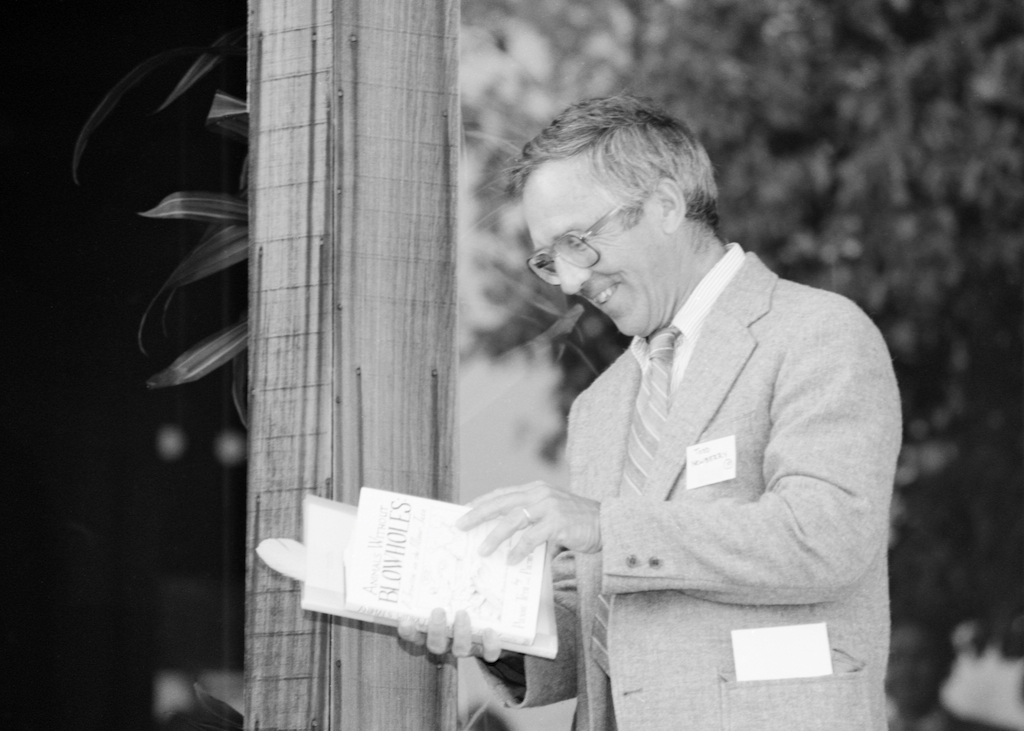
Saffo was just one of many students inspired by Newberry. Saffo said Newberry was a professor who published through his students as much as through his own work.
“He so profoundly affected his students that, for many of us, our own work is permanently perfused with his keen biological insights, his style of teaching, writing, and scholarship, and his overall wisdom about organisms and about life. Certainly it is true for me ,” Saffo said.
Kerstin Wasson came to UC Santa Cruz in 1990 to pursue a Ph.D. with Newberry serving as her dissertation adviser.
In her first quarter on campus, she was Newberry’s teaching assistant for Biology 1A: The Organism in its Environment. The class, regularly taught by Newberry, was made up of nearly 500 undergraduate students working to fulfill one of the basic requirements for a biology degree.
In the first week, he sent undergraduates outside to find a pattern in nature and craft questions that could be answered with more observations.
“He really inspired generations of biologists or just thinkers, not all of them became biologists,” Wasson said. “In that class, he really wanted to foster curiosity and creativity and a passion for natural history in particular.”
Within the course, Wasson said, he would incorporate art history depictions of animals, underscoring that science is just one way of understanding the natural world.
Wasson chose Newberry as her dissertation adviser because they shared an interest in modular organisms—those that have many bodies for the same genetic individual, such as anemones or redwoods in a fairy ring. Newberry suggested she could focus on Kamptozoa, a little-studied category of aquatic animals he had observed in the low winter tidal at Natural Bridges. As part of her work, she needed to describe the species, ultimately naming one in his honor: Pedicellina newberryi.
In mentoring Wasson, he assigned biology texts, as well as books by Marcel Proust and Anna Karenina, by Leo Tolstoy. Years later, Wesson published a paper about healthy and unhealthy salt marshes, including a reference to the novel’s famous opening: “Happy families are all alike; every unhappy family is unhappy in its own way.”
Newberry elected to retire in 1994, which allowed him to spend more time birding. He served as president of the Santa Cruz Bird Club from 2001 to 2005 and was well known for giving regular birdwatching walks at the Arboretum.
Newberry’s daughter Ellen, now a lecturer on campus, said that UC Santa Cruz was the backdrop of her adolescence with memories of exploring the campus, flying kites with him, and playing softball with some of his students.
In spring 2004, she was scheduled to give the Merrill College commencement speech, when her mother suddenly died. Organizers asked if she still wanted to give the speech, and she said she would if her dad could walk with her in the procession.
“It felt very much like a movement from his role to my role,” she said. “It was really special to me to connect with him on that level.”
Several years later, Wasson—an adjunct professor at UC Santa Cruz and research coordinator for Elkhorn Slough National Estuarine Research Reserve—enlisted Newberry’s help for a research project focused on understanding the biodiversity of the eucalyptus groves at the reserve. The research included conducting bird surveys at dawn when fog shrouded the trees.
Newberry, relying almost entirely on sound, would rattle off the names as Wasson scribbled notes.
“It was like having the Merlin (Bird ID) phone app before it was readily available,” she joked.
Newberry published The Ardent Birder in 2005, a collection of 50 essays about bird watching with suggestions for how beginners can hone their skills. Five years later, he delivered an emeriti lecture, Some Dilemmas for Birdwatchers.
As he concluded the hour-long talk, which included recordings of bird songs slowed down to demonstrate their complexity, he told the audience about a recent visit to the Arboretum where he heard a bird trilling.
“Was it a junco? Yes. And there it was singing I knew a much more complicated song than I could hear and, audaciously, singing from the top of the tallest tree. Crazily, it thrilled me, as much as when I first identified a junco 60 years ago.
Memories came together at that moment in the Arboretum.
What a good time I have had bird-watching since those bad boarding school days. I was, in a word, astonished. The junco did it. The little bird was my feathered Madeleine.
Proust smiled.”
Newberry is survived by his two daughters, Ellen Newberry and Liz Chapman (Newberry). His wife of 46 years, Louise, died in May 2004. She had worked for five years as director of the Eloise Pickard Smith Gallery at UC Santa Cruz and helped to launch the Museum of Art and History in Santa Cruz.