Social Justice & Community
In Memoriam – Teresa de Lauretis (1938-2026)
A pioneering thinker who brought semiotics and psychoanalytic theory to bear upon cinematic representations of desire, de Lauretis taught at the University of California, Santa Cruz, from the mid-1980s until her retirement in 2008 as Distinguished Professor Emerita.
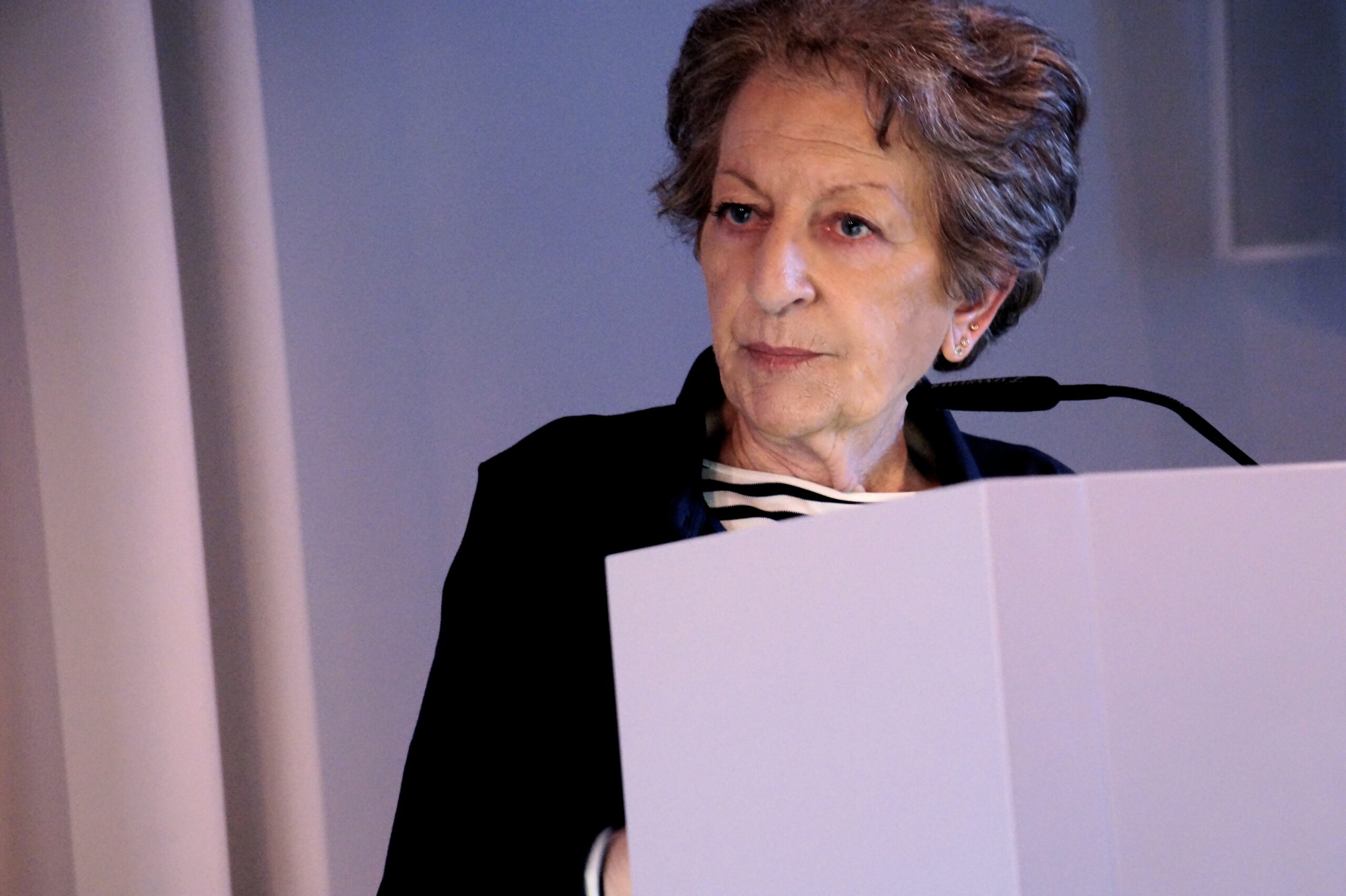
Photo courtesy of Claudia Peppel, ICI Berlin
Teresa de Lauretis, internationally renowned feminist and film theorist who coined the term
“queer theory,” died in San Francisco on February 3, 2026. She was 87 years old. A pioneering
thinker who brought semiotics and psychoanalytic theory to bear upon cinematic representations
of desire, de Lauretis taught at the University of California, Santa Cruz, from the mid-1980s until
her retirement in 2008 as Distinguished Professor Emerita.
De Lauretis was born and educated in Italy, receiving her doctorate in modern languages and
literatures at Bocconi University in Milan. Soon after, she relocated to the US, starting her career
in the 1960s at University of Colorado-Boulder and University of California-Davis before
moving to the University of Wisconsin-Milwaukee. There, her cinema studies course drew
hundreds of students, marking a point of emergence for film studies as an academic field of
study in the US. At the Center for Twentieth Century at Milwaukee, scholars began to deeply
engage with British and French film theory through a series of early and historic conferences. De
Lauretis and Stephen Heath edited the proceedings of one of these conferences, The Cinematic
Apparatus (1980), confirming film studies as one of the most influential disciplines of the late
20th-century. During this time she served on the editorial board of Ciné-Tracts: A Journal of Film
and Cultural Studies, one of the first film theory journals to emerge from the US. The
publication of Alice Doesn’t: Feminism, Semiotics, Cinema in 1984 announced her as a
formidable theorist at the intersection of these disciplines.
In 1985 she left Milwaukee to accept a position in the History of Consciousness, the acclaimed
interdisciplinary humanities graduate program distinct to UC Santa Cruz. In 1990 she organized
a momentous working conference on lesbian and gay sexualities at Santa Cruz, whose title,
“Queer Theory,” lent its name to an academic inquiry that would reshape the humanities in the
1990s. Essays from the conference were compiled into a special issue of the journal differences:
A Journal of Feminist Cultural Studies in 1991. Her later works brought her inimitable writing
style and rigorous intellect to a deep engagement with the psychoanalytic theory of Sigmund
Freud and Jean Laplanche.
The author of eight books and more than one-hundred essays in both English and Italian, de
Lauretis addressed a wide range of topics, including cinema, science fiction, semiotics, literature,
film theory, opera, psychoanalysis, and pedagogy. Her most cited books include Alice Doesn’t:
Feminism, Semiotics, Cinema (1984), Technologies of Gender: Essays on Theory, Film and
Fiction (1987), The Practice of Love: Lesbian Sexuality and Perverse Desire (1994), and
Freud’s Drives: Psychoanalysis, Literature and Film (2008). A collection of her essays, Figures
of Resistance: Essays in Feminist Theory (2007), was edited by her former doctoral student
Patricia White. In 2010, she received the Distinguished Career Achievement Award from the
Society for Cinema and Media Studies. Her works have been translated into more than 14
languages in Western and Eastern Europe, Latin America, and Asia. She has held visiting
professorships in Canada, Germany, Italy, Argentina, and the Netherlands. The recipient of
numerous grants and awards, including an honorary doctorate from the University of Lund, de
Lauretis taught and lectured internationally before and after her retirement from UC Santa Cruz.
She made her home in San Francisco. Among her closest friends were J. Reid Miller, Wally
Scott, and Giulia Colaizzi. She is survived by her son Paul Loeffler.