Health
Revealing the secrets of the human brain
UC Santa Cruz research innovations and academic programs advance brain and mental health.
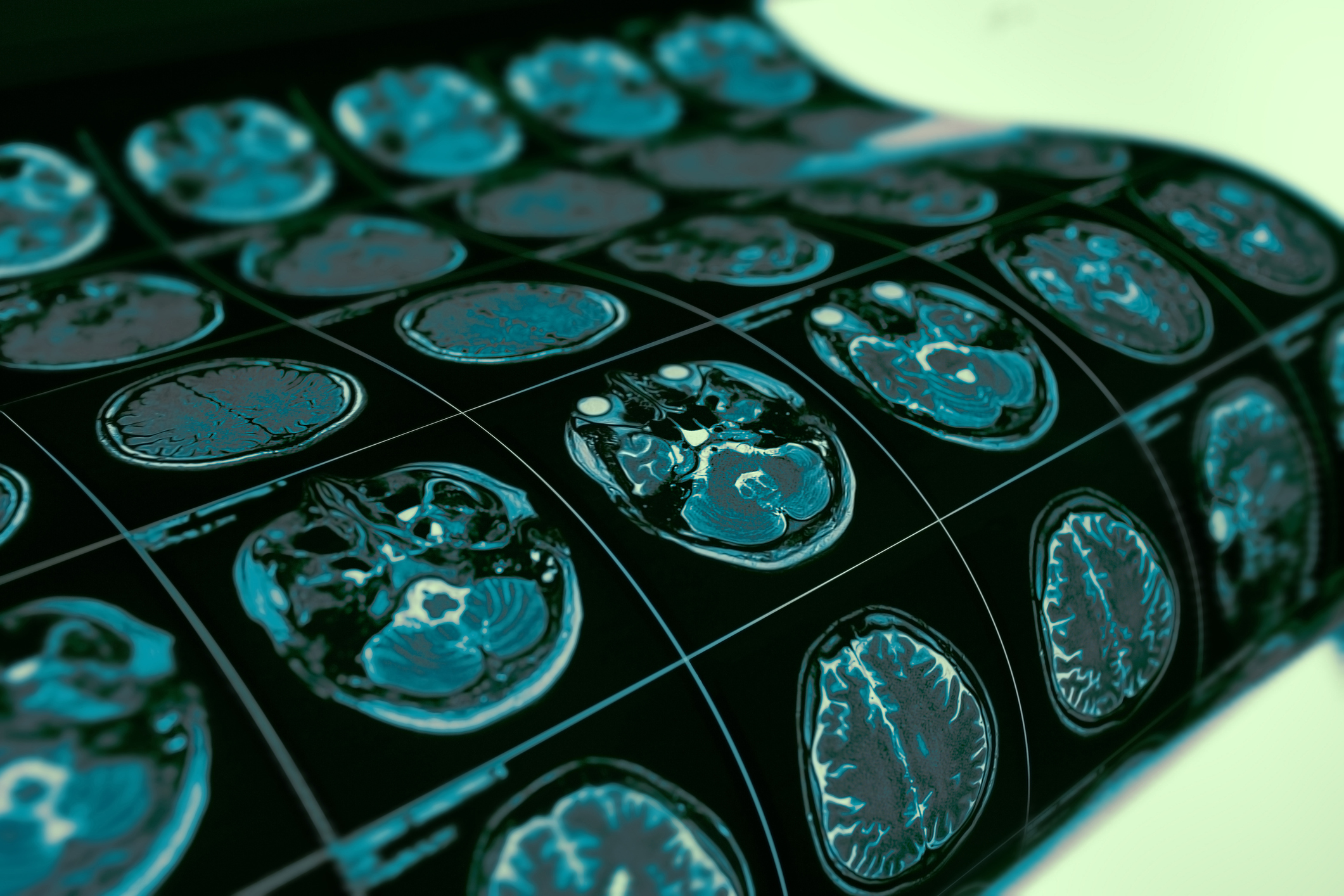
There’s a lot to love about brains. They are arguably the most complex organ in the entire human body. 86 billion neurons send electrical and chemical signals back and forth within your brain to enable processes like memory, emotion, thought, and sensory perception. Your brain is the physical basis for who you are. Yet there’s so much we still don’t understand about our brains.
From the biological mechanics of brain functions to how our brains change as we age and how best to protect mental health, UC Santa Cruz researchers are unpacking many of the mysteries that play out within our skulls. That includes a strong focus in our Psychology Department on research that explores how broader societal factors influence our internal mental processes, development, and wellbeing.
This work is more important now than ever. Mental health in America has declined significantly over the past decade, coupled with a nationwide shortage of mental health providers. Meanwhile, more and more people are living with neurodegenerative diseases as our population ages. UC Santa Cruz is rising to these challenges through life-changing research innovations and strong academic programs that prepare students for careers in patient care, research, and beyond.
Learn more about some of our work below. If you value research and education that keeps brains healthy and enables each individual to live their lives to the fullest, please take a moment to voice your support for the University of California.
Molecular-level insights on Alzheimer’s disease
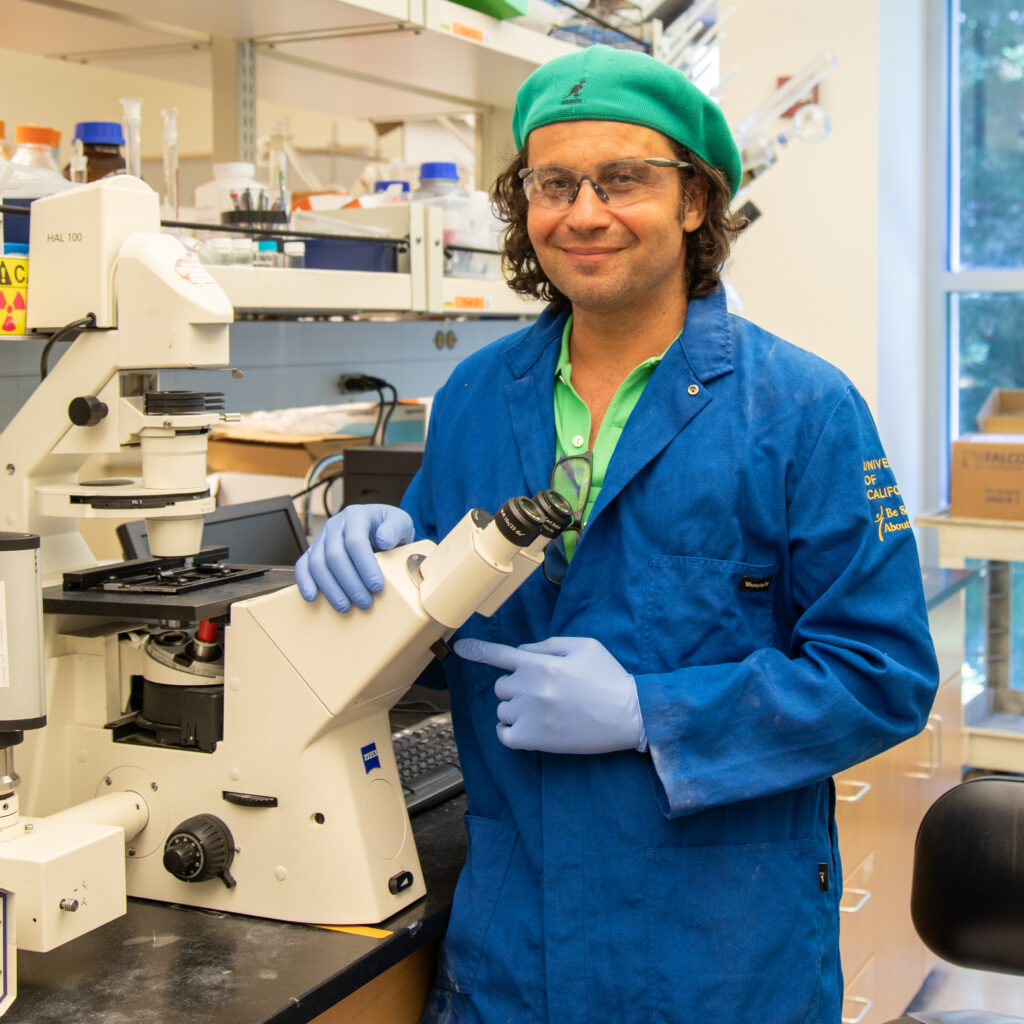
UC Santa Cruz Chemistry Professor Jevgenij Raskatov leads a research group focused on molecular-level discoveries that aim to help drug makers produce better treatments for Alzheimer’s disease. Raskatov’s research has often focused on amyloid beta—the proteins thought to lead to Alzheimer’s disease when they accumulate in the brain. He developed a technique called “chiral inactivation,” to reduce the protein’s toxicity. This work was underpinned by the lab’s validation of the “rippled” beta-sheet hypothesis, which has applications including biomolecular targeting of amyloids and materials tailored for delayed drug release. Raskatov is also working to develop new chemistry techniques for studying the process of methionine oxidation, which alters proteins and damages cell components within the aging brain, leading to conditions like Alzheimer’s and Parkinson’s disease.
Societal influences on the brain-body health connection

Danny Rahal is an Assistant Professor in the Psychology Department and an affiliated faculty member with the Global and Community Health Program. He leads the Health Equity in Youth Lab at UC Santa Cruz, which uses psychobiological measures to study how being treated as and feeling marginalized or “lower status,” can negatively impact physical health. Youth receive messages regularly from peers, media, and broader societal systems that can cause them to feel undervalued or disrespected because of their social identities. These persistent feelings trigger chronic physical and chemical stress responses in the brain, affecting the immune system and autonomic nervous system in ways that wear the body down and set the stage for poorer long-term health. Rahal’s work also frequently investigates substance use and what factors may put adolescents at increased risk of using alcohol or drugs as a coping mechanism.
New treatment possibilities for a poorly understood disorder
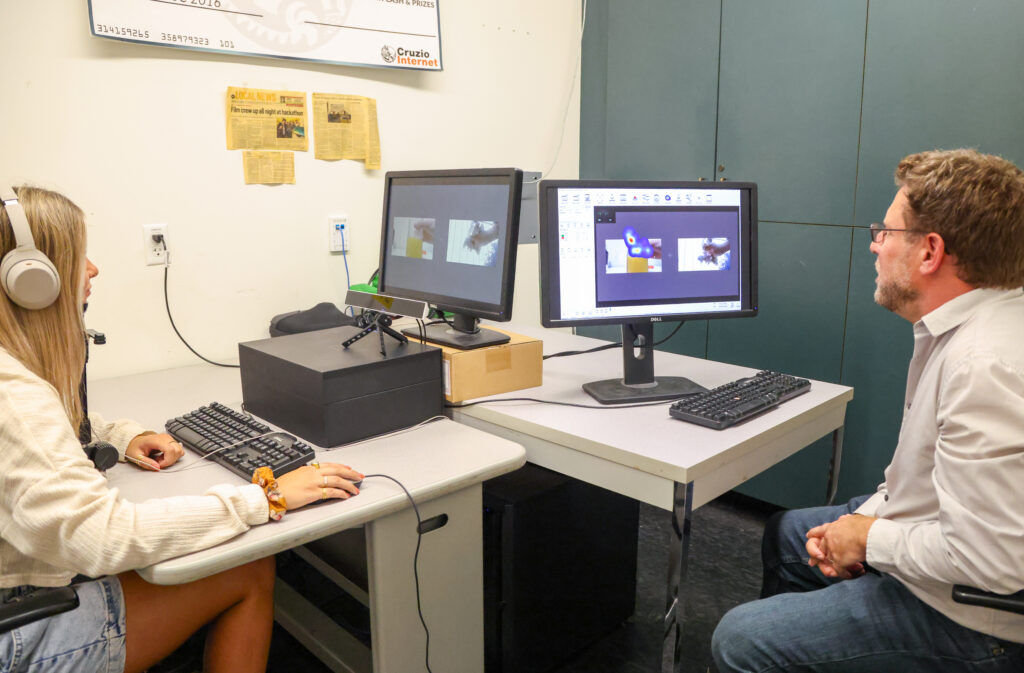
Psychology Professor Nicolas Davidenko, a cognitive psychologist who investigates human perception, is a world-leading expert in the emerging field of misophonia research. Misophonia is a recently discovered disorder that causes intense negative physical and emotional reactions to certain “trigger sounds,” often the sounds of other people chewing, breathing, or sniffing. With a grant from the Misophonia Research Fund, Davidenko is leading a study to determine whether mental imagery can reduce distress from trigger sounds. Researchers use behavioral judgments and special machinery to record eye movements and pupil size changes as well as galvanic skin response, which, together, indicate how people respond to trigger sounds when asked to imagine they are coming from a different source: for instance, a sweeping broom instead of a sniffing nose. Initial findings suggest this may be a promising technique for managing the condition.
Investigating the genetic roots of neurological disorders
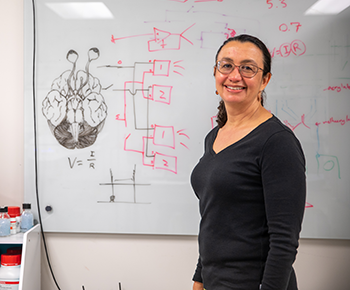
The Braingeneers research group at UC Santa Cruz is experimenting with cerebral organoids—minature models of brain tissue grown in the lab—to study the behavior of human neural circuits, observe brain development, and uncover how genetic changes affect brain architecture. The team has been investigating the gene pathways that cause autism spectrum disorder and applying findings to develop laboratory tests that explore potential targets for treatment. Part of this work includes classifying different types of autism based on genetic information. The team also received new funding to study how DiGeorge syndrome, a genetic microdeletion, impacts brain circuits to cause schizophrenia and why humans are uniquely vulnerable to mutations in the SHANK3 gene, which are linked to challenges in learning, social behavior, and cognition associated with schizophrenia and autism spectrum disorders.
Tackling OCD and hoarding with tools from virtual reality

Assistant Teaching Professor of Psychology Hannah Raila leads the Emotion, Cognition, and Psychopathology Lab at UC Santa Cruz. Her research focuses on how what we pay attention to in our environment influences our emotional state, and vice versa. She studies links between visual attention (what we look at) and emotion (how we feel) in conditions like obsessive-compulsive disorder (OCD) and hoarding disorder. Using tools from cognitive psychology, including eye tracking and continuous flash suppression, Railia investigates visual biases. She’s also experimenting with how virtual reality (VR) can enhance treatments for OCD and hoarding. In a recent pilot study, older adults with hoarding disorder who practiced discarding items in a VR simulation of their homes later reported improvement in their real-life symptoms — potentially alleviating the health and safety risks associated with this condition.
Illuminating brain health with improved imaging
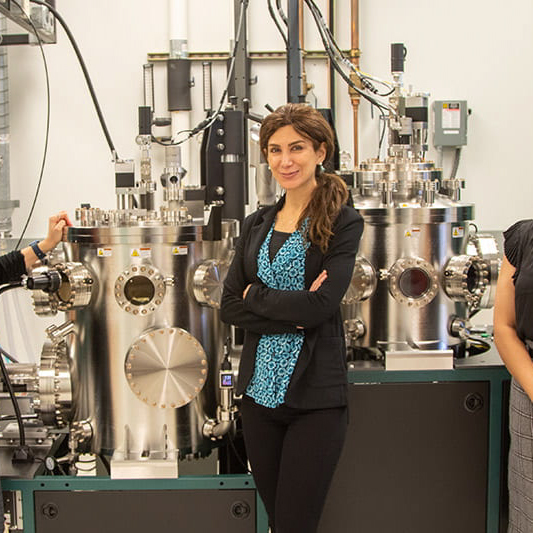
With a new NIH-funded project, Associate Professor of Electrical and Computer Engineering Shiva Abbaszadeh aims to transform brain imaging by enabling multi-isotope detection in a single scanner. With their new technology, the research team aims to overcome three long-standing limits in nuclear medicine: low sensitivity in single-gamma imaging, difficulty distinguishing multiple positron-emitting isotopes, and spatial resolution barriers in standard positron emission tomography (PET). Led by researchers including Abbaszadeh and Professor of Medical Imaging at the University of Arizona Lars Furenlid, the team will leverage advanced cadmium zinc telluride (CZT) detectors capable of precise 3D positioning, high energy resolution, and event-by-event analysis. Over five years, the project will progress from simulation and proof-of-principle to a prototype tomographic system, enabling multi-isotope, high-resolution studies of complex brain function and potentially opening a path toward next-generation human neuroimaging.