Technology
Meet UC Santa Cruz entrepreneurs creating jobs and sparking innovation
As we enter entrepreneurship month this November, we’re celebrating the professors and alumni who are fueling job creation and creating opportunity
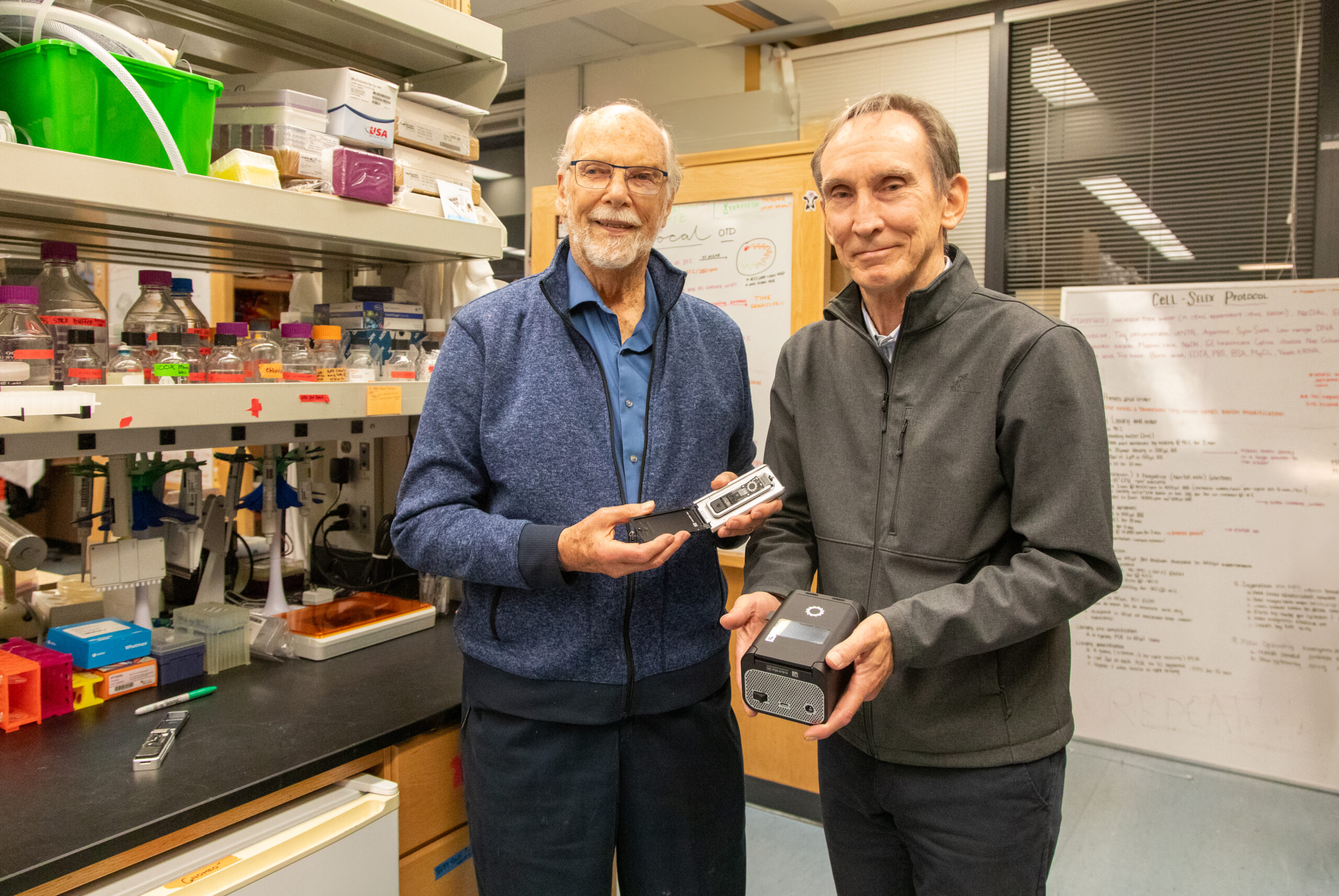
Professors David Deamer (left) and Mark Akeson hold up Oxford Nanopore devices used for DNA and RNA sequencing. Their invention of nanopore sequencing underpins this widely used technology.
Photo by Carolyn Lagattuta.
Research and teaching at UC Santa Cruz don’t just stay on our forested campus—they impact our wider community and economy by developing technologies that forge new companies, and training students who go on to lead them.
As we enter entrepreneurship month this November, we’re celebrating the professors and alumni who are fueling job creation and creating opportunity beyond the redwoods. Read on to learn more about four impactful companies with members of the UC Santa Cruz community behind them. Everyone in the University of California can Stand Up for UC and advocate for innovation and entrepreneurship.
Enabling DNA discoveries worldwide

DNA sequencing has enabled some of the most significant health discoveries in recent years, and these would not have been made possible without long-read sequencing, the ability to understand long strings of DNA at once. Professors Emeriti of Biomolecular Engineering David Deamer and Mark Akeson invented one of the main techniques for accomplishing long reads —called nanopore sequencing—in the labs of UC Santa Cruz’s Baskin School of Engineering.
The concept for nanopore sequencing technology, licensed to the UK-based company Oxford Nanopore Technologies, led to the creation of the MinION, the only hand-held device for genetic sequencing, priced at a fraction of the cost of other sequencers. Now, Oxford Nanopore Technologies employs more than 1,000 people, with the technology used worldwide for scientific research and in fields such as biopharmaceuticals, health and safety, and more—an innovation continues here in Santa Cruz.
“Santa Cruz is really one of the centers internationally for implementing nanopore sequencing on the Oxford devices,” Akeson said in 2022. “The invention and pioneering academic work was at our campus, our Genomics Institute and the RNA Center really knows how to use the technology—Santa Cruz is world class in both of those fields. The spark started at our campus.”
Designing drugs for the ‘undruggable’
Some diseases have long been considered “undruggable” because they are linked to challenging protein targets or can only be addressed via injections. Unnatural Products (UNP), a Santa Cruz-based biotech company founded by UC Santa Cruz alumni Cameron Pye (Ph.D. ’17, chemistry and biochemistry) and Joshua Schwochert (Ph.D. ’17, chemistry and biochemistry) is on a mission to change that.
Recently partnered with global immunology company argenx, alongside existing partnerships with Merck, and BridgeBio, UNP’s technology opens up treatment possibilities for diseases in areas like oncology, cardiometabolic disorders, and autoimmune conditions. The founders credit their ability to get where they are today to opportunities afforded by UC Santa Cruz and the surrounding community.
“The university’s first-class facilities, including a chemical screening facility, and the ability to work across labs gave us a broad perspective,” Schwochert said. “We love UCSC’s community—brilliant people focused on impactful work, without the glitz and glam of prestige-driven institutions.”
Creating opportunities on the Central Coast
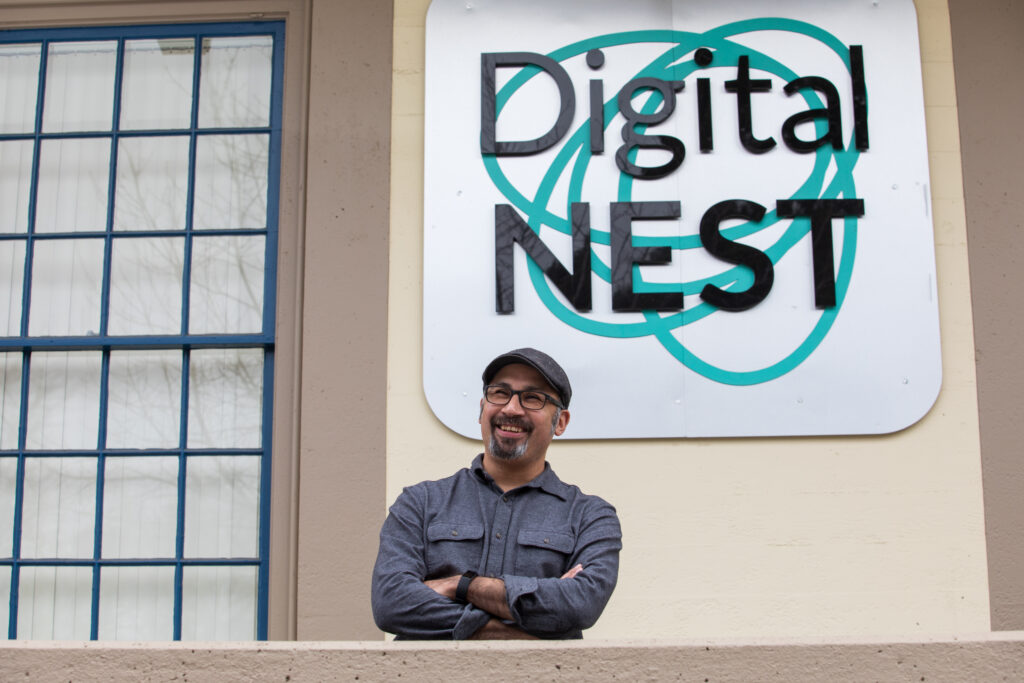
Digital NEST is a technology workforce development hub based on the Central Coast and rooted in the belief that talent exists in every community—and that opportunity should, too.
Founded in 2014 by UC Santa Cruz alumnus Jacob Martinez (Oakes ’04, evolutionary biology), the organization supports youth ages 14 to 24 with digital skills, mentorship, and real-world experience to help them build successful careers. What began in Watsonville has now expanded to five locations across California, offering training and career pathways in fields like digital marketing, IT, and web development—aiming to serve communities that Silicon Valley impacts but doesn’t necessarily invest in.
“I want to see young people get the skills they need to find a good job in their own communities or to create their own jobs if they choose,” Martinez said in a 2021 interview. “That allows them to stay. That strengthens the community. That’s my motivation.”
Solving cold cases
DNA sequencing has brought peace to many families affected by crime, and a company called Astrea Forensics is bringing this same relief to people whose cases have long gone unsolved. Astrea Forensics was co-founded by Professor of Biomolecular Engineering Richard “Ed” Green, who has used his expertise in ancient genomics at Baskin Engineering to develop methods for criminal investigations.
Astrea Forensics’ technology makes it possible to recover genetic profiles from rootless hair and other highly degraded samples that otherwise fail traditional forensic DNA testing—enabling investigators to close cold cases and identify unknown individuals from other burial contexts.
Their methods have helped solve dozens of cases since the company’s founding in 2019.
In September, the validity of Astrea’s methods were affirmed when the technology cleared a ‘Frye hearing,’ a rigorous legal process to demonstrate that scientific evidence is admissible in court—marking a major step forward for the use of more robust DNA evidence in court.
Resources on campus
UC Santa Cruz has a number of places and programs to help innovators and aspiring entrepreneurs. Programs such as QB3, the Innovation & Business Engagement Hub, CITRIS at UC Santa Cruz, and the Center for Innovation and Entrepreneurial Development run innovation commercialization and internship programs, provide opportunities for networking with mentors, and support students and researchers in their entrepreneurship journeys.
Students can also use makerspaces on campus, such as Slugworks and the Digital Scholarship Innovation Studio, which provide access to a range of tools for bringing their ideas to life.