Technology
Effort aims to uncover the learning and reasoning potential of brain organoids
The Braingeneers team will test the ability of brain organoids to solve tasks in real time
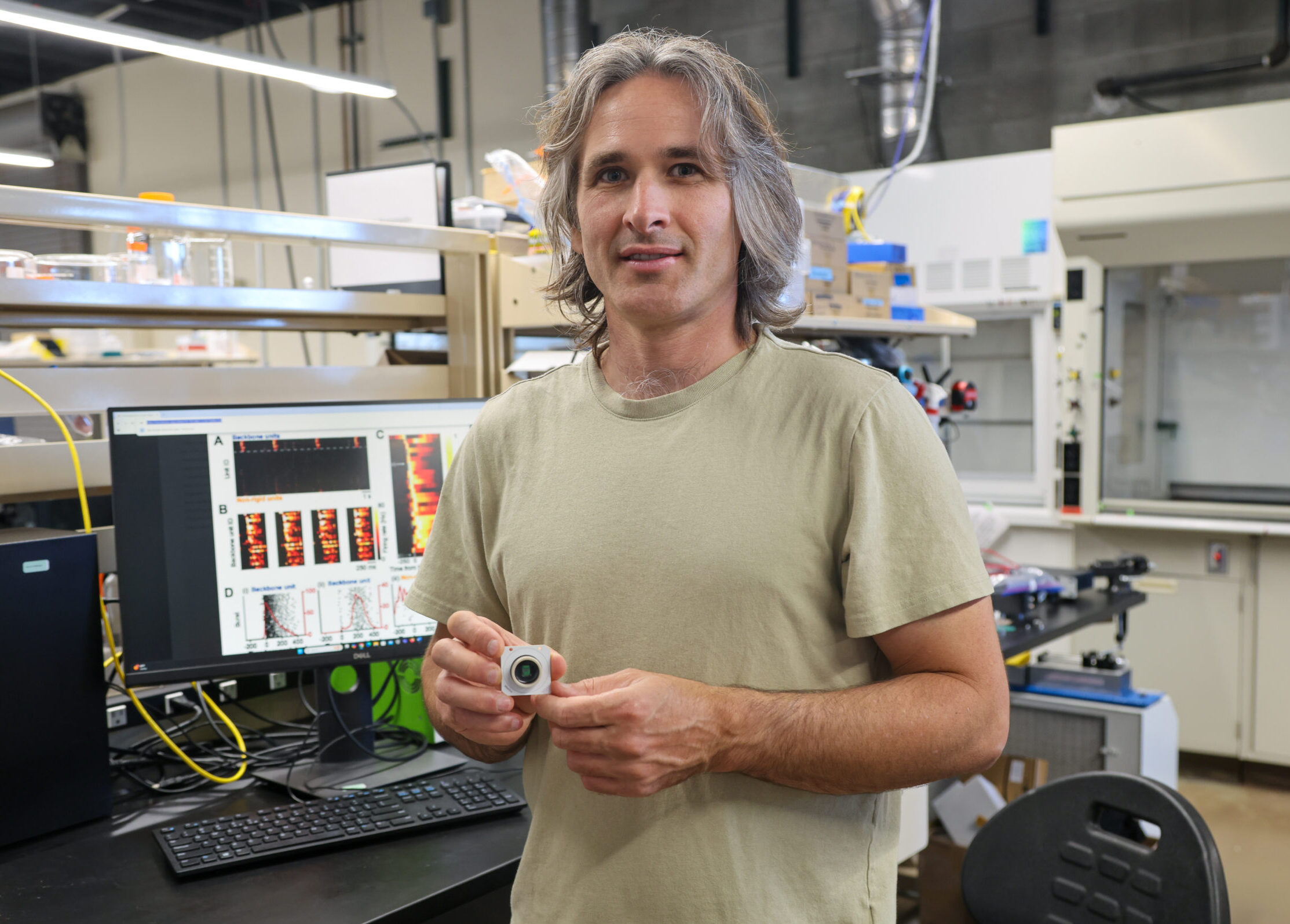
Assistant Professor of Biomolecular Engineering Tal Sharf holds up a specialized chip for recording electrical activity in brain organoids.
Photo by Carolyn Lagattuta
Press Contact
Artificial intelligence (AI) has proven its incredible ability to reason, problem solve, and control machines—but could tiny models of brain tissue grown in the lab do the same, given the right conditions?
That question will be explored by a team of researchers at the University of California, Santa Cruz Genomics Institute, with the support of $1.9 million in funding from the National Science Foundation (NSF).
The team, led by Assistant Professor of Biomolecular Engineering Tal Sharf, will create an interactive system to test the ability of brain organoids to learn from experience, respond to feedback, and solve tasks in real time. In the course of their work they will develop benchmarks for organoid intelligence, which will be used to understand their learning and problem solving methods and monitor them to address concerns about the potential emergence of consciousness. With the wider community, they will also further develop frameworks for ethical cell donor consent, legal status, and safeguards for intelligent bio-AI systems.
Ultimately, the team hopes this fundamental exploration of the capabilities of brain organoids will not only unlock the scientific basis for human cognition, but make biomedical discoveries and create new and better therapies for disease. Additionally, this work could help reveal how the human brain manages such complex computation on little energy, offering insights into making future AI systems more energy efficient.
“These organoid models provide an unprecedented opportunity to probe the emergence of human cognitive capacity – a property that defines what makes us human,” said Sharf, a faculty researcher at the Baskin School of Engineering who is a member of the Braingeneers group. “This work aims to make a transformative leap in engineering and neuroscience, addressing the grand challenge to generate scalable human-based brain models and will offer a blueprint for integrating biological intelligence into engineered systems, while also creating the human-based preclinical disease models needed for development of effective therapeutics.”
Putting organoids to the test
Brain organoids, which are created through the careful growth of stem cells in the lab, can develop into a network of neurons—the cells that transmit information in the brain. These networks emulate the early stages of human brain development, so studying organoids can provide a window into this crucial and hard to access period.
The researchers want to figure out how the early brain self-organizes into a structure that can intelligently interact with the outside world, and how its learning processes compare to those of modern AI systems. They want to explore what human brain tissues can teach us about minds.
“The greatest threat to humanity today is the premature appearance of artificial superintelligence we can neither understand nor control. The blind race to mold silicon into an artificial supermind without any real understanding of how our mind or AI actually works could be our final engineering project if we are not careful. Our work is part of a wider scientific and ethics-first attempt to lift us out of ignorance before we sink irrevocably in over our heads,” said David Haussler, distinguished professor of biomolecular engineering who is a co-principal investigator on this project.
To explore the human brain, they will create a set of new tools to enable the brain organoids to interact with their environment via electrical signals and chemicals. This will be a long-term, cloud-connected Internet of Things system, that combines electrophysiology, real-time imaging, microfluidics, and AI-driven control to support large-scale, reproducible organoid training and maintenance.
“To truly understand learning, we must not only study neurons, but also engineer the environment that allows them to think,” said Mircea Teodorescu, associate professor of electrical and computer engineering and co-principal investigator. “Learning is a complex and continuous process that depends not only on the architecture of the neural network, but also on the environment that sustains it. In a living brain, this balance is maintained naturally through homeostasis. Here, we are developing the electronic and microfluidic infrastructure needed to recreate that balance for brain organoids, allowing them to grow, adapt, and ultimately reveal how biological systems learn and reason.”
This expands on work by the Braingeneers group to make tools that increase the automation and reproducibility of organoid experiments. All software and hardware tools will be made open source, giving other researchers the opportunity to advance the field within appropriate ethical and legal frameworks.
These tools will be used to map the moments that the neurons begin to communicate and function. The organoids will be trained to solve reinforcement learning tasks, a common machine learning technique often used for situations requiring adaptation such as driverless navigation. In this case, reinforcement learning techniques will be used to explore how organoids can respond to sensory input with motor output to solve tasks.
The researchers will also develop an organoid-specific version of the Turing Test. The traditional version of this test examines if a human can detect that AI content is in fact coming from a computer and not a human. The new version will assess organoid problem-solving and intelligence, while also addressing critical issues such as the potential for consciousness, donor consent, legal status, and safeguards for bio-AI systems.
“This work raises ethical issues just as exciting as the scientific and technological ones,” said Hank Greely, Stanford Law Professor and Director of the Center for Law and the Biosciences. “They range from the status of the human brain organoid and, ultimately, an organoid computational device—should they be treated as human tissue samples, as lab animals, as persons, or something else entirely—to the details of the informed consent process for people whose cells are used to make these organoids.”
This work builds on previous work by the researchers to understand the emergence of computation in the human brain and in organoids. In 2018, Haussler published work that revealed some of the genetic origins of human brain size expansion. In 2022, Sharf led a study that provided the first mappings of neuronal circuits within organoids, and a 2025 study, currently a pre-print, uses organoids to shine light on the earliest moments of electrical activity in the brain.
They’ve also led efforts to develop, scale, and share the technology that makes this research possible. Teodorescu led work developing cloud-connected Internet of Things frameworks has enabled long-term noninvasive experiments on brain organoids, as shown in a 2025 study. Mostajo-Radji has deployed remote education tools that allow undergraduate students to gain direct experience experimenting with brain organoids.
Educational platform
Now, the team will develop an educational platform that will further enable students or public participants to run live experiments with brain organoids. This will drive learning in the fields of neuroscience and computation.
These participants will also take part in discussions led by the research team on ethics and the future of brain-based technology. This educational program is designed to inspire a new generation of neuroscientists and engineers, while ensuring that the research moves forward responsibly and transparently.
“Our goal is to turn organoids into an accessible experimental platform. By combining cloud connectivity with automation and AI, we can study how biological networks learn and adapt while making these experiments available to classrooms and researchers worldwide,” said Mohammed Mostajo-Radji, a research scientist at the Genomics Institute who is also a co-principal investigator.
The award is an Emerging Frontiers in Research and Innovation (EFRI) grant, supported by the NSF’s Biocomputing through EnGINeering Organoid Intelligence (BEGINOI) program.