Technology
Study reveals user preferences for social media in the AR ‘metaverse’
Research explores how privacy and content format impact users’ level of comfort in sharing and consuming social media AR content.
gorodenkoff/ Getty Images
Press Contact
Media Access
Key takeaways
- People feel most comfortable engaging with AR social media in private spaces and prefer familiar 2D video formats over 3D or static images.
- Insights can guide designers and researchers in shaping AR platforms that align with users’ comfort.
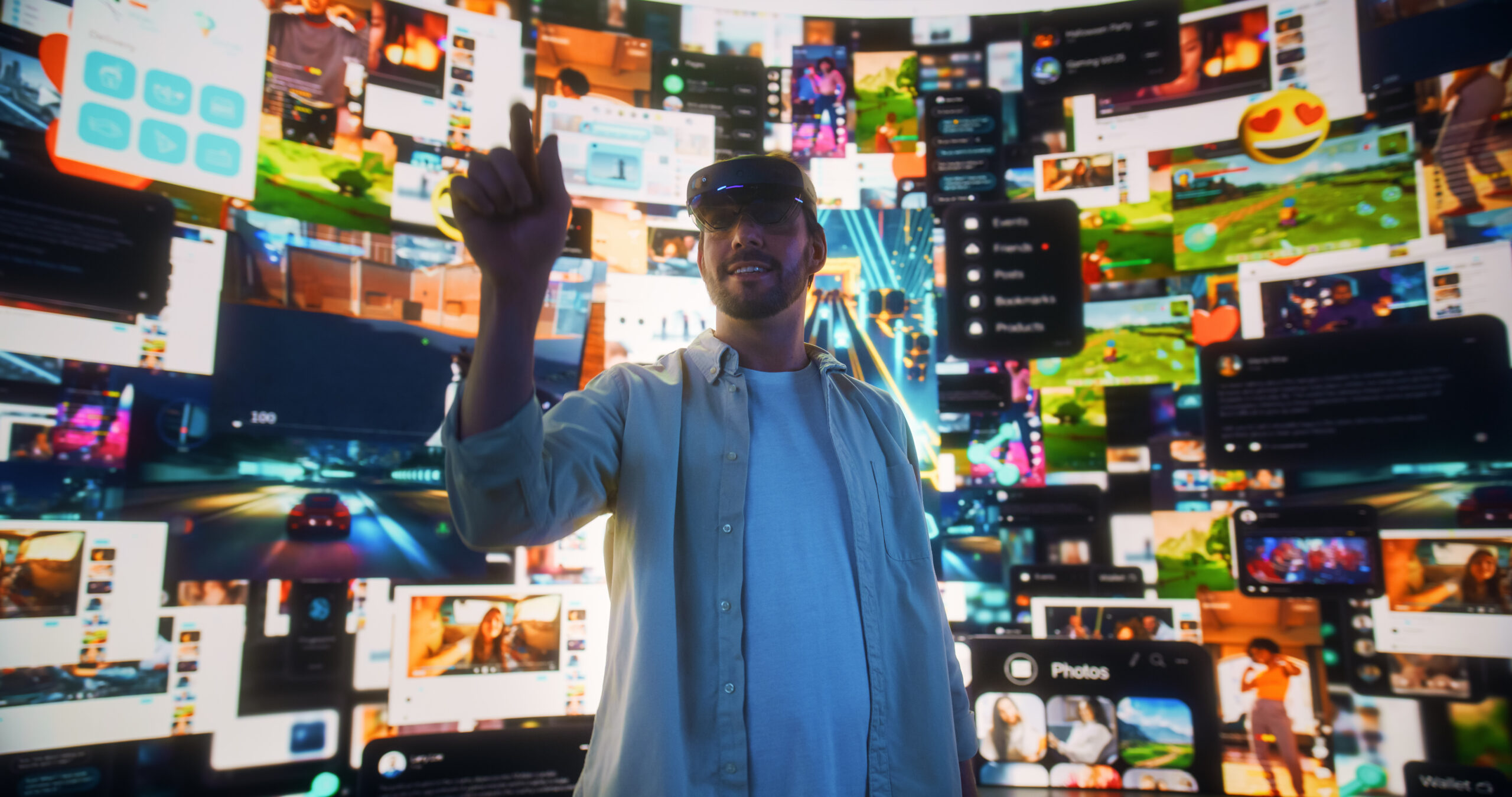
Augmented reality (AR) is when digital content is superimposed on the physical world by devices like smart glasses—a future sometimes described as the metaverse. While AR technology has a stronghold in contexts such as games like Pokemon GO, it still has a lot to prove before it’s accepted into the mainstream.
Research from the University of California, Santa Cruz, is exploring what contexts and formats might make AR social media content most appealing.
A new study led by Linda Hirsch, a postdoctoral researcher at the Social Emotional Technology Lab within the Baskin School of Engineering, explores how privacy of the surrounding space, dimensionality (2D vs. 3D), and dynamics (images vs. video) impact users’ level of comfort in sharing and consuming social media AR content.
Results show that people are most comfortable interacting with AR in a private space, prefer 2D content over 3D content, and prefer video content over static images. These takeaways, which could help designers, researchers, and developers shape the future of AR social media, are published in a study in the journal Virtual Reality. The work was completed in collaboration with researchers Robin Welsch at Aalto University, Florian Mueller at TU Darmstadt, and Mari Kruse and Andreas Butz at LMU Munich.
Foundational questions

As AR social media becomes more common, there are many questions to be answered over privacy and content type: who has access to post and share content, and where? What are the restrictions on who can see that content? How will we navigate the varying “realities” presented by people’s varying digital overlays?
This work aims to better understand users’ foundational preferences for privacy and content-type when sharing social media content as AR, as a foundation to begin to tackle these larger issues. The researchers looked at private, public, and semi-public spaces, the latter referring to spaces that are often open to all but may be privately owned or require tickets or membership to enter, like a museum or a school.
“This is part of a discussion of how we negotiate this new place usage between the digital content and the physical world that we all share,” Hirsch said.
The work also explores which content type people prefer, using existing social media modalities as a framework to better understand if people prefer dynamic or static content, and 2D or 3D content.
The researchers ran an online study with 110 participants to gauge people’s AR preferences. Users rated their level of comfort with 36 different combinations of privacy and content type.
Understanding preferences
Results from the study revealed that participants preferred consuming AR social media content in a private space, a somewhat surprising finding.
“Right now, most research is focused on public or semi-public environments, and a lot less on private spaces,” Hirsch said. “But what we saw was that people felt most comfortable with consuming AR content in their private environment—so that’s something where there’s definitely a lot more research potential.”
The study revealed that users’ preferences aligned with current social media content trends: people preferred AR content in the form of 2D videos.
Researchers found that 3D content is more naturally perceived in the environment. But with users accustomed to seeing social media content in 2D, they have a preference toward what they already know. Hirsch noted that this could be advantageous in helping people distinguish the difference between what is a digital overlay and what is actually present in the physical world.
This work could help researchers and designers in industry and academia shape the young field of AR social media.
“On the one hand, we feel like it’s definitely relevant. But it’s also a long way until we have a complete metaverse that surrounds everybody,” Hirsch said. “While not everyone will use the technology, some already are, and more will. We have to think about how to merge this together to find balance for a healthy world.”