Arts & Culture
Ariel Chan is a new voice for linguistics and bilingualism studies
For as long as she can remember, Assistant Professor of Languages and Applied Linguistics Ariel Chan has lived her life in two languages. Now one of three new Humanities faculty hires at UC Santa Cruz, Chan is challenging outdated assumptions about bilingualism through her work at the intersection of psycholinguistics, sociolinguistics, and neuroscience.
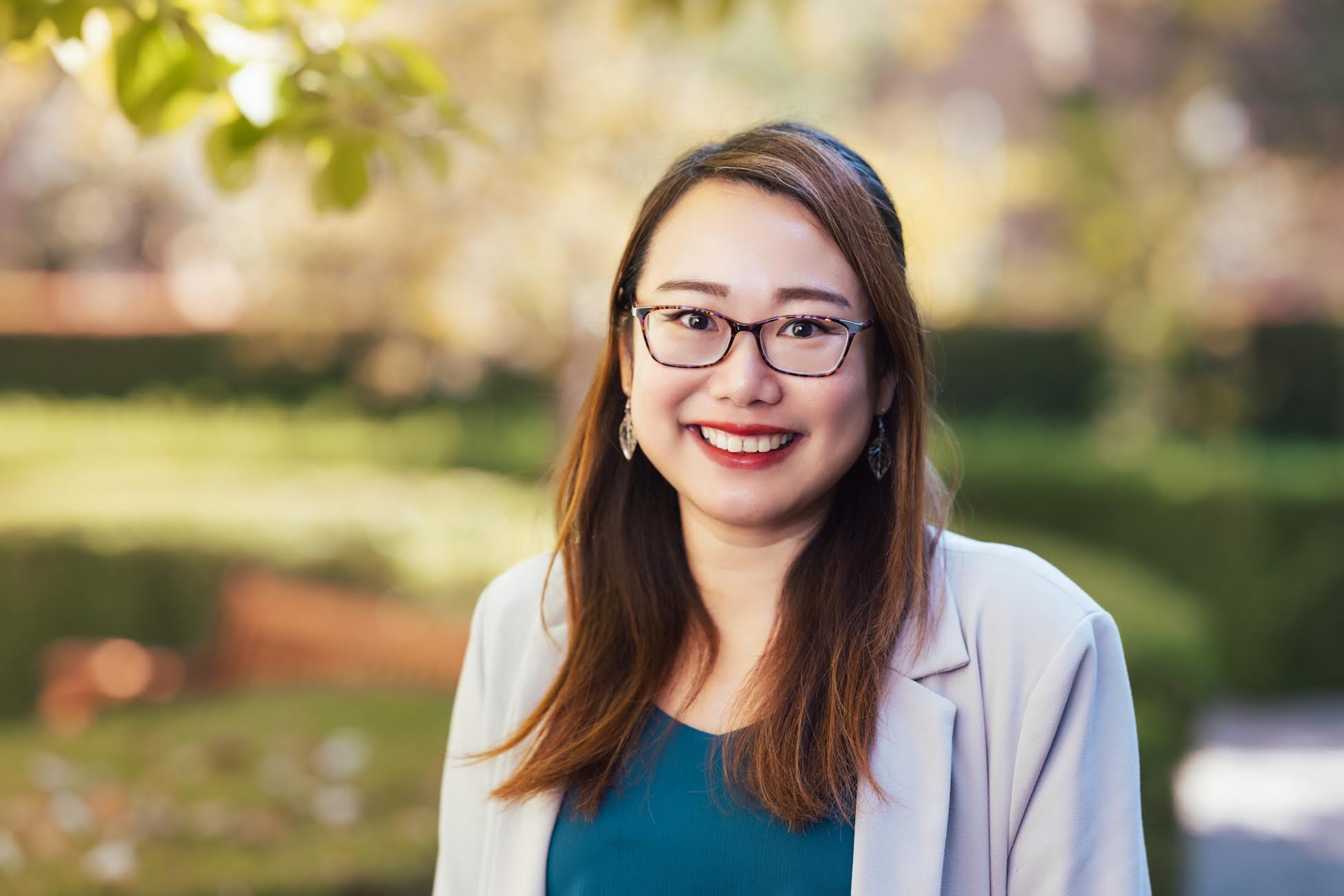
Assistant Professor of Languages and Applied Linguistics Ariel Chan is challenging outdated assumptions about bilingualism through her work at the intersection of neuroscience and sociolinguistics.
For as long as she can remember, Assistant Professor of Languages and Applied Linguistics Ariel Chan has lived her life in two languages. She grew up in Hong Kong when it was still a British colony, prior to its handover to China in July 1997. At home, she spoke Cantonese. At school, she began learning English as early as kindergarten.
Now one of three new Humanities faculty hires at UC Santa Cruz, Chan is challenging outdated assumptions about bilingualism through her work at the intersection of psycholinguistics, sociolinguistics, and neuroscience.
Her research offers fresh insights into how language, identity, and cognition intertwine—insights shaped in part by her own experiences as a Cantonese-English bilingual raised in Hong Kong.
“Actually, the majority of the world’s population is bilingual,” Chan said. “Interestingly, in the United States, it’s kind of the reverse. (Only 23 percent of the U.S. population identifies as bilingual.) But in reality, the U.S. is not truly monolingual. There’s a huge population of what we call heritage speakers—children of immigrants who usually grow up speaking another language at home that is not English.”
Chan studies how bilinguals’ cultural identity and language experiences affect how they understand and use language, as well as how they manage attention and mental flexibility. Her research combines insights from psycholinguistics—the study of how language is processed in the mind—and sociolinguistics, which looks at how language is shaped by social and cultural factors.
“It’s really interesting to ask: what’s going on with all these home languages?” Chan said. “How do culture and language development affect language use overall? A number of researchers indicate that if you constantly juggle two or more languages, it’s actually beneficial to cognition. You tend to be better at multitasking and adapting to different situations. The benefit isn’t just for language—the process of multitasking has broader cognitive advantages.”
Mark Amengual, Professor and Chair of the Department of Languages and Applied Linguistics, emphasized the significance of Chan’s appointment.
“Ariel will further strengthen our department’s interdisciplinary profile,” Amengual said. “Her expertise creates exciting opportunities for cross-linguistic research and collaboration. By bridging theory and practice, she will offer students rich insights into the cognitive, social, and interactional dimensions of language, broadening the intellectual and methodological tools available to our students.”
The neural underpinnings of ‘code-switching’
Before joining UC Santa Cruz in July, Chan was a Provostial Fellow and lecturer in Linguistics at Stanford University. There, she used brain research to better understand how people process two languages in their early language learning, while also deepening her sociolinguistic training in how language works in society.
She was drawn to UC Santa Cruz because of its vibrant bilingualism research scholarship, with bilingualism researchers in the Linguistics, Languages And Applied Linguistics and Psychology Departments.
Chan is conducting research that uses tools such as EEG (electroencephalography) to measure brainwaves in real time as bilinguals read or listen to language. She will carry out this laboratory-based work at the Bilingualism, Sociolinguistics, and Cognition (biSoN) lab on campus.
This allows her to identify instances where people may not think they’re bilingual, though their neural responses say otherwise, showing that they are much more conversant in two languages than they realized.
“In interviews, heritage speakers of another language (e.g., Spanish, Cantonese) will sometimes say, ‘Oh, I only speak English,’” Chan explained. “But when we test them, their brains show clear bilingual processing patterns.”
It’s not about what you say you know, in other words. It’s about how the brain reacts. Chan’s expertise also includes studying how people alternate between languages conversationally, a practice commonly known as code-switching.
“If you’re bilingual, chances are you’re constantly figuring out what language to use in a given situation,” Chan said. “I always ask my students, ‘Have you ever found yourself using the wrong language with someone?’
“For example, I assume that most of the people I meet on a daily basis don’t speak Cantonese—so if I’m talking to you, my mind defaults to English because that’s the socially appropriate choice,” Chan said. “I won’t speak Cantonese unless I know you understand it. But there are times when I’m talking to someone and I know I shouldn’t be using a certain language—yet I find myself using it anyway. ”
Chan says slips like that can happen because bilingual people are often not actually consciously aware of the language switches they make during conversation—they’re simply focused on the topic.
“Somehow, you’re able to juggle all these inputs and make language decisions in real time,” she said. “It’s a mental workout you’re doing every day, and that’s probably why it strengthens other parts of cognition too.”
Understanding bilingual communities
In light of her research area, Chan is understandably concerned that bilingual education is currently under attack in the United States. In March 2025, the U.S. Department of Education laid off roughly half of its staff and dismantled the Office of English Language Acquisition (OELA)—the main federal office that supports bilingual and emerging bilingual learners.
“Hopefully, this won’t be a permanent shift—because it affects entire bilingual communities,” Chan said. “What does it mean when children don’t have access to a language that’s dear to their hearts? And what are the long-term effects on the linguistic diversity of this country?”
As Chan points out, the U.S. is not alone when it comes to prejudice regarding language preference.
Mandarin has been promoted as the standard Chinese language by the Chinese government, especially since the founding of the People’s Republic of China. However, both cultural and political repression have been directed at Cantonese—schools are pressured to switch to Mandarin, and Cantonese is often sidelined.
This dynamic extends to the U.S., where many people assume all Chinese Americans speak Mandarin, Chan said. In reality, Cantonese has much deeper roots in the diaspora.
“Among Chinese-English speakers in the U.S., aside from Spanish speakers, Cantonese is one of the top heritage languages,” Chan said. “When I gave a presentation at a symposium, people were shocked to learn this. Yet, Cantonese-English bilingualism is very understudied.”
“There’s this perception that Mandarin dominates because of economic and political forces, but if you live in the Bay Area and visit Chinatown—especially historically—the language of the Chinese community is Cantonese, not Mandarin,” Chan said. “Mandarin is often more of a ‘learning language’ for newer immigrants. During the Gold Rush era, the influx of Chinese immigrants came primarily from the southern parts of China and Southeast Asia—Cantonese-speaking regions. It’s a deeply diasporic language community.”
Chan got a vivid sense of that truth this August when she took a research trip to Angel Island—the historical immigration detention center in the San Francisco Bay. It was meant to detain people for a minimum of six days, but many Chinese immigrants were held there for months due to the Chinese Exclusion Act of 1882.
“They had to undergo extensive interrogations and health checks. Many were ultimately deported. Angel Island is known as the Ellis Island of the West, but for Chinese immigrants in the late 1800s and early 1900s, it was primarily a detention center. The majority language among those detained? Cantonese. You can still see poems and inscriptions in Cantonese carved into the wall.”