Health
Two UC Santa Cruz faculty win NIH Director’s New Innovator Awards
The two awardees are Assistant Professor of Chemistry and Biochemistry Jaron Mercer and Assistant Professor of Biomolecular Engineering Andy Yeh
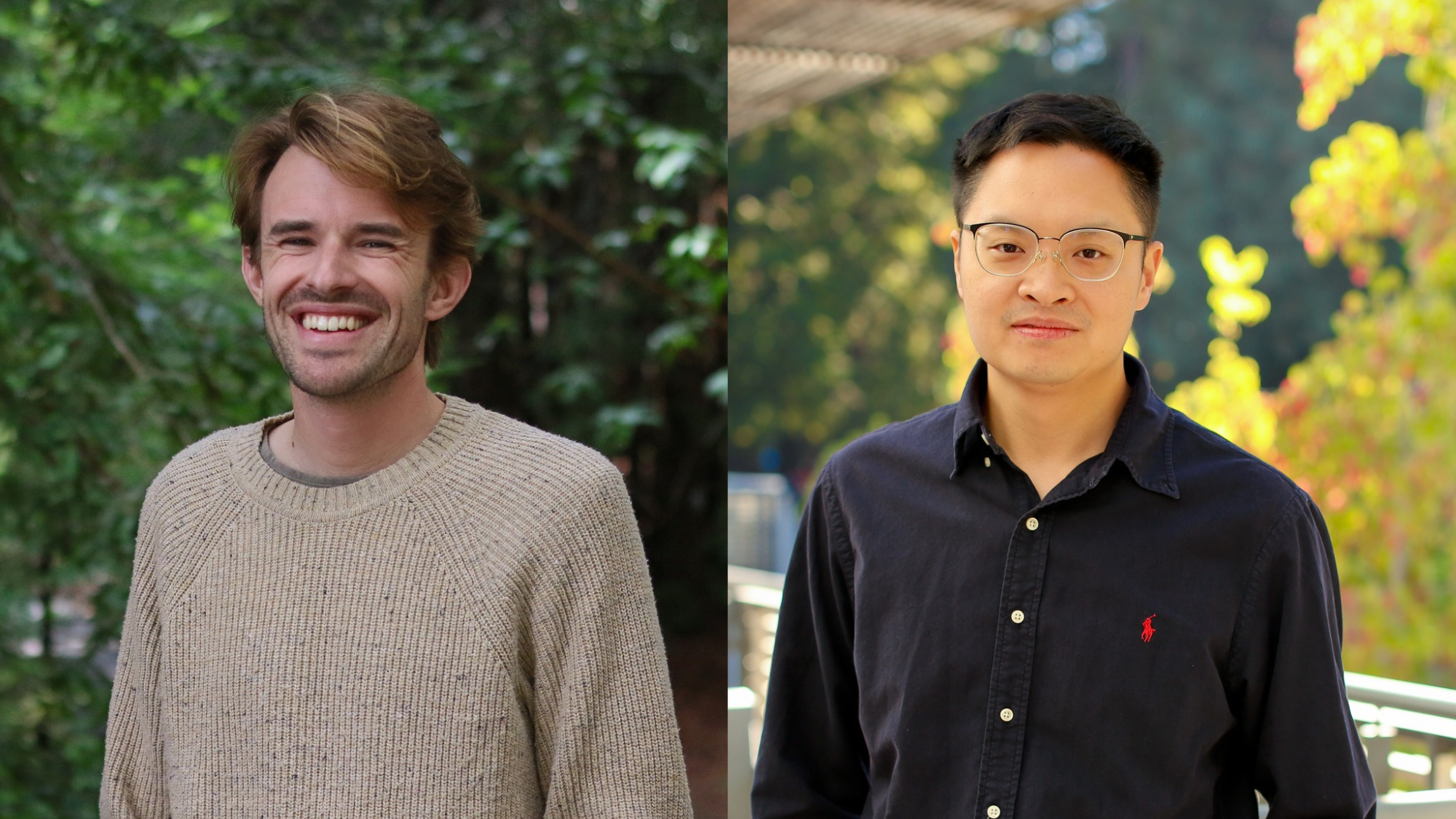
Jaron Mercer (left) and Andy Yeh are recipients of the NIH Director’s New Innovator Awards
Press Contact
Two faculty members at the University of California, Santa Cruz are recipients of the National Institutes of Health (NIH) Director’s New Innovator Award, which supports exceptionally innovative research from early career investigators with the potential for broad impact on biomedical and behavioral science.
The two awardees are Assistant Professor of Chemistry and Biochemistry Jaron Mercer and Assistant Professor of Biomolecular Engineering Andy Yeh. Each will receive $2.38 million in direct funding over five years. The UC Santa Cruz researchers are among only 42 New Innovator awardees across the country in 2026, part of the larger NIH High-Risk, High-Reward Research program.
Programmable enzyme evolution
Mercer’s project will tackle a fundamental challenge in organic chemistry: customizing enzymes—nature’s precision catalysts—to synthesize complex molecules cleanly and efficiently. Traditional chemical manufacturing relies on high-energy reagents and toxic solvents, while conventional enzyme evolution in the lab is painstaking, screening only hundreds of variants per round.
Mercer’s innovative approach pairs an automated process called “phage-assisted continuous evolution” with synthetic hybrid biosensing circuits. Functioning like a genetic dimmer switch, these circuits convert the presence of a target molecule into a survival signal for the viruses central to the phage process. This allows researchers to continuously test billions of enzyme mutations in just a few days.
By making enzyme evolution programmable for nearly any chemical transformation, this technique could transform pharmaceutical production. The scope of impact could include environmentally friendly peptide drug manufacturing and the scalable synthesis of advanced antibiotics, potentially saving billions in manufacturing costs while reducing toxic chemical waste.
‘Neoluminescence’ for imaging and health
Yeh’s project will use deep learning, protein design, and synthetic chemistry to develop a new generation of light-emitting probes, dubbed “neoluminescence,” for biomedical imaging and sensing across biological scales.
Yeh and his team will design both light-emitting enzymes and substrates from scratch that work together to literally shine light on biological processes in a genetically encodable manner. Unlike traditional fluorescence imaging tools that require external light or bioluminescent tools that rely on suboptimal natural proteins, these artificial probes emit customized colors and are highly stable and sensitive. This will allow them to continuously measure and track a range of medically relevant processes at different scales—from the tiny, like interactions between biomolecules, to the relatively large, like tumor growth in preclinical models.
Yeh envisions that these probes could be used for a wide range of biomedical applications like biological discovery, preclinical studies, and clinical diagnostics to improve human health.
Yeh also recently received an NIBIB Trailblazer Award (R21) to develop probes that could replace antibody-based detections in research and diagnostics.