Social Justice & Community
To save democracy, put financial power in the hands of the people
An award-winning book by Professor Michael McCarthy reveals the financial sector’s power over governments and envisions a new path forward for democratizing finance
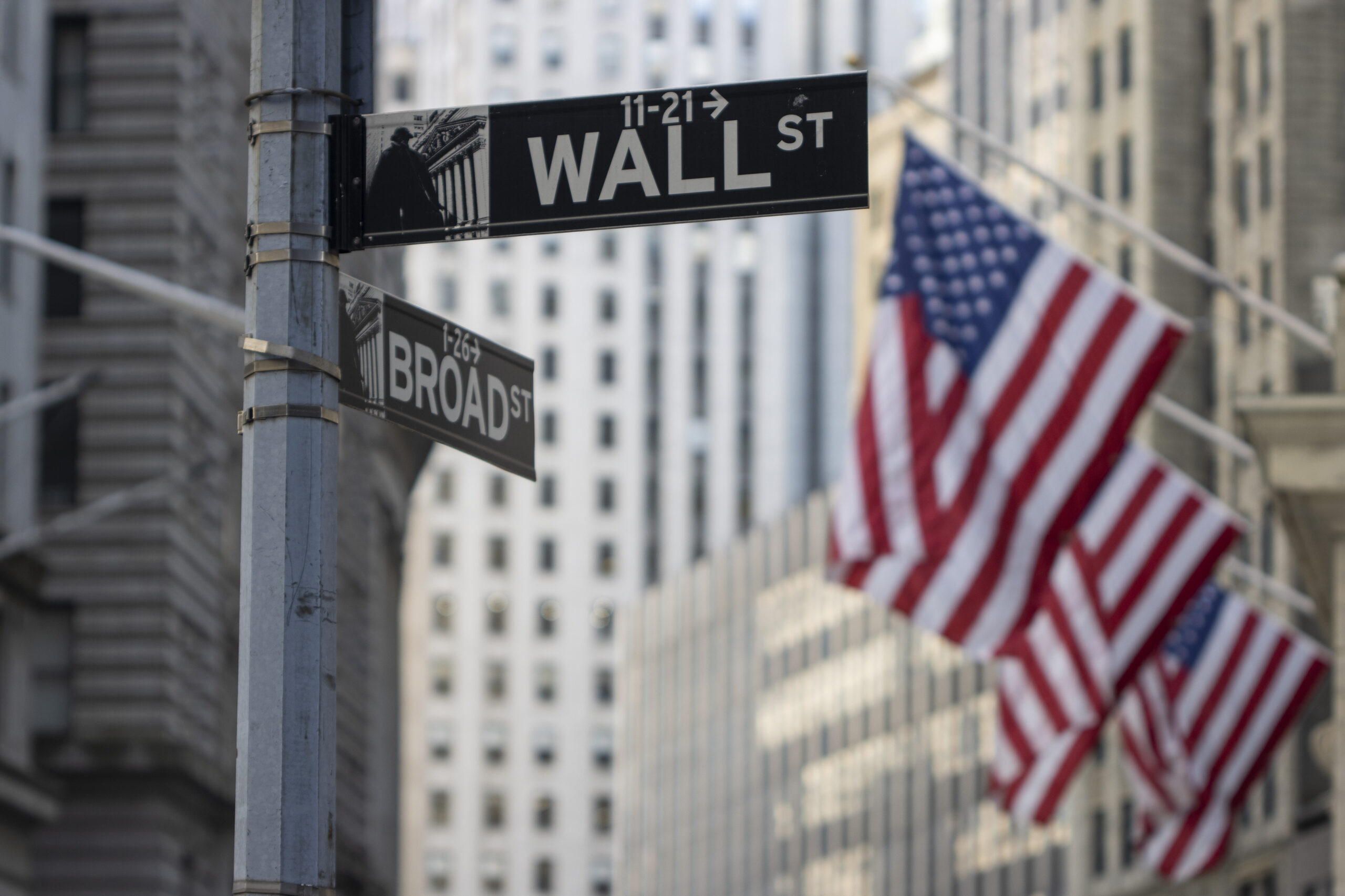
Road signs mark the crossroads of Wall Street and Broad Street in front of the New York Stock Exchange building. Professor Michael McCarthy's latest book argues that the growing power of financial institutions has eroded American democracy. To restore it, he envisions a new form of democratic public banks, led by the people and operating for the public good.
As America heads toward midterm elections next month, many voters are harboring concerns about the health of our nation’s democracy. A Pew Research Foundation poll over the summer found that 69% of Americans reported being dissatisfied with how the nation’s democracy is working. At the same time, economic anxiety is running high. Amidst a cost of living crisis and near record low consumer sentiment, voters of all political persuasions have consistently ranked the economy as the top issue in this year’s elections.
What if these two seemingly separate issues were actually related? Are there changes we could make in our economy that would actually improve the health of American democracy? That’s the argument of the latest book by Sociology Professor and Community Studies Program Director Michael McCarthy.
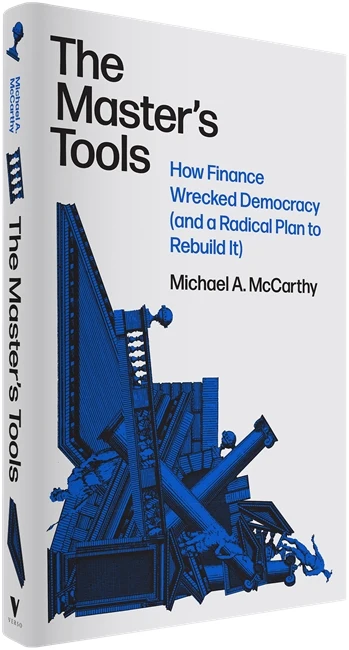
In The Master’s Tools: How Finance Wrecked Democracy (and a Radical Plan to Rebuild It), McCarthy lays out his theory. The growing power of financial institutions has eroded American democracy and constrained our nation’s political possibilities, he argues. And all of this has come at the expense of working people.
For solutions to the challenge, McCarthy looks to the origins of democracy in ancient Greece. Taking inspiration from the Greeks’ randomized distribution of power—upon which the jury duty selection process is also based—he envisions a new form of democratic public banks, led by the people and operating for the public good.
McCarthy’s book recently won two national awards from the American Sociological Association: the 2026 Outstanding Contribution to Political Sociology Book Award and the Theory Prize. The UC Santa Cruz news team caught up with him to discuss the ideas from his book and what it might take to disentangle finance from American democracy.
Many people have concerns about money in politics, but what you’re working on is much bigger than campaign finance reform. Can you explain?
Yes, my work actually focuses on the influence of the entire financial sector. It’s about who controls financial assets and makes decisions about the movement of money in our economy. Finance is often thought about like a big speculative casino that sits adjacent to the “real economy.” But this is a misconception. Financial operations are deeply interwoven into both businesses and the institutions of the state itself.
Finance is actually so important to the workings of our society that I argue that, in order to democratize the state, we would have to democratize finance. What’s especially influential is finance capital, or the money that is advanced for loans and investments and is returned with interest. Finance capital has become more salient over time in the economic activity of businesses, in the governance tools wielded by the state, and in the everyday lives of working people.
Could you unpack how the influence of the financial sector has changed over time?
Finance is not at all new, but the scale to which it has grown is. For instance, here in the U.S., finance, insurance, real estate, and business services contributed about 17% of total value added to Gross Domestic Product (GDP) in 1949. By 2009 that had risen to 35%, while manufacturing, mining and construction fell from about 30% to 16%. Looked at another way, the financial sector’s share of total U.S. profits rose from under 10% after World War II to nearly 40% in the early 2000s, and has held around 26% since the 2008 downturn.
The problem is not that finance starves the economy of investment. It’s that it channels investment toward whatever maximizes financial returns, at the expense of the things we desperately need as a society. We have plenty of new AI models to choose from. What we lack is clean energy and green infrastructure, affordable housing, empowering workplaces, and viable public goods.
How has this reshaped democracy?
There are three main ways that finance shapes political decisions. The first is the direct spending on lobbying and campaign contributions that we are all familiar with. The political spending from finance has soared over the last two decades.
Another lesser known influence route is the leverage that comes from a sector’s size and its capacity to withdraw investment, or what is known as an “investment strike” or “capital strike.” The threat of disinvestment can bring governments to their knees, as happened to the Allende government in Chile and the Mitterrand government in France. Politicians are keenly aware of this growing disinvestment threat.
And then the final type of influence is the way that finance is infrastructurally interwoven into the logistical operations of governments and businesses, which in turn tends to make both want what is best for the financial sector. The net result is that while our institutions are democratic in name, they are oligarchic in practice.
What are some examples of the finance sector’s influence over governance?
After Hurricane Maria devastated Puerto Rico in 2017, the Boston hedge fund The Baupost Group, which had bought up nearly $1 billion in Puerto Rican debt at depressed prices, exerted a massive pressure campaign on the Puerto Rican government to adopt a ruthless austerity program. As a result, the government raised university tuition, cut employee benefits and vacation, closed schools, cut welfare assistance, and sold off the public electric utility. Paying creditors was prioritized over the island’s devastated inhabitants, and largely successfully.
There are many examples of how financial institutions will squeeze a sovereign state dry when the state is distressed. The irony is that the financial institutions themselves depend on government bailouts to operate.
How does all of this impact the average person?
Finance capitalism ultimately produces debt and financial insecurity, underinvestment in socio-environmental goods, creates macroeconomic instability in financial markets, and deepens climate change. It’s fundamentally bad for working people.
Take debt, for instance. U.S. household debt rose from roughly 43% of GDP in 1983 to nearly 100% in 2008. Mortgage debt now exceeds its peak from before the Great Recession. And the shift toward investor-owned real estate, both commercial and residential, has been at the center of staggering price and rent increases. Meanwhile wealth has become even more concentrated than it was when Occupy Wall Street erupted.
And workers’ own financial investments have historically been used against them. Pension funds, many of which were won by unions after World War II, have been invested in ways that hurt labor standards and wages, contributed to deindustrialization, financed the leveraged buyouts and asset stripping of the 1980s merger wave, and weakened the very labor movement that fought for them.
What’s the alternative to the current system?
There are a lot of alternatives floating around right now. Normative reforms, like corporate social responsibility, ESG investing, and the UN Principles of Responsible Investment, work on the moral calculus of financiers. Regulatory reforms, like reinstating some of the financial regulations of the New Deal period, constrain what financial actors can do. Supplemental reforms, like a postal bank, create state-governed institutions to fill market niches and compete with the dominant financial institutions.
But I argue that we need democratic reforms that aim to shift financial ownership and decision-making power to the people. In the book, I offer both a strong and a weak version of this. In the strong version, we might think about creating democratic structures in all of our major financial institutions. But I spend the bulk of the discussion on exploring a weaker version—the creation of democratic public banks.
How would a democratic public bank work?
It would essentially be a financial institution that’s led by a set of boards and assemblies made up of people selected at random from the general public. The idea goes all the way back to ancient Athens. During the period of radical democracy, most aspects of Athenian society, from the setting of market prices to the cleaning of temples, was done by small groups of people selected at random.
For a democratic public bank, I propose a multi-layered design. A People’s Assembly sets multi-year investment mandates for the bank. People’s Research Juries can be commissioned to investigate areas the assembly identifies as poorly understood. People’s Investment Boards oversee actual allocation in specific areas, which may include housing, clean energy, worker cooperatives, or community wealth-building. A People’s Review Board audits and reports to the next assembly. And finally, class- and issue-based standing commissions—which may include workers, clean energy, racial justice, tribes, cooperative ownership commissions—can review the assembly’s draft mandates and veto up to one.
Is there hope for this solution in the real world?
Definitely, because this isn’t an idea that comes from nowhere. Some similar organizations already exist. The Organisation for Economic Co-operation and Development (OECD) calls the 500-plus popular assemblies now running worldwide a “deliberative wave.” Most are advisory, because few politicians want to surrender agenda-setting power. But the idea is more popular than ever.
My book itself actually grew out of on-the-ground work with organizers and policymakers like the Public Bank LA coalition and Congresswoman Rashida Tlaib. With Public Bank LA, I helped write several public-facing briefs on what a democratic public bank could do for the people of Los Angeles. And that work led to consulting with Congresswoman Rashida Tlaib’s staff on the Public Banking Act of 2023, which she introduced with Congresswoman Alexandria Ocasio-Cortez. She’s planning to reintroduce a revised version of the bill, either this year or next. So there are some elected leaders who are already championing this concept, and those efforts will continue.