Arts & Culture
THI Moving Image Lab Public Fellow helps bring horror exhibition to life at the Academy Museum
A scholar of queer history and culture with a passion for horror, Bradford Nordeen is The Humanities Institute Moving Image Lab’s 2026 curatorial and exhibitions fellow at the Academy Museum, where he worked on the new exhibition The Horror Show, featuring nearly 400 horror-movie artifacts. The exhibition, which runs until July 21, drew nearly 8,000 visitors during its opening weekend in late September.
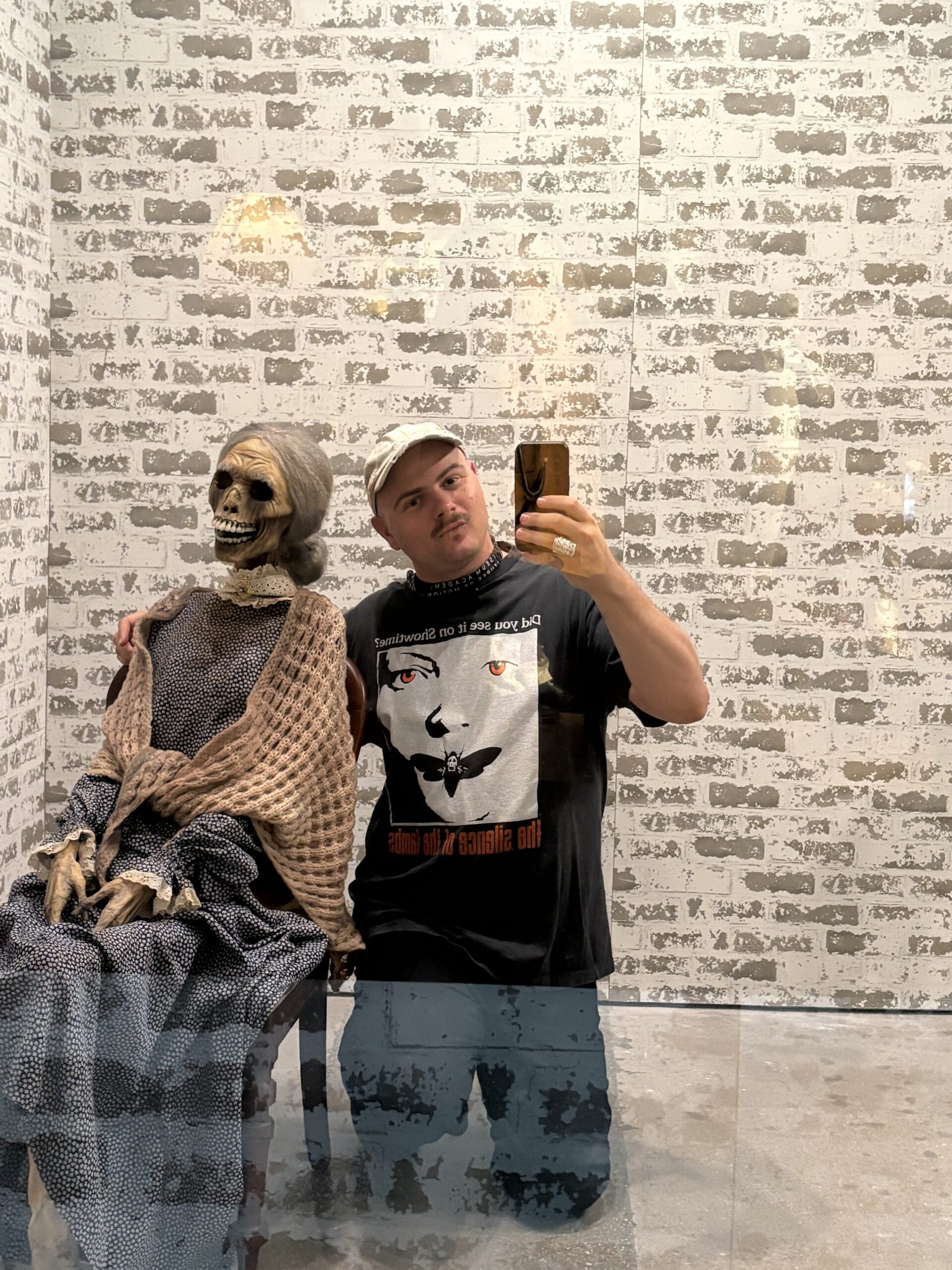
Bradford Nordeen posing with a prop from the movie Psycho at The Horror Show exhibition
On the first day of Bradford Nordeen’s fellowship at the Academy Museum of Motion Pictures in Los Angeles, an exhibition design meeting centered around a detailed drawing that appeared in the 1991 horror movie The Silence Of The Lambs.
The image of FBI trainee Clarice Starling, played by Jodie Foster, appears in a scene in which the homicidal psychiatrist Hannibal Lecter is plotting to bust out of his high-security lockup.
For Nordeen, a Ph.D student in film and digital media at UC Santa Cruz, the drawing was a sign that the fellowship he’d landed at the museum was something special. “I knew it was a perfect fit,” Nordeen said.
A scholar of queer history and culture with a passion for horror, Nordeen is The Humanities Institute Moving Image Lab’s 2026 curatorial and exhibitions fellow at the Academy Museum, where he worked on the new exhibition The Horror Show, featuring nearly 400 horror-movie artifacts. The exhibition, which runs until July 21, drew nearly 8,000 visitors during its opening weekend in late September. Among the attendees were directors Jordan Peele and Robert Eggers.
“I saw so many people smiling,” Nordeen said. “I was able to see a sense of excitement spread among the people who walked through the exhibition.”
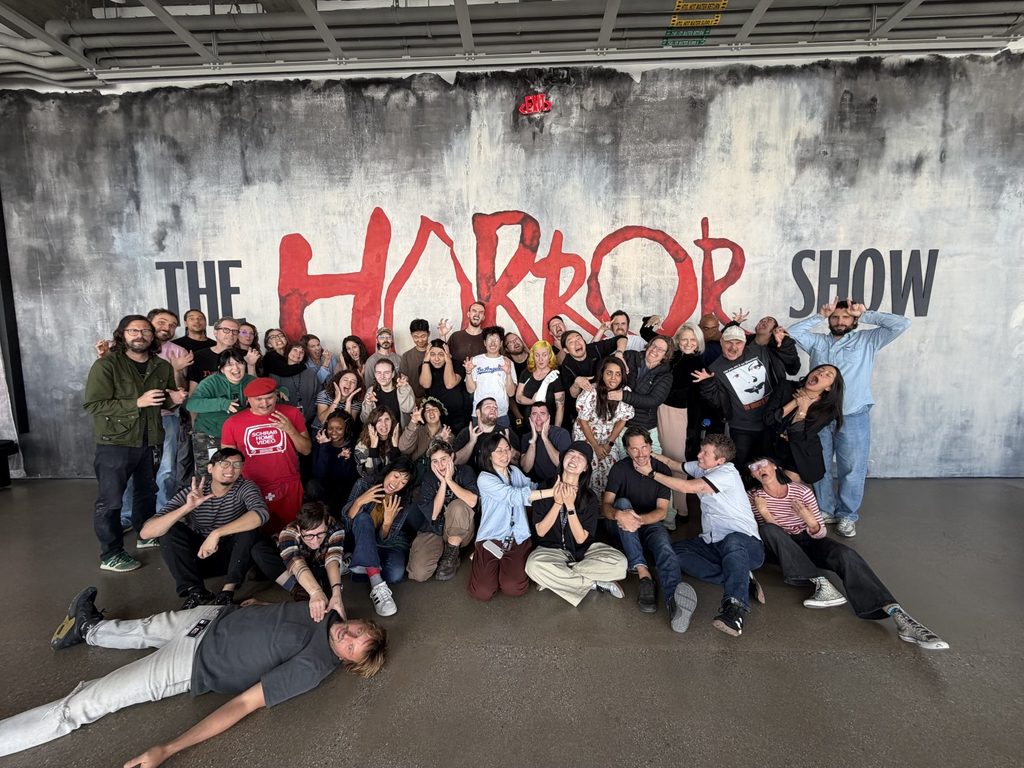
The fellowship program, sponsored by the Mellon Foundation and led by Distinguished Professor of The Arts and History of Consciousness Isaac Julien and Arts Professor Mark Nash, creates opportunities for emerging arts professionals to connect their scholarly interests with the work of museums and other cultural institutions. THI, which houses the Moving Image Lab, managed the fellowship, and Nordeen worked closely with Laura Martin, THI’s research program manager, whom he called his “guardian angel.” He said she was particularly helpful in laying out my roles and responsibilities in the fellowship.
“It has been a real joy to work with Bradford and to see his talents and interests appreciated not only here at UC Santa Cruz but at the Academy Museum,” Martin said. “He is having just the kind of experience that we had hoped for when we created these public fellowships. I think he’s done this and more.”
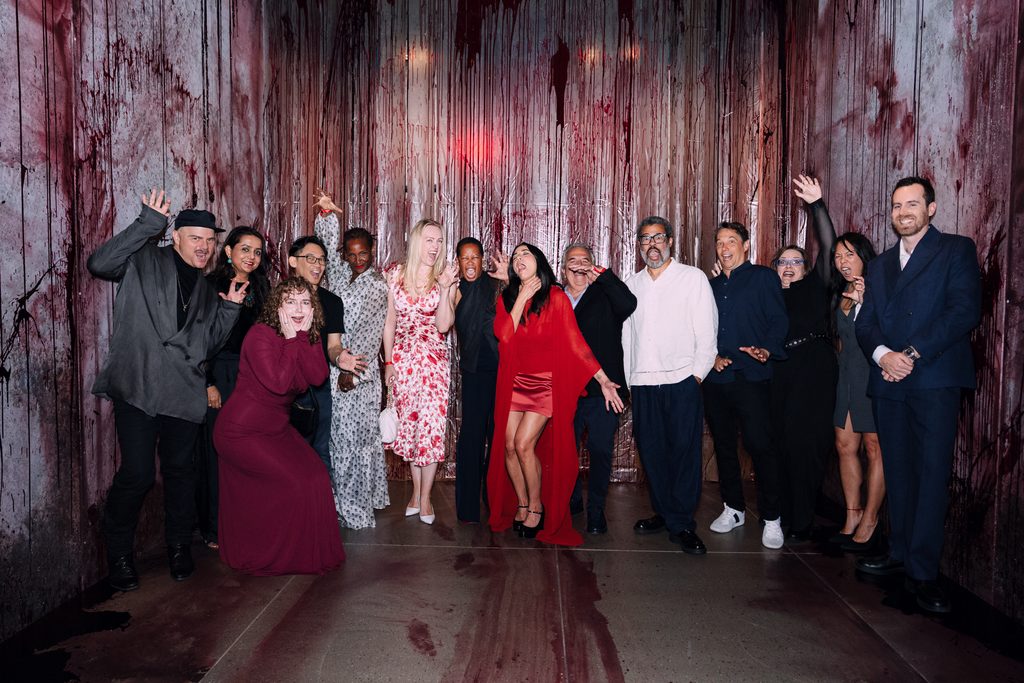
Nordeen’s responsibilities included writing exhibition and publication texts, participating in design meetings, and helping to determine how objects and film footage would be presented.
One of his most meaningful contributions involved writing the detailed wall text for storyboards laying out the lair of the serial killer Buffalo Bill, one of the villains from The Silence Of The Lambs, directed by Jonathan Demme. The family of the late director lent a Hannibal Lecter costume to the exhibition.
After its release in 1991, the film drew backlash from LGBTQ audience members who felt that Buffalo Bill was an anti-trans caricature.
Nordeen worked hard on the wall text, ultimately rewriting it dozens of times in a span of over four months, and his efforts paid off. The horror fandom magazine Fangoria praised the exhibition’s willingness to engage in a difficult conversation.
In another gallery, Nordeen helped organize a grouping of VHS horror cassette tapes in an exhibit that evoked the lived-in atmosphere of a home video collection. Elsewhere he helped curate footage playing in a long darkened hallway, showing scenes from Dario Argento’s Suspiria, Friday The 13th Part 8: Jason Takes Manhattan, and James Whale’s classic The Old Dark House.
Nordeen loved watching the exhibition take shape. He saw a group of workers from Legacy Effects assemble a lifesize xenomorph from the movie Alien: Romulus. The morning after the team finished the monster, Nordeen marveled at the light projection that threw the creature’s shadow on the wall, making its jaws appear enormous. This was the handiwork of Academy senior lighting specialist Kelly Howland. “He did great work, which was done when we left for the night,” Nordeen said.
He examined a chainsaw that appeared in the notorious shower scene of Damien Leone’s Terrifier 3 and realized it was the real thing, not a prop. “It smelled of gasoline,” he said.
Among Nordeen’s favorite parts of the exhibition is a grouping in the Gothic-themed room that brings together Eiko Ishioka’s red armadillo armor from Bram Stoker’s Dracula directed by Frances Ford Coppola, the dressing down worn by Lily-Rose Depp in Nosferatu directed by Robert Eggers, and Bela Lugosi’s Dracula cape.
Placed in relation to each other, the objects stage a visual conversation across different moments in horror cinema. Visitors can consider their designs, histories, and cultural associations instead of encountering each artifact in isolation.
Eggers himself showed up to the exhibition, and Nordeen saw the director gazing at the triangulation of objects at the gothic gallery.
“In that section of the exhibition, I heard the exhibition designer director, Laura Belevica, take a deep breath, and I had this quiet moment when I just said to myself, ‘you get to do this,” Nordeen said.
That grouping of objects captured something Nordeen hopes visitors will experience throughout the exhibition – not necessarily fear, but delight, curiosity, and a sense of connection to the people and films that have shaped the horror genre.
The fellowship also supported Nordeen’s dissertation research. Despite the demands of the museum work, he was able to complete an 11,000-word chapter on the filmmaker Luther Price.
“Learning how to translate complicated ideas for a wider audience is very important,’’ he said. “The fellowship gave me license not to limit myself in terms of whom I was speaking to.”
Working on the exhibition gave him a sense of wonder that extended beyond the museum.
A research trip took him to the Margaret Herrick Library, where he touched Saul Bass’s original storyboard for the shower scene in Alfred Hitchcock’s Psycho.
For Nordeen, working at the museum brought together his interests in film, horror, and queer history in ways he’d never imagined.
“I’m so happy this opportunity took place,’’ he said. “It is a dream, literally.’