Earth & Space
Astronomers use Webb telescope to pinpoint host galaxy of the most distant fast radio burst to date
Originating just 3 billion years after the Big Bang, the record-setting burst was localized with key contributions from UC Santa Cruz collaborators.
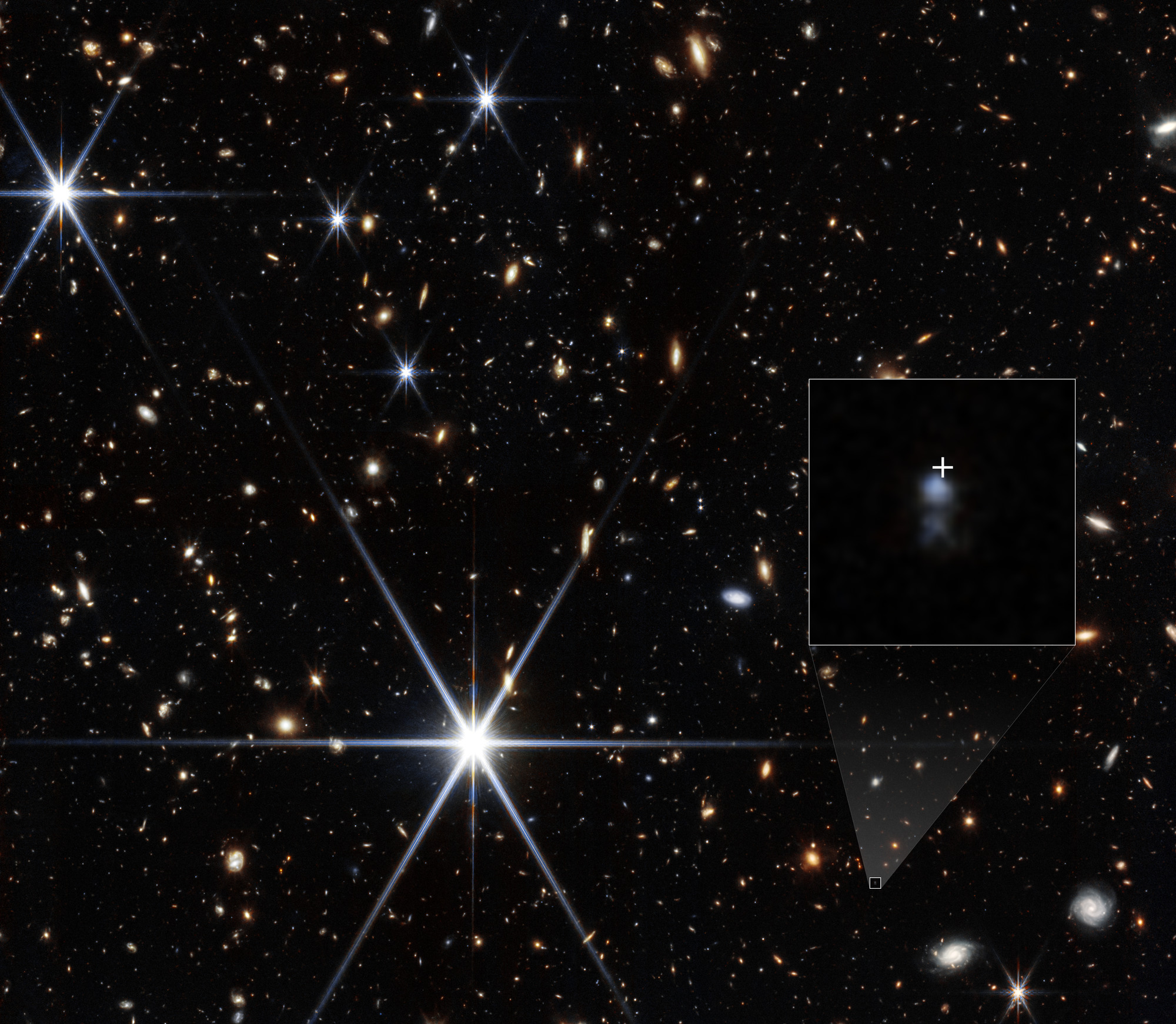
NASA’s James Webb Space Telescope’s Near-Infrared Camera detected the host galaxy of the fast radio burst called FRB 20240304B, whose location is shown by the white cross. It was found in a small dwarf galaxy actively forming stars.
Credit: NASA, ESA, CSA, STScI, Themiya Nanayakkara (USYD)
Press Contact
Key takeaways
- Astronomers used NASA’s James Webb Space Telescope to identify the host galaxy of the most distant fast radio burst ever detected.
- The record-breaking energy burst originated just 3 billion years after the Big Bang in a galaxy far smaller and younger than expected.
- The discovery suggests these mysterious cosmic signals are generated by young, highly magnetic dead stars rather than colliding stellar remnants.
- UC Santa Cruz researchers played a pivotal role by proving the host galaxy was invisible to ground-based observatories and then planning the space-based observations.
The fleeting beams of energy known as fast radio bursts (FRBs) that pierce the cosmos are an astronomer’s flashlight, revealing secret structures and matter that make up the universe. And the deeper into space that an FRB originates, the more of the cosmic web that its beam hits along the way.
That’s why astronomers are excited by the latest discovery enabled by NASA’s James Webb Space Telescope (JWST). In a new study published on October 8 in the journal Science, researchers from the University of California, Santa Cruz, along with collaborators say they have pinpointed the host galaxy of the most distant FRB seen to date. Their finding has implications for what kind of energetic event creates these bursts.
A team of FRB hunters used the MeerKAT radio-telescope array in South Africa to detect the burst on March 4, 2024, leading to its designation as FRB 20240304B. The radio data from this burst suggested that it was extremely distant, possibly the most distant one seen to date.
But to confirm that distance, astronomers needed to identify its host galaxy. Although they knew the location of the FRB very precisely, the world’s largest ground-based telescopes could not see any galaxy at that spot in the sky. As a result, the team turned to JWST.
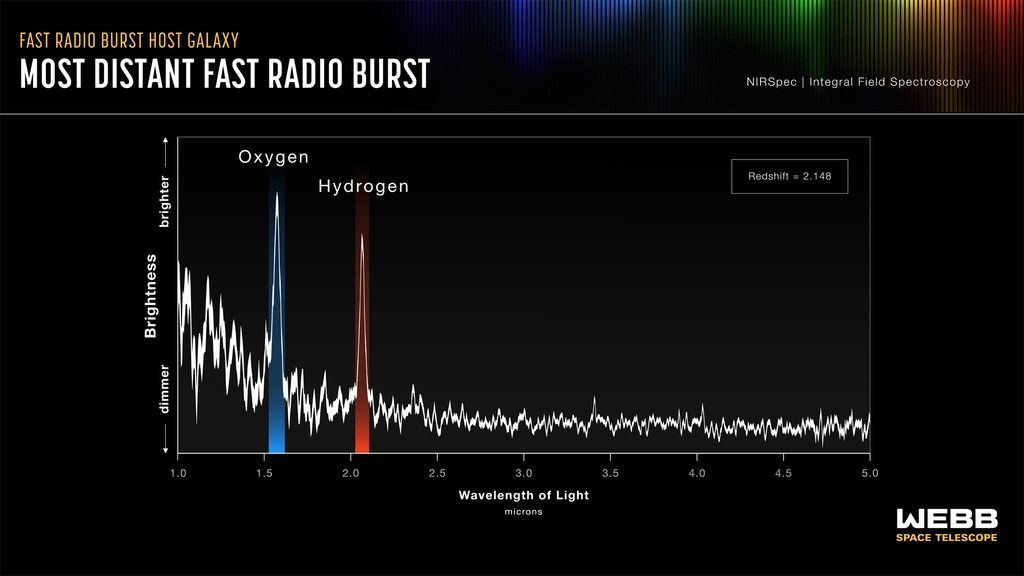
Webb’s NIRCam (Near-Infrared Camera) instrument detected a galaxy in the right location, and its NIRSpec (Near-Infrared Spectrograph) instrument provided a precise measurement of the galaxy’s redshift: 2.148, corresponding to a time just 3 billion years after the Big Bang. The vast majority of FRBs detected to date occurred billions of years later in cosmic history.
A ‘null’ result was key

“UC Santa Cruz’s contributions were critical to the program’s success,” said study co-author J. Xavier Prochaska, a professor of astronomy and astrophysics. “We collaborate with the radio astronomers on the MeerKAT telescope to study the galaxies that host these enigmatic phenomena.”
Specifically, UC Santa Cruz’s researchers planned, organized, executed, and analyzed observations from the W. M. Keck Observatory in Hawaiʻi that proved the FRB’s home galaxy is too faint to be seen by any ground-based telescope. This “null” result was needed to justify and plan their request for observation time on JWST.
The team discovered that the host galaxy of FRB 20240304B was not typical of other galaxies with FRBs. Most FRB galaxies are massive star-forming galaxies, but this one was 1,000 times less massive than they expected—explaining its null detection at the Keck Observatory. Its size and age surprised the team, and suggested a delay between when galaxies form stars and when they become capable of generating FRBs.
Clues to cosmic origins
This indicates that FRBs likely are caused by young neutron stars known as magnetars. “What makes fast radio bursts interesting is that we don’t know what generates them. We have theories for what objects produce them, but we don’t have conclusive proof,” said the study’s lead author, Manisha Caleb, an astrophysicist at the University of Sydney.
Prochaska’s team has been using Keck to study post-event host galaxies of FRBs for nearly 10 years. They spent an hour conducting imaging using the Low Resolution Imaging Spectrometer (LRIS) instrument on the Keck I telescope. LRIS is a versatile and ultra-sensitive visible-wavelength imager and spectrograph that was used in observing distant supernovae by astronomers who received the Nobel Prize in Physics in 2011.
“The Keck and LRIS combination is as powerful as it gets for finding faint, distant galaxies from the ground. We pointed it right at the location of the FRB and looked as deeply as we could from Earth, but there was simply nothing to see,” Prochaska said. “We immediately concluded: If we wanted to find the source, we had to go to space.”
As it turned out, the galaxy existed at the height of “cosmic noon”—a period in the history of the universe when star formation was at its peak. The galaxy’s rate of star formation suggested that the majority of its stars may have formed within just 30 million years.
Explosive theories
This has important implications for the origin of fast radio bursts. One theory suggests that FRBs may originate from the merger of two neutron stars. However, the process of orbiting neutron stars gradually approaching closer and closer until they collide is expected to take billions of years. As a result, FRBs would be expected to be associated with older galaxies containing more evolved stellar populations.
A second theory proposes that an FRB can originate from a single, young, highly magnetic neutron star known as a magnetar through a mechanism like starquakes. In that case, once a massive star explodes as a supernova and leaves behind a magnetar, an FRB might occur relatively quickly with no large time lag. As a result, FRBs would also be expected to be found in younger galaxies like the host of FRB 20240304B.
In addition to being a record-holder, the new FRB enabled the team to learn more about the billions of light-years of apparently empty space between the burst and Earth. The team found the imprint of two cosmic structures on the FRB’s signal: one previously unknown galaxy cluster at a redshift of 0.3 (about 3.5 billion light-years from Earth), and the nearby Virgo Cluster, which is located about 54 million light-years from Earth.
A future so bright
Looking ahead, the team is excited about the potential to discover more distant FRBs. They estimate that the MeerKAT telescope may be able to detect and localize several FRBs per year at a redshift greater than 1.0—meaning they existed more than halfway back to the start of the universe. As other new radio telescope facilities and instruments come online, that discovery pace may grow.
Study co-author Lordrick Kahinga, a Ph.D. student on Prochaska’s team at UC Santa Cruz, said the opportunity to work alongside world-class researchers who are supportive and provide invaluable experiences for a young scientist like himself is incredible. “It’s hard for me to describe in words,” Kahinga said. “I wake up every day feeling extremely grateful that I get to do what I love, and excited to tackle extraordinary problems and better understand the universe.”
This article was adapted from announcements by NASA and Keck Observatory.