Campus News
Four UC Santa Cruz faculty elected Fellows of the California Academy of Sciences
New Fellows reflect UCSC’s distinctive strengths across planetary science, biodiversity, marine science, environmental governance, and justice
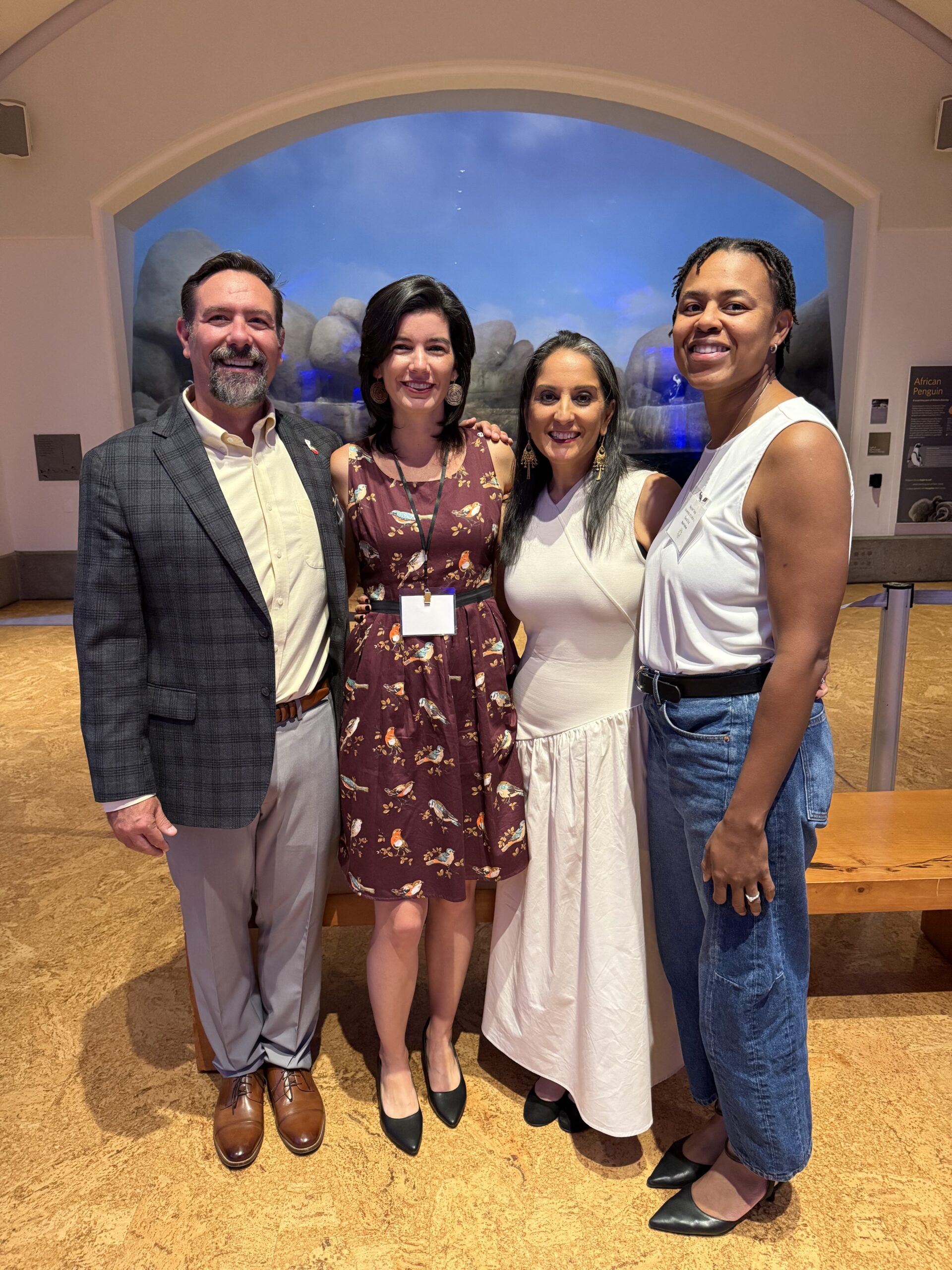
From left: Eric Palkovacs, Natalia Ocampo-Peñuela, Sikina Jinnah, and Myriam Telus are among the 12 new Fellows with the California Academy of Sciences.
Four UC Santa Cruz faculty members—Sikina Jinnah, Natalia Ocampo-Peñuela, Eric Palkovacs, and Myriam Telus—have been elected Fellows of the California Academy of Sciences, an extraordinary recognition that brings together four scholars whose work reaches from the origins of planetary systems to the future of biodiversity, oceans, climate governance, and environmental justice.
The California Academy of Sciences announced 12 new Fellows on Oct. 7. The honor recognizes outstanding contributions to the natural sciences. Fellows also contribute to the Academy’s broader mission through research, public engagement, education, and collaboration.
“We’re delighted to announce this year’s distinguished class of Academy Fellows,” said Academy Dean of Science and Research Collections Shannon Bennett, PhD. “Each of our new Fellows has advanced our understanding of the natural world, from the ecology and evolution of life on Earth to the processes that shape our planet and universe.
“As we look forward to the upcoming COP17 United Nations biodiversity gathering later this month, our new Fellows strengthen our resolve to turn international commitments into tangible results for nature. They inspire the next generation of scientists, educators, and storytellers, and join us as partners in the Academy’s mission to regenerate the natural world through science, learning, and collaboration.”
The four new Fellows from UC Santa Cruz work at dramatically different scales. Telus reads chemical signatures preserved in meteorites to reconstruct the earliest history of planets. Palkovacs studies how evolution and ecological change reshape freshwater and marine ecosystems. Ocampo-Peñuela works to understand and protect biodiversity across rapidly changing landscapes. Jinnah examines how societies build institutions capable of governing climate change and emerging technologies—and how justice, power, and participation shape those decisions.
Together, their election tells a larger story about UC Santa Cruz.
Few of the environmental challenges confronting society fit comfortably within a single discipline. Neither does the scholarship at UC Santa Cruz. Across environmental studies, Earth and planetary sciences, ecology and evolutionary biology, ocean sciences, marine sciences, and environmental justice, UC Santa Cruz has built an intellectual community in which understanding planetary change, protecting living systems, and confronting questions of governance and justice are deeply connected.
From the origins of planets to the future of our own
Myriam Telus, associate professor of Earth and planetary sciences, studies some of the oldest materials available to science to understand how worlds are made. Using meteorites as records of the early solar system, she combines isotope geochemistry, petrography, laboratory experiments, and planetary science to reconstruct when the first planetary bodies formed, how they evolved, and how the building blocks of planets acquired their chemical and physical properties.
Her research reaches from microscopic signatures preserved for billions of years to fundamental questions about the formation and evolution of rocky planets and planetary environments, including our own.
Telus has also been an institution-builder for planetary science at UC Santa Cruz. She has helped create pathways that bring students into Earth and planetary sciences through research opportunities, sustained mentoring, and academic support, broadening access to a field where early research experience can be transformative. Her leadership extends beyond campus through efforts to strengthen California’s broader planetary science community.
Eric Palkovacs, professor of ecology and evolutionary biology, studies how living systems respond and evolve as their environments are transformed. His research investigates the interplay between ecological and evolutionary processes in freshwater and coastal ecosystems and applies those insights to biodiversity conservation, sustainable fisheries, and managing rapidly changing ecosystems.
Palkovacs also serves as director of UC Santa Cruz’s Institute of Marine Sciences, one of the university’s major interdisciplinary research organizations. In that role, he helps connect fundamental discovery with conservation, public agencies, and partnerships across the Monterey Bay region and beyond. His work exemplifies a UCSC tradition of moving between fundamental science and the environmental challenges facing communities and ecosystems.
Natalia Ocampo-Peñuela, assistant professor of environmental studies, works at the intersection of ecological discovery and conservation action. A conservation ecologist, she studies how human activities reshape birds, biodiversity, and their habitats, particularly in tropical regions and in her native Colombia.
Working across natural, agricultural, and urban landscapes, Ocampo-Peñuela uses spatial ecology, geographic information systems, connectivity modeling, animal tracking, and conservation-priority mapping to understand not simply where biodiversity is being lost, but where conservation can have the greatest impact. Her scholarship connects rigorous ecological research with the urgent challenge of protecting species and landscapes amid accelerating environmental change.
Although early in her faculty career, Ocampo-Peñuela is already emerging as a transformative mentor and community builder in conservation ecology. She is creating opportunities for students to see themselves not simply as participants in environmental research, but as scientists who can shape the field’s future. Her approach brings research, mentorship, and conservation practice together, helping build a new generation of ecologists prepared to work across disciplines, communities, and geographic boundaries.
That commitment is also reflected in her participation in UC Santa Cruz’s Emerging Leaders Fellowship through the Center for Reimagining Leadership. Her trajectory represents an important dimension of the university’s environmental strength: investing not only in established leaders, but in early-career scholars who are already reimagining how scientific communities are built, who have the opportunity to participate in them, and how ecological knowledge can serve communities and conservation.
Sikina Jinnah, professor of environmental studies and associate vice provost for Academic Affairs, is an internationally recognized scholar of global environmental governance whose work asks a defining question of our time: how can societies govern environmental change—and powerful emerging technologies—in ways that are effective, democratic, and just?
Her research spans climate change, climate engineering, international trade, and environmental politics, with particular attention to the institutions, rules, and power relationships that determine who participates in environmental decision-making, whose knowledge matters, and who bears the consequences. Her work on the governance of emerging climate technologies is increasingly important as technological possibilities develop faster than many of the institutions charged with overseeing them.
That commitment to governance and justice extends directly into Jinnah’s leadership at UC Santa Cruz. As associate vice provost for Academic Affairs, she works to strengthen the conditions in which faculty can thrive, supporting their development, leadership, and success across the university. As co-director of the Center for Reimagining Leadership, she is helping build new models of academic leadership centered on collaboration, belonging, mentorship, and institutional change. She also leads the Center’s Climate Justice Fellows Program, bringing together scholars across disciplines to strengthen the university’s capacity for climate justice research, teaching, and public engagement.
Across these roles, Jinnah brings the same questions that animate her scholarship into institutional practice: how do we build structures that distribute opportunity, strengthen participation, and enable people and communities to flourish? Her work demonstrates how scholarship on governance and justice can inform not only how we respond to global challenges, but how universities themselves lead and change.
Scholarship that crosses boundaries
Taken together, the work of the four new Fellows moves across extraordinary scales—from chemical signatures preserved for billions of years in meteorites, to individual species and ecosystems, to oceans and landscapes, to the international institutions through which societies respond to planetary change.
That range reflects the unusual breadth of environmental and planetary scholarship at UC Santa Cruz. Environmental research and education at UCSC extend across traditional disciplinary boundaries, bringing together the natural and social sciences to understand planetary change and its consequences. Earth and planetary scientists investigate how planetary systems form and evolve. Ecologists and marine scientists connect fundamental research with conservation and environmental decision-making. Environmental scholars examine how governance, justice, and power shape society’s response to environmental change.
Just as importantly, the four new Fellows are helping build the institutions and communities in which this work can flourish.
Palkovacs leads the Institute of Marine Sciences, strengthening connections across marine research and between the university, public agencies, and partners throughout the region. Jinnah works across university leadership and the Center for Reimagining Leadership to strengthen faculty development, climate justice, and new approaches to academic leadership. Ocampo-Peñuela represents an emerging generation of faculty developing scientific and institutional leadership alongside an ambitious research program.
Telus has similarly worked to strengthen the scientific community beyond her own research group. At UCSC, she has helped create pathways that bring students into Earth and planetary sciences through research opportunities, sustained mentoring, and academic support. Across California, she has helped build connections among planetary scientists and strengthen the regional scientific community, including through her leadership in the Bay Area Planetary Science Conference. That work resonates deeply with the mission of the California Academy of Sciences: scientific excellence coupled with a commitment to building communities around discovery, education, and public engagement.
Their election therefore recognizes more than four distinguished bodies of scholarship. Collectively, the new Fellows embody an approach to research in which discovery, community building, and leadership reinforce one another.
From asking how planets are formed, to understanding how ecosystems respond to change, to determining how biodiversity can be protected, to designing institutions capable of governing emerging technologies and environmental challenges justly, their work reflects a shared intellectual ambition.
It is also distinctly UC Santa Cruz: discovery across boundaries, leadership in service of community, and knowledge directed toward a more sustainable and just future.