Climate & Sustainability
UC Santa Cruz explores soil steam disinfestation as a non-chemical alternative to strawberry fumigants
Building on a nearly 60-year legacy of organic innovation, Center for Agroecology researchers are testing a non-chemical soil disinfestation alternative for California’s high-value strawberry industry.
California produces roughly 90% of the nation’s strawberries—a multi-billion-dollar industry centered in coastal agricultural hubs like the Salinas and Pajaro Valleys. But the delicate crop faces a persistent vulnerability: high susceptibility to aggressive soilborne pathogens.
For decades, strawberry production relied heavily on preplant soil fumigation with methyl bromide before its global phaseout for ozone depletion. Today, growers depend on alternative chemical fumigants like chloropicrin and 1,3-dichloropropene. Because these chemical fumigants can easily vaporize, their use can pose direct health risks to farmworkers working in and around treated fields, while off-site drift near homes and schoolyards has driven strict state buffer zones and growing community opposition.
Now, regulatory targets are accelerating the search for sustainable alternatives. Under California’s Sustainable Pest Management roadmap, the state has mandated a transition away from high-risk chemicals by 2050. The urgency was underscored in a recently published, multi-part study commissioned by the Department of Pesticide Regulation (DPR) and conducted by the California Council on Science and Technology (CCST). Co-authored by Jenny Broome, professional researcher in environmental studies and Center for Agroecology research affiliate, alongside researchers from Harvard and UC Davis, the CCST report evaluated preplant soil fumigants and highlighted soil steam disinfestation as a key non-chemical alternative to help growers transition away from fumigant reliance.
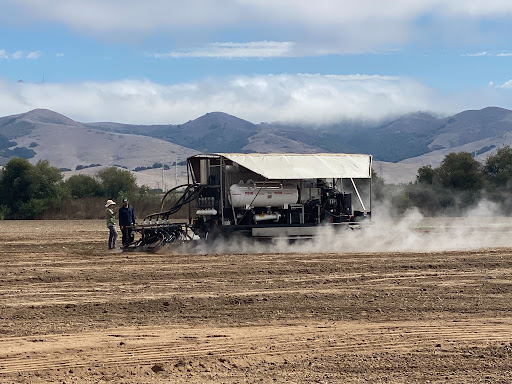
To bridge this critical gap, researchers at the Center for Agroecology have been investigating soil steam disinfestation as a non-chemical fumigant alternative for strawberries. Building on recent prototype technology that previously proved successful in controlling pathogens for both strawberries and leafy greens, the method uses high-temperature steam to selectively pasteurize soil without synthetic chemicals inputs—an approach now heading into commercial trials near Pajaro Valley schools, following four decades of organic strawberry research at UC Santa Cruz.
Deep roots in sustainable agriculture
Finding practical answers to California’s toughest agricultural challenges draws on a deep history of collaborative research at UC Santa Cruz.
For decades, conventional strawberry production relied almost entirely on potent soil fumigants to eradicate soilborne pathogens and suppress weeds. When Steve Gliessman, professor emeritus of environmental studies and founder of the Agroecology Program (now the Center for Agroecology), and local farmer Jim Cochran established early experimental plots in Davenport in 1986, it was widely believed that growing commercial strawberries without significant quantities of chemical inputs was nearly impossible. Yet their work proved against widespread industry skepticism that organic strawberry production was both scientifically and economically viable.

Two decades later, Carol Shennan, professor emerita of environmental studies, and Joji Muramoto, UC Cooperative Extension specialist in organic agriculture, expanded that groundwork by pioneering the application of Anaerobic Soil Disinfestation (ASD) in California strawberries—a technique to control soilborne pathogens by creating an anaerobic fermentation process in soil. Today, Muramoto continues to lead ASD research, a practice now utilized on thousands of commercial acres statewide. Yet as state roadmaps demand an accelerated phaseout of chemical fumigants, the need for a wider toolkit of viable non-chemical alternatives has never been more urgent.
“For forty years, the Center for Agroecology has worked on strawberry research that holds economic performance in balance with community and ecological outcomes,” said Darryl Wong, executive director of the Center for Agroecology. “This is research that is often too long-term or too uncertain for industry alone, and this is really what a public university is for. We need non-chemical alternatives just as much today as we did in the 80s and this project represents our commitment to stay with the work.”
Steam soil disinfestation: How it works and initial results
Building on that legacy, Broome and Wong are leading a California Department of Food and Agriculture (CDFA)-funded project adapting steam soil disinfestation for strawberries along California’s ag-urban interface.
The initiative brings together a multidisciplinary coalition spanning ag-tech engineers at High Degree Machinery and Smart Steam Applications for Agriculture, United States Department of Agriculture (USDA) plant pathologists, UC Davis economists, UC Agriculture and Natural Resources (ANR) extension advisors, the California Strawberry Commission, and mentor grower Rod Koda of Shinta and Kawahara Farms.
Unlike broad-spectrum chemical fumigants that volatilize and can drift through the air, steam disinfestation works entirely within the soil profile. Specialized applicators inject high-temperature steam into the soil bringing soil temperatures to a target window between 158 – 176°F (70-80 C) for 20-30 minutes.
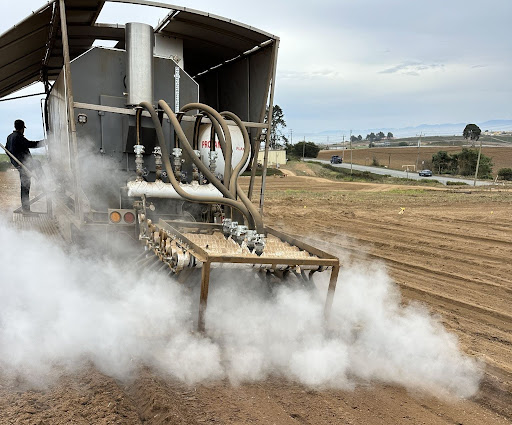
The process selectively pasteurizes the soil, killing heat-sensitive pathogens like Verticillium dahliae and Fusarium oxysporum along with weed seeds, without sterilizing the soil into a biological vacuum.
“We are excited to partner with the Center for Agroecology to expand biologically integrated farming systems through science‑backed, community‑centered projects that give California the tools it needs to protect its farms and neighborhoods,” said Kevi Mace, CDFA Senior Environmental Scientist Supervisor.
While preliminary research and trial findings demonstrate that key soilborne pathogens are effectively suppressed and beneficial soil microbiomes successfully bounce back post-treatment, researchers emphasize that further work is needed to optimize machine efficiency, economics, and treatment longevity under diverse commercial field conditions.
“After researching preplant fumigant alternatives in berry crops for 13 years together with UC Davis weed scientist Steve Fennimore, I am convinced that steam soil disinfestation is one of the most promising approaches that will enable us to move away from soil fumigants, particularly in areas near schools and other sensitive sites in a community,” said Broome.
From research to county action
Those initial research findings and identified questions served as the direct foundation for a new county-led effort to take steam disinfestation out of experimental conditions and test it in sensitive community areas.
In August, Santa Cruz County Agricultural Commissioner David Sanford secured a $175,000 grant from the DPR for a local pilot project designed specifically to build upon UC Santa Cruz’s research. Conducted in close collaboration with Broome, local growers, High Degree Machinery, and the community advocacy group Safe Ag Safe Schools (SASS), the county project will deploy and evaluate steam disinfestation on commercial berry fields located directly adjacent to Pajaro Valley schools. The pilot will utilize a larger, faster steam applicator, significantly increasing the acreage that can be treated near Santa Cruz County schools.
The project represents a powerful alignment between local county leadership, university researchers, growers, and neighborhood advocates.
“The Pajaro Valley has some of the most concentrated use of fumigants in the state, including near schools and homes,” said Kathleen Kilpatrick, SASS member and retired school nurse. “SASS members support exploring non-chemical alternatives on fields near schools. We hope these pilot projects will provide tools for pesticide reduction and expansion of organic buffers.”
Scaling for California’s future
These multi-partner initiatives reflect UC Santa Cruz’s deep commitment to conducting community-centered research—delivering practical, science-backed data that growers, local leaders, and neighborhood advocates can directly utilize. Ultimately, this collaborative approach centers grower experience to ensure non-chemical solutions are not only environmentally sound, but practical, economically viable, and protective of farmworker and public health.