Social Justice & Community
Parking policy masks anti-Muslim discrimination for communities building new mosques
New research shows that disputes around parking during the urban planning process are disproportionately used to fight the construction of mosques across the country
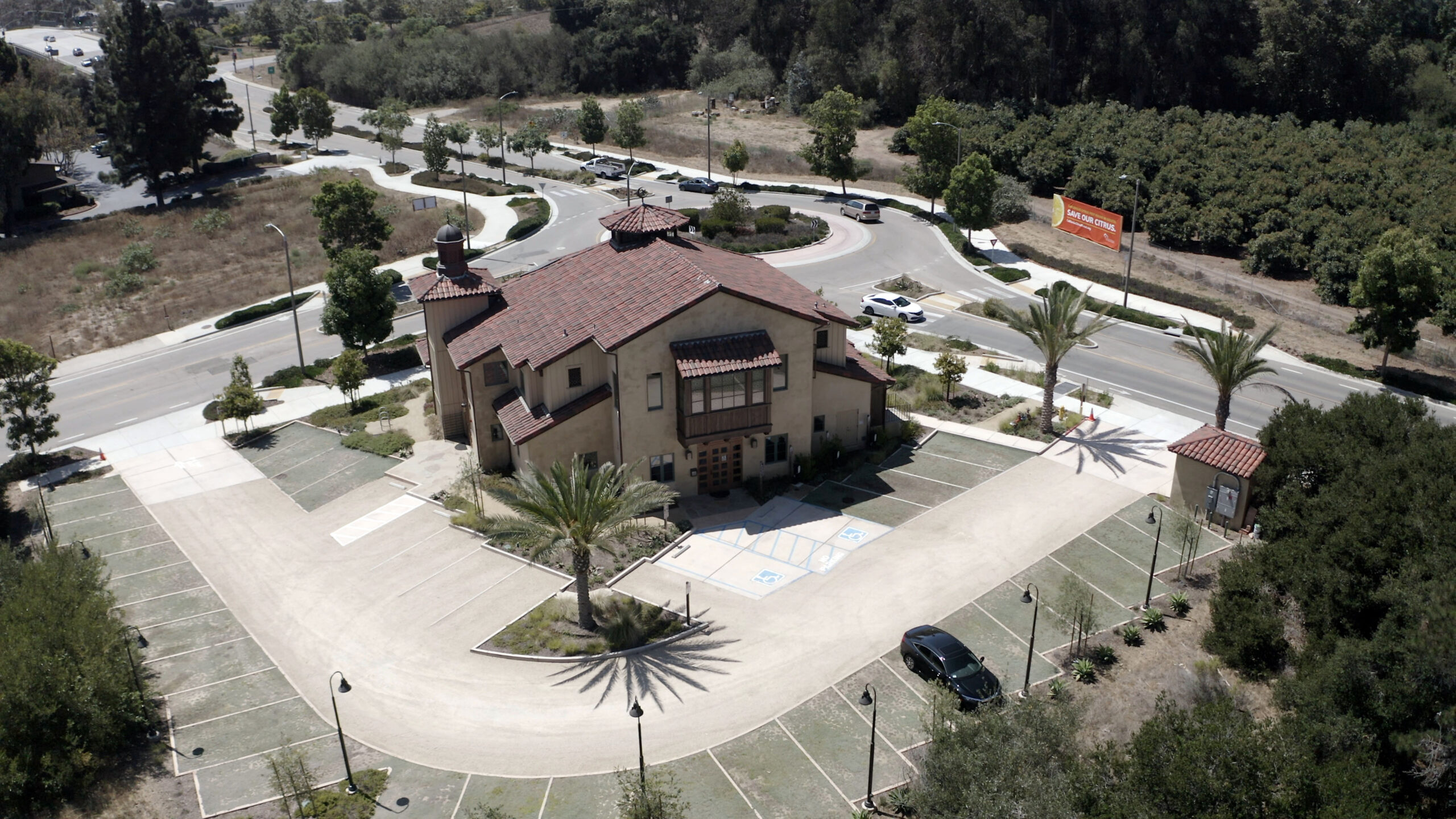
The Islamic Society of Santa Barbara's new mosque in Goleta, California was delayed in the city's permitting process for 10 years.
Appleton Partners LLP.
Press Contact
Key takeaways
- Newly proposed mosques are 16-18% more likely to experience opposition than newly proposed churches nearby.
- Citizen complaints around whether a new mosque will have enough parking lend an appearance of legitimacy to prejudice against Muslims, and city planners often impose arbitrary or ad-hoc requirements that delay and raise costs of mosque construction.
- Researchers recommend eliminating minimum parking requirements and allowing city staff to handle permitting decisions to remove this avenue of discrimination.
When the Islamic Society of Santa Barbara finally welcomed their community to their newly built mosque in 2019, nearly 19 years had passed since they purchased the property, with 10 years alone spent on the city’s permitting process. The development faced delays during 16 public hearings, during which residents of the suburban town of Goleta voiced a range of concerns, particularly around where worshippers would park their cars.
While objections like these might seem legitimate in isolation, a new study led by scholars at the University of California, Santa Cruz, and UCLA reveals that Muslim communities building new mosques disproportionately face opposition in the form of parking disputes, and that this procedural delay may often be used to mask anti-Muslim prejudice.
Published in the Journal of the American Planning Association, the country’s leading journal for urban planning, their research shows that newly proposed mosques are 16-18% more likely to experience opposition than newly proposed churches nearby—significantly more than what might be expected by chance.
The researchers argue that because both religion and parking cause deep, fear-based responses for many people, the two can fuse together as community members and city officials take action that delay and derail mosque construction.
“A fear of religion and religious minorities exists in many areas of America, as much as we care about religious freedom. But there’s also the fear of not enough parking,” said UC Santa Cruz Professor of Politics and Legal Studies Mark Fathi Massoud, the study’s senior author. “You put religion and parking together, and it results in this conflagration of emotion that is very visceral for people. We are trying to surface that viscerality of parking and of religion, and the ways that they come together, even in progressive towns and cities, that ultimately hurts Muslim communities.”
Prejudice in planning
Land use processes across the U.S. often provide space for public input, and while some objections are made in good faith, urban planning research has shown that this can provide an avenue to disguise prejudices as planning objections. Affordable housing projects, for example, frequently face opposition masked as procedural complaints.
“Opposition to new development comes from many places, including from people who are trying to hide socially unacceptable, prejudicial, or racist opinions,” said Adam Millard-Ball, study author and professor of urban planning at UCLA. “Objectors rarely say ‘we don’t want low-income people living here.’ Instead, they say, ‘well, the building doesn’t have enough parking.’ It’s attractive as a disguise because parking is also a genuine concern for many people, and so separating the parking from the prejudice is a challenge.”
Massoud and Millard-Ball sought to understand if similar weaponization was at play against Muslim communities—a question no academic research had previously addressed. UC Santa Cruz Ph.D. student and undergraduate alumni Huzaifa Shahbaz joined their team, bringing his expertise as a former Senior Researcher for the Council on American Islamic Relations (CAIR). The San Francisco Bay Area chapter of CAIR served as a community partner on this research, and the UC Institute for Transportation Studies provided funding.
To understand if discrimination was taking place, the researchers examined whether new mosques experienced complaints on the grounds of parking during the planning process at the same frequency as new churches, which represent the U.S.’s dominant religion. They identified 107 newly built mosques with a newly built church nearby as a point of comparison, and studied any opposition reported in local news coverage. To understand the larger qualitative landscape, they examined public records of city council hearings related to mosque construction across the country, and interviewed planners, elected officials, and religious leaders from case studies in the West Coast, Midwest, the South, and the East Coast.
Comparing churches and mosques
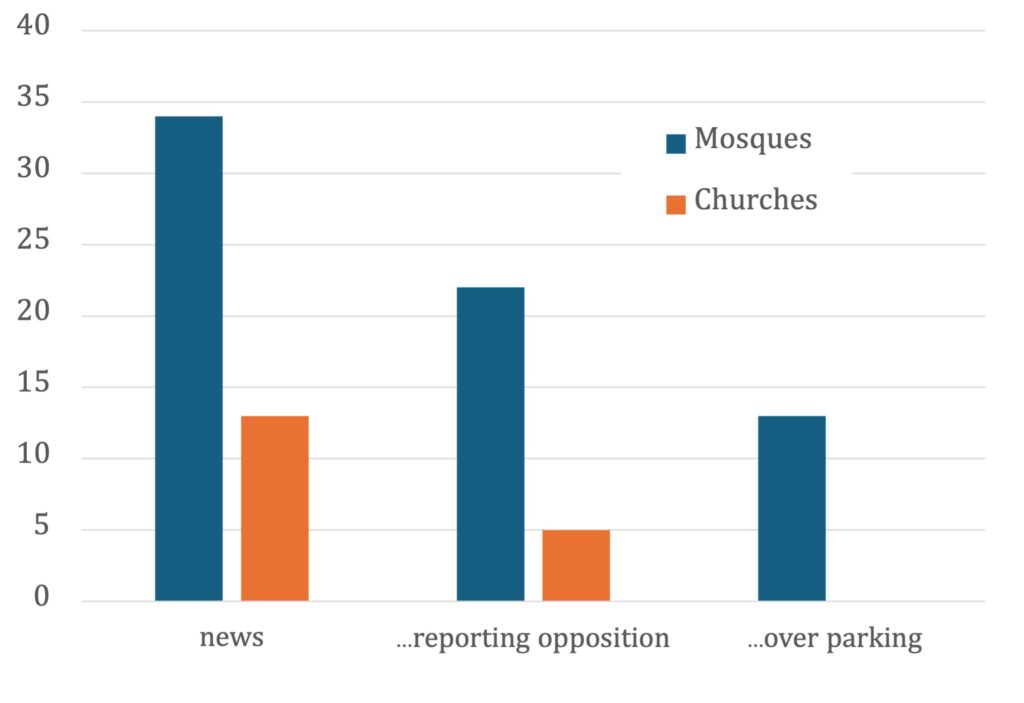
Their data revealed that mosques regularly faced opposition, even after complying with or exceeding parking requirements. The majority of both mosques and churches provided more parking than required by their local governments, with median capacities at 113% for mosques and 107% for churches.
Despite meeting parking requirements, the mosques still faced frequent challenges. Local news coverage revealed that about 20% of the 107 new mosques faced opposition, with parking as a theme in more than half the instances of opposition. In comparison, only five of the 107 new churches faced opposition as reported in local news, and parking did not emerge as a theme in any of these cases.
“Both mosques and churches are providing more parking than needed, but the mosques were receiving all sorts of opposition disguised under the veil of parking,” Massoud said. “That’s not to say concerns over parking are not legitimate—these are real issues, but real issues can also be used to discriminate.”
The parking cover
Interviews and public records demonstrated how citizen complaints over lot sizes, driveways, fire hydrants, and more could be used to delay and derail mosque construction—which the researchers say lends a smokescreen of legitimacy to underlying prejudice. Executive Director of CAIR-San Francisco Zahra Billoo, a community partner on this research, dubbed this pattern “the parking cover.”
“When more process is involved, that opens up more space for public comment, and for rules to be applied inconsistently,” Shahbaz said.
When community members raised complaints, city officials often imposed additional arbitrary or ad-hoc requirements, ordering mosque leaders to conduct additional parking studies, hire traffic engineers and consultants, or build more spaces. In one instance, planners asked for the dimensions of prayer rugs to determine how many parking spaces would be imposed on the mosque; in another, a city changed the zoning code to double the amount of parking required after a mosque applied for their permit. These costly processes posed logistical and financial barriers to development.
“As proposed mosques get delayed, the Muslim communities have to come up with additional money to fund additional studies,” Massoud said. “Meanwhile construction costs are going up across the country, so they have to fundraise even more, which often delays or prevents projects from going forward entirely. Parking can actually stop people from building places of worship that matter for a lot of people.”
City council transcripts revealed that many of the complaints surrounding parking were made during hearings in which other community members displayed micro- or outright aggressions against Muslims. Some accused mosques of being a “threat” to home values, and one person expressed that it would be upsetting to hear a daily call to prayer.
And while U.S. laws like the First Amendment and the Religious Land Use and Institutionalized Persons Act (RLUIPA) bar religious discrimination in land development, Muslim leaders often hesitated to protect themselves through the legal system in order to preserve a positive relationship with their town or city. Even so, nearly 40% of federal RLUIPA investigations of cities and towns involve Muslims, who make up only 1.1% of the population.
“Many mosque communities we talked with were reluctant to even mention RLUIPA, because they felt that would alienate their colleagues in the city who they would later need to work with. Many mosques wanted to do right by the city. What things look like on the ground can be very different from what the law might provide,” Massoud said.
“Parking can actually stop people from building places of worship that matter for a lot of people.”
Mark Fathi Massoud
Eliminating parking requirements
The researchers found the parking cover at play in communities across the country, regardless of the areas’ political leanings. Millard-Ball noted that liberal cities tend to have more processes for citizen participation in public hearings, which offer more inroads for people to object.
Due to this pattern of discrimination, the researchers propose that cities eliminate minimum parking requirements as a way to take away this mechanism for prejudice. They advise that city staffers should approve most new places of worship that comply with zoning codes, rather than allowing these decisions to go to public hearings.
Their policy recommendation joins a chorus of other planners who suggest eliminating minimum parking requirements as a way to encourage more sustainable and healthy modes of transportation, as research shows these minimums reinforce a car-oriented transportation system that discourages walking, biking, and public transit. Some places across the country, particularly in California, are already starting to eliminate parking requirements around major public transit hubs on these grounds.
More details are available in the full study, the researchers’ StoryMap article, and their policy brief.