Earth & Space
Is dark matter ‘natural?’ A UC Santa Cruz physicist puts the question to the test
A quantitative study of different dark-matter scenarios finds that primordial black holes can be just as ‘natural’ as traditional particle theories.
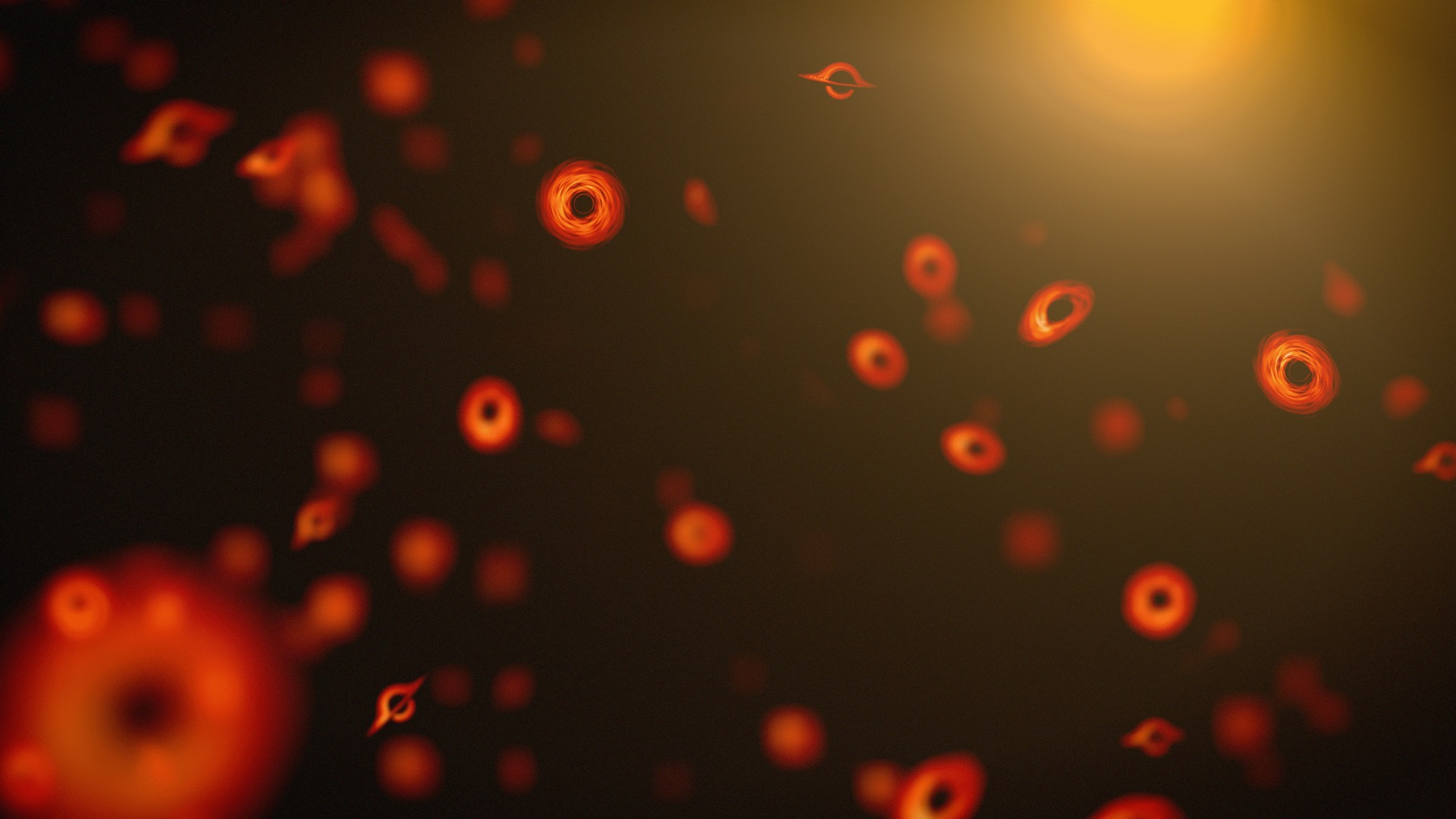
An artistic rendering of primordial black holes, one of the more recent theories proposed to solve the ongoing mystery of dark matter. A new paper by UC Santa Cruz physicist Stefano Profumo offers a mathematical "yardstick" akin to Occam's razor to help researchers assess different theories.
Credit: NASA's Goddard Space Flight Center
Press Contact
Key takeaways
- A new paper by UC Santa Cruz physicist Stefano Profumo applies a common ruler across 12 distinct dark-matter scenarios to evaluate “naturalness,” a measure of how much fine-tuning a theoretical model requires.
- The study demonstrates that primordial black holes are not inherently more exotic or fine-tuned than particle dark matter, with certain black hole models proving just as natural as leading particle theories.
- The findings indicate that fine-tuning is a property of a specific model’s mathematical structure rather than the physical category of dark-matter candidate being proposed.
Dark matter is one of the oldest open problems in physics. It makes up most of the matter in the universe and shapes how galaxies form and move, yet no one has ever directly detected it. Physicists have proposed dozens of candidates to explain it: exotic new particles, black holes formed moments after the Big Bang, and more.
Returning to ‘naturalness’
With no direct detection to settle the question, researchers often fall back on a different test: not “is this candidate detected,” but “is this candidate natural.” Naturalness is physics’ version of Occam’s razor. A theory is called natural if it explains the universe we see without requiring its underlying numbers to be delicately, almost implausibly, fine-tuned. A theory that only works if several unrelated quantities happen to cancel out to many decimal places is treated with suspicion, even if it isn’t strictly ruled out.
Naturalness has quietly guided decades of research into which ideas are worth pursuing, but it’s a slippery concept: intuitive to invoke, hard to pin down, and rarely applied evenhandedly across competing ideas.

That’s the gap Stefano Profumo, professor of physics at the University of California, Santa Cruz, addresses in a new paper published in Physical Review D. Rather than debating naturalness in the abstract, Profumo puts it to a direct, quantitative test, applying the same yardstick to two very different dark matter candidates: subatomic particles, and primordial black holes—the latter being hypothetical phenomena forged in the first fraction of a second after the Big Bang, long before stars existed to collapse into them.
Measuring fine-tuning across models
That yardstick, called the Barbieri-Giudice measure, asks a simple question of any model: If you nudge one of its input numbers by a tiny amount, how much does the predicted outcome swing? A gentle swing means the model is forgiving of its own assumptions, and hence, natural. A wild swing means the model only works because its numbers have been tuned within a hair’s breadth of what’s required.
Profumo ran 12 well-studied dark matter scenarios through this test, including several flavors of particle dark matter—like the long-favored “WIMP,” or weakly interacting massive particle—and several distinct ways primordial black holes could have formed in the early universe. The result cuts against a common assumption in the field.
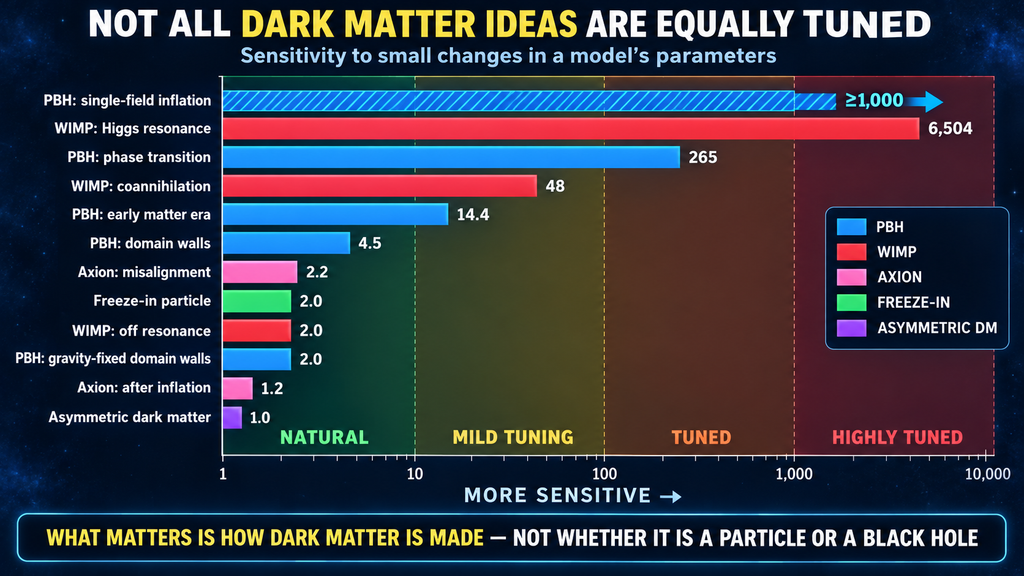
“There’s a habit of treating primordial black holes as the exotic, fine-tuned alternative, and particle dark matter as the safe, natural default,” said Profumo, deputy director for theory at the Santa Cruz Institute for Particle Physics. “When you actually run the numbers side by side, that story doesn’t hold up. Some black hole scenarios are about as natural as it gets. Some particle scenarios are wildly fine-tuned. And some of each land right in the middle.”
For instance, black holes formed from collapsing networks of structures called “domain walls” came out among the most natural constructions in the entire study, rivaling the most forgiving particle models. Meanwhile, one of the most popular particle scenarios, in which dark matter annihilates through a resonance tied to the Higgs boson, turned out to be among the most fine-tuned scenarios Profumo examined, requiring one of its numbers to be pinned down to within a fraction of a percent. Other constructions, on both sides, fell somewhere in between.
Challenging common assumptions
The pattern that emerges, Profumo argues, is that naturalness isn’t a property of what dark matter is made of; it’s a property of the mathematical machinery connecting a model’s starting assumptions to its final prediction. Some machinery is gentle and forgiving by its structure, whatever physical story it’s dressed up in. Other machinery amplifies small tweaks into wild swings, regardless of whether the underlying physics involves particles or black holes.
“Naturalness has real power as a filter for deciding where to look next,” Profumo said. “But it can’t be a shortcut for dismissing an entire category of ideas, like primordial black holes, just because a few individual models within that category happen to be tuned. The tuning lives in the specific model, not in the kind of dark matter you started with.”
The paper doesn’t identify a winner. Instead, it offers researchers a common ruler for comparing vastly different dark matter proposals on equal footing—and a caution against letting a single word like “natural” do more work than it’s earned.
This study follows Profumo’s previous, widely discussed paper about how new theories on dark matter’s origin point to a “mirror world.”