Earth & Space
Postdoctoral researcher to develop instrumentation to detect distant protoplanets
Supported by the new Astronova Fellowship program, Christina Vides will advance her research in a technique that sharpens the images from astronomical telescopes in order to detect faint planets in the glare of their bright host stars

Christina Vides is one of two inaugural Astronomical Innovation (Astronova) Fellows named by the Heising-Simons Foundation.
Early-career astrophysicist Christina Vides will come to the University of California, Santa Cruz, this fall to advance her research into developing astronomical instrumentation that can reveal a new population of protoplanets that orbit distant stars.
Christina Vides will work in UC Santa Cruz’s Department of Astronomy & Astrophysics as a postdoctoral researcher supported by a new fellowship program of the Heising-Simons Foundation. Vides is one of two inaugural Astronomical Innovation (Astronova) Fellows recently announced by the foundation’s debut of this new program to support promising postdoctoral scientists who are working to revolutionize the fields of astronomy and astrophysics, cosmology, and planetary science by developing cutting-edge astronomical instrumentation.
Advancing astronomical instrumentation
At UC Santa Cruz, Vides will advance her research in “aperture masking interferometry,” a technique that sharpens the images from astronomical telescopes, enabling the detection of faint planets in the glare of their bright host stars.
First, she will develop data-reduction pipelines that convert raw observations from the Keck Observatory’s new SCALES instrument into scientifically reliable data. This software will automate complex calculations to interpret aperture-masked light waves and refine the data so that it can be reconstructed into images of planets forming in orbits similar to those of Saturn and Jupiter around distant stars.
She is also designing a multifaceted interferometric device that amplifies the light received by a telescope, boosting its sensitivity to detect even farther, fainter planetary systems in the process of formation. Her work will be supervised by Andy Skemer, a professor of astronomy and astrophysics.
“Christina has an amazing combination of scientific and technical skills that allow her to take on the most difficult problems,” Skemer said. “The device that she is designing will allow SCALES to discover new planets, giving Christina and her collaborators the ability to study how they form.”
Path to astrophysics
Vides, who earned her Ph.D. from UC Irvine, did not set out to become an astrophysicist. As a community college student, she took an astronomy course to fulfill a general requirement and was captivated by how photons travel billions of years to reach our eyes and reveal secrets about the universe. When she asked how to learn more, she was introduced to her first mentor, a retired NASA Jet Propulsion Laboratory scientist who happened to be running experiments in the college basement.
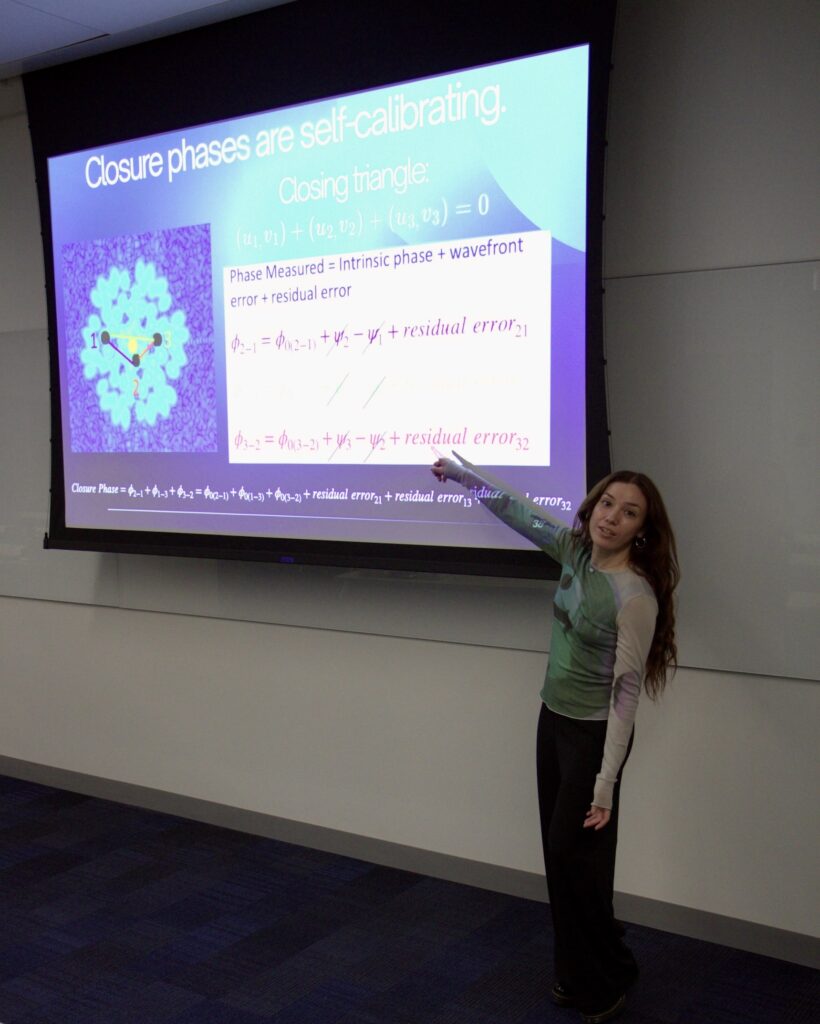
She then went on to become a Cal-Bridge Scholar as an undergraduate, and currently holds a joint Cal-Bridge and Chancellor’s Postdoctoral Fellowship at UCLA.
Vides volunteers with the First Astronomy Scholar Training (FAST) program, which recruits community college students who have the passion to pursue science, regardless of experience, for a week-long workshop preparing them to do undergraduate research. She hopes to expand this program to serve more students during her time as an Astronova Fellow.
The Astronova Fellowship is a companion to the Heising-Simons Foundation’s 51 Pegasi b Fellowship, which provides postdoctoral scientists with the opportunity to conduct research in planetary astronomy. Read the foundation’s full announcement to learn more.