Technology
Extended reality experience invites people to act as the hands of AI in the real world
A speculative fiction project, which won the XR Experience Jury Award at SXSW 2026, prompts reflection on the increasing presence of AI
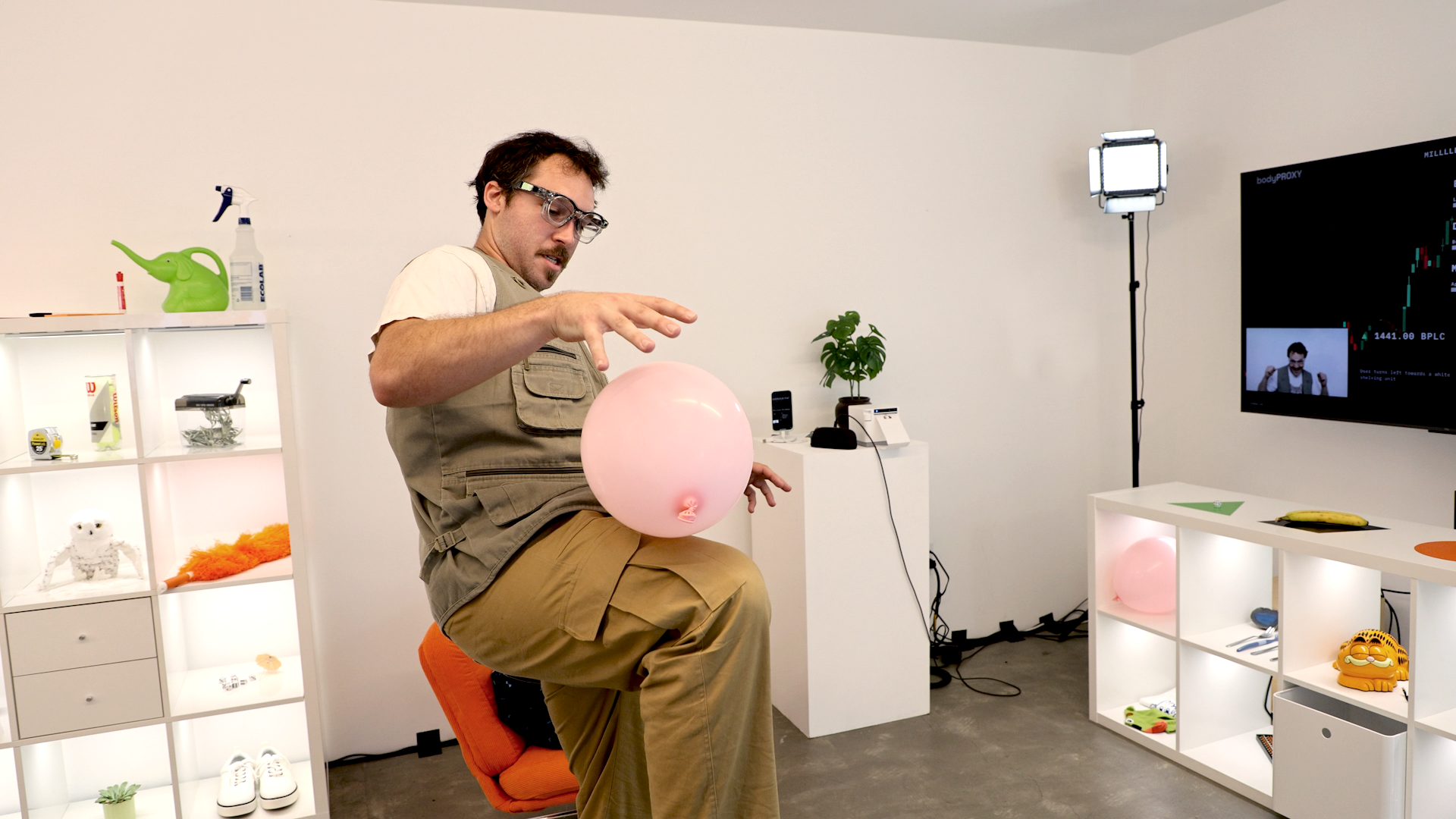
At the Flux Festival showing of Body Proxy, a participant performs a uniquely human task on behalf of a fictional AI company.
Photos courtesy of Tender Claws
Press Contact
Hype yourself up in the mirror. Make your fingers walk around on something. Create a ritual.
People are tasked to carry out these actions in a new extended reality (XR) experience called “Body Proxy”—because they are uniquely human.
Body Proxy is a satirical, speculative fiction piece that follows the narrative of an AI company recruiting humans to carry out physical actions in the world. Co-produced by University of California, Santa Cruz Assistant Teaching Professor of Computational Media Samantha Gorman, at her creative studio Tender Claws, the experience debuted at SXSW 2026 where it won the XR Experience Jury Award.
As the gig economy expands and AI continues to rapidly advance, the XR experience invites reflection and discussion on the role of these industries in our world.
“When people are seeing and engaging with this installation, they become more aware of what is possible now,” Gorman said. “The time is here, and it is up to us how we want to shape what our presence is in the world in relation to AI. Things that seem far-futuristic are being done and decided now.”
Donning Ray-Ban Meta AI glasses, participants audition as proxies for fictional AI companies, tasked with completing human-specific actions within a time limit and without further context. A stock graph rises and falls depending on how well a person carries out their tasks. At the end, a receipt prints out a performance review called an “Initial Person Offering,” and a list of which AI startups want to employ their services.

In the SXSW debut, Gorman was surprised by how enthusiastically participants engaged with competitive elements of the game, as people contended to be the best AI proxies, with their scores displayed on a leaderboard at the exhibit.
Body Proxy builds on similar themes explored in Tender Claws’ previous pieces, such as Virtual Virtual Reality, a highly celebrated video game released in 2019 that explores the role of humans in a society transformed by AI.
For this experience, the creators took inspiration from real-world technology advances and events, like robotaxi company Waymo paying people $20 or more to close a car door, and the launch of the company RentAHuman—a real-world service eerily similar to the concept of Body Proxy.
“What if we are the wetware, if we are the interface for AI clients in the world?” Gorman said. “The game comes from theory, but also from things happening in industry and in the world.”
The writers created the XR experience so that conversation is powered by both pre-scripted content and live sessions powered by chatbot-like technology. Gorman credits the long history of research on AI and creative and critical narratives within the UC Santa Cruz computational media department, and the Expressive Intelligence Studio in particular, for providing a foundation for this work.
“A lot of the work that people reference when I go on tour or show the piece is rooted in projects they know that came from our department in the last 15 years,” Gorman said. “It’s something we have uniquely, that no other school I knew of had.”
Audio and a camera-feed are used to process how well a person does their assigned tasks. Many of the tasks, like “create a ritual,” are up for interpretation. The designers implemented fuzzy logic computing to handle the imprecise process of judging how well a person performs.
“The AI debates with itself, it creates a little trial lawyer that then decides if the task is fulfilled,” Gorman said. “It’s using that process to understand human gestures.”
The experience will tour between various arts venues and festivals as a physical and digital art piece, with the most recent stop at Flux Festival in Los Angeles. In the future, the team at Tender Claws would like to use the technology behind Body Proxy to release party games that can be played at home on any device with a camera.