Student Experience
Engineering student wins NVIDIA Agents for Impact Hackathon
Preet Karia built an AI-powered tool to turn physics notes into 3D visualizations.
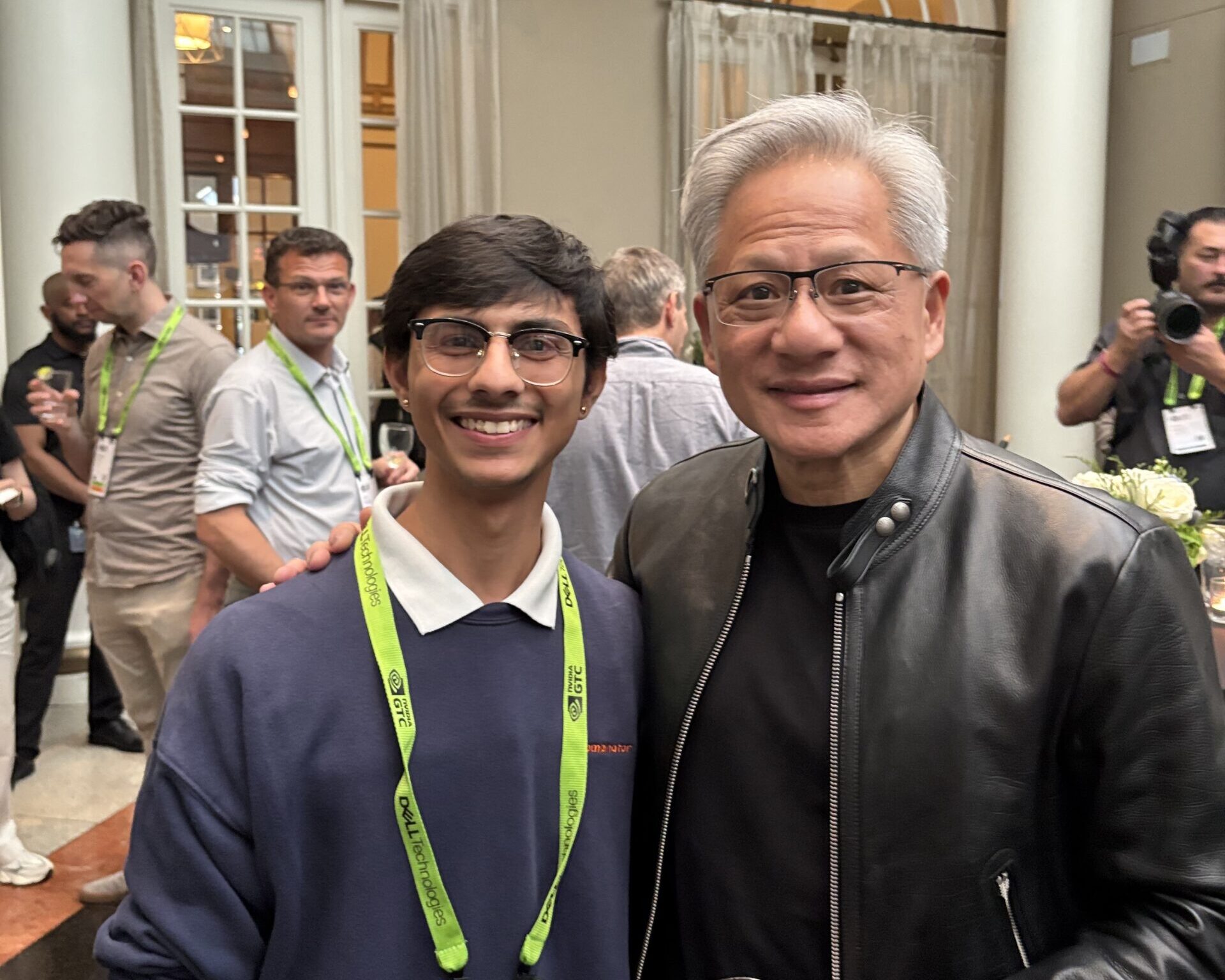
Engineering student Preet Karia with NVIDIA CEO Jensen Huang.
Preet Karia, a second-year robotics and computer science engineering student at the University of California, Santa Cruz, claimed first place at the NVIDIA GTC 2026 Agents for Impact Hackathon for creating an AI-powered tool called Loomin that turns physics notes into 3D visualizations.
This hackathon, hosted on March 19 at San Jose State University, was part of the larger NVIDIA GTC event, a conference that some call the “Super Bowl of AI.” After taking the gold in the competition among around 300 participants, Karia also got the chance to speak with NVIDIA CEO and Co-Founder Jensen Huang.
“I think last week I made some of the best decisions of my life,” Karia said. “We spoke for a couple minutes, I was asking him a bunch of questions and he was giving me feedback. And as a student, he also wanted to learn my perspective of how I use NVIDIA’s technologies.”
The idea for Loomin emerged from conversations with other participants at the hackathon. This helped identify a common frustration: engineering students struggle not with accessing information, but with developing intuition around visualizing and solving problems.
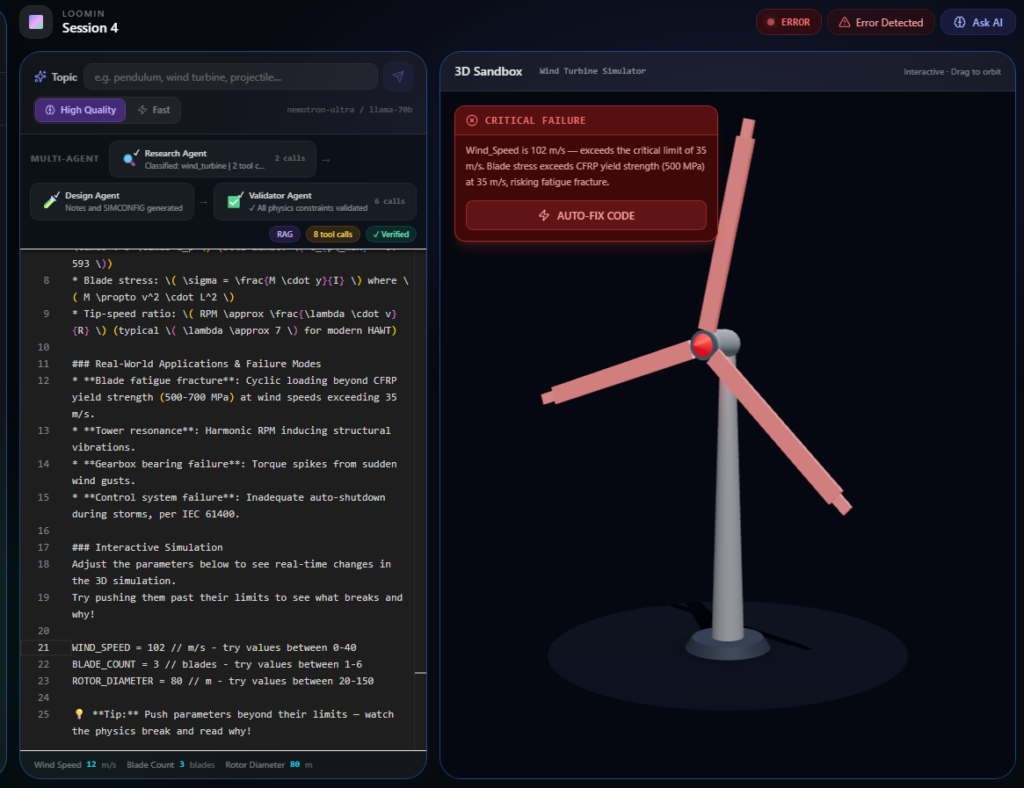
Loomin allows users to type in any physics concept and receive structured notes, real equations, and an interactive 3D model whose parameters can be adjusted in real time. When a simulation breaks, the tool explains what happened and why, offering students a hands-on understanding that static textbooks cannot provide.
“The idea was simply to break the machine,” Karia said. “The way I look at it, as students, we’re always told ‘Don’t do this, don’t do that,’ but they don’t explain why. This idea was to encourage students to play around with the parameters, break them, understand why they broke, what changed, and understand all the components and concepts behind that.”
Karia credits lab-based classes at Baskin Engineering, such as EC167 “Sensing and Sensor Technologies,” for imparting the value of using 3D renders as a learning tool.
Loomin delivers its results in under three seconds and is powered by NVIDIA’s Nemotron Ultra model for generation. It uses retrieval-augmented generation (RAG), a strategy for improving AI accuracy by using external sources, with a local physics knowledge base.
Karia is continuing to develop Loomin and is actively seeking feedback from students and educators on his project, and is interested in broadening its reach for anyone who works with 3D visualizations.
“I could see this as something that can be implemented within not just schools, but also industry as well,” Karia said.