Health
Three UC Santa Cruz professor-student teams win Keck Foundation funding
The program provides funds to support the career trajectories of early- to mid-career faculty and their graduate students.
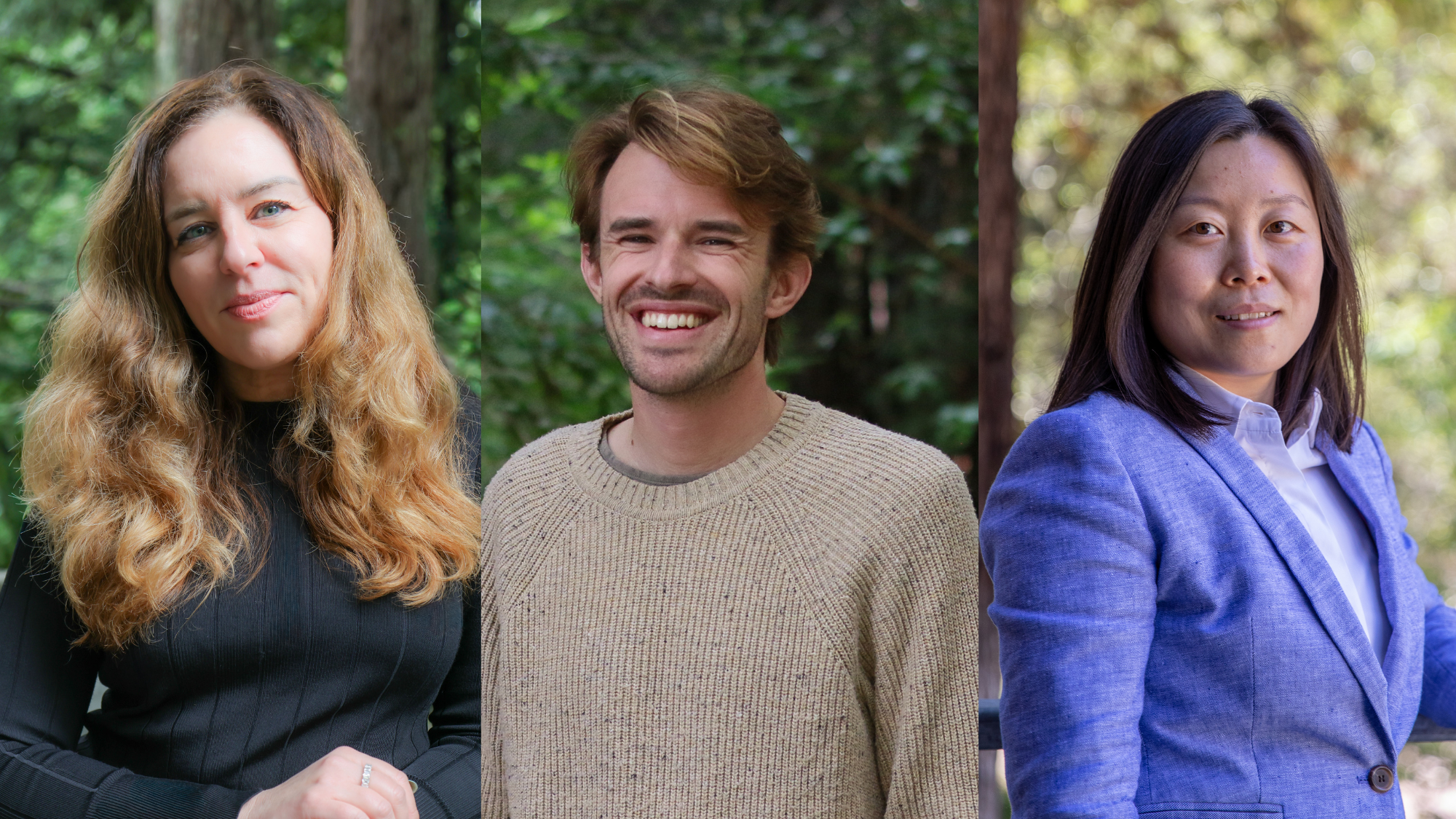
Professors Vanessa Jonsson, Jaron Mercer, and Aiming Yan.
Three professors at the University of California, Santa Cruz, and their Ph.D. student mentees will pursue high-impact basic science research with the support of the W. M. Keck Foundation’s Bridge Funding Initiative.
The program provides funds to support the career trajectories of early- to mid-career faculty and their graduate students who are especially vulnerable to sudden shifts in traditional funding mechanisms. Each faculty-student pair will receive $200,000 in grant funding for a two-year project.
The winning UC Santa Cruz teams are Assistant Professor of Biomolecular Engineering Vanessa Jonsson and Ph.D. student Divya Venkatraman, Assistant Professor of Chemistry and Biochemistry Jaron Mercer and Ph.D. student Cameron Paloutzian, and Assistant Professor of Physics Aiming Yan and Ph.D student Carlos Gonzalez.
A resource to understand ‘immune visibility’
Jonsson and Venkatraman will build the Human Immunome Atlas, an open, interpretable, basic-science resource for understanding the connection between the variability of a set of genes crucial to immune response—Human Leukocyte Antigen (HLA) genes—and the body’s ability to fight cancers and pathogens.
HLA genes form an important part of the human immune system by identifying and signaling which cells belong in the body and which don’t. How much information the HLA genes can present to the immune system varies vastly from person to person, a characteristic the researchers call “immune visibility.”
The researchers will use specialized AI for understanding proteins called protein language models (PLMs) and deep learning to quantify how immune visibility varies between individuals, and at the population scale. They will carry out three main elements of this project to get a full picture of how immune visibility impacts health.
The first is to map how recurring cancer mutations can present in HLA genes, identifying how different variations in the gene can influence potential cancer risk for individuals and populations. The second is to link how HLA genes influence susceptibility to major infectious agents like viruses and bacteria, and see what geospatial trends appear to identify if certain populations face unique immune vulnerabilities. Leveraging expertise in ancient DNA at UC Santa Cruz, the third goal is to extend this analysis to ancient human and pathogen genomes to understand how historical infections may have shaped immune diversity.
Accelerating enzyme engineering for new medicines and chemicals
Mercer and Paloutzian’s project seeks to radically speed up the way scientists teach enzymes— nature’s chemical workhorses—to perform new reactions, a breakthrough that could transform how medicines and chemicals are made. Instead of slowly testing enzyme variants one by one, the team will tie enzyme performance directly to the survival of a fast-replicating virus, allowing successful enzymes to automatically multiply. By harnessing this rapid, self-driving evolutionary process, the project aims to overcome one of the biggest bottlenecks in enzyme engineering: the time and effort required to discover enzymes that can efficiently carry out new chemistry.
The approach relies on continuous evolution using a harmless bacteriophage that infects bacteria and can generate vast numbers of genetic variants in a single day. To make this work for virtually any chemical reaction, the researchers must solve a key problem: how to measure, inside a living cell, how much of a given small molecule an enzyme produces. Their solution is a new class of biosensors that convert the presence of almost any target molecule into a simple biological signal—whether the virus survives and replicates or not—effectively letting evolution “read out” chemical success on its own.
The project will evolve enzymes to perform multi-step reactions used in making pharmaceuticals, replacing processes that are currently inefficient and wasteful. At the same time, the team will track how enzyme genes change during evolution using advanced DNA sequencing, creating massive datasets that show which mutations improve performance. Together, these insights could create a powerful feedback loop between enzyme design and evolution—opening the door to custom-built enzymes for nearly any chemical transformation.
Brain-inspired computing to lower energy consumption
Yan and Gonzalez aim to develop a new kind of ultra-efficient electronic building block for brain-inspired, or “neuromorphic,” computing—an approach designed to dramatically reduce the enormous energy demands of today’s artificial intelligence hardware. The goal is to create a device that can both store and process information in the same place, much like neurons and synapses do in the human brain. By harnessing unusual electrical behaviors in atomically thin materials, the research seeks to overcome a long-standing hardware limitation that forces computers to constantly shuttle data back and forth between memory and processors, wasting time and power.
At the heart of the effort are memristors—tiny electronic switches whose resistance can change and “remember” past activity. In this project, the memristor’s active layer is made from two-dimensional materials only a few atoms thick, which allows devices to be packed extremely densely while using very little energy. The researchers are focusing on a special property called ferroelectricity, in which internal electric patterns can be rearranged and remain stable without constant power. This effect enables fast operation, gentle read-out that doesn’t disturb stored information, and a range of intermediate states that more closely resemble how biological synapses behave.
What remains poorly understood is exactly how the material’s atomic structure influences its electrical performance while the device is operating. To answer this, the project will combine material growth with real-time, atomic-scale imaging of working devices, allowing researchers to directly observe how structural changes translate into useful computing behavior.
By linking how these materials are made, how they behave at the smallest scales, and how well they perform in devices, the project could provide a roadmap for building large, reliable neuromorphic systems. Beyond improving energy efficiency, the work may enable electronics that more faithfully emulate the adaptable, parallel nature of the brain—opening the door to faster, smarter, and far less power-hungry AI technologies.
Based in Los Angeles, the W. M. Keck Foundation was established in 1954 by the late W. M. Keck, founder of the Superior Oil Company. The Foundation’s grant making is focused primarily on pioneering efforts in the areas of medical research and science and engineering. The Foundation also supports undergraduate education and maintains a Southern California Grant Program that provides support for the Los Angeles community, with a special emphasis on children and youth. For more information, visit www.wmkeck.org.