Student Experience
Against all odds, popular math animator Grant Sanderson wooed into the redwoods
Mathematics Department convinced famous YouTuber to speak on campus, enthralling a full house with visualizations of high-dimensional geometry that powers large language models
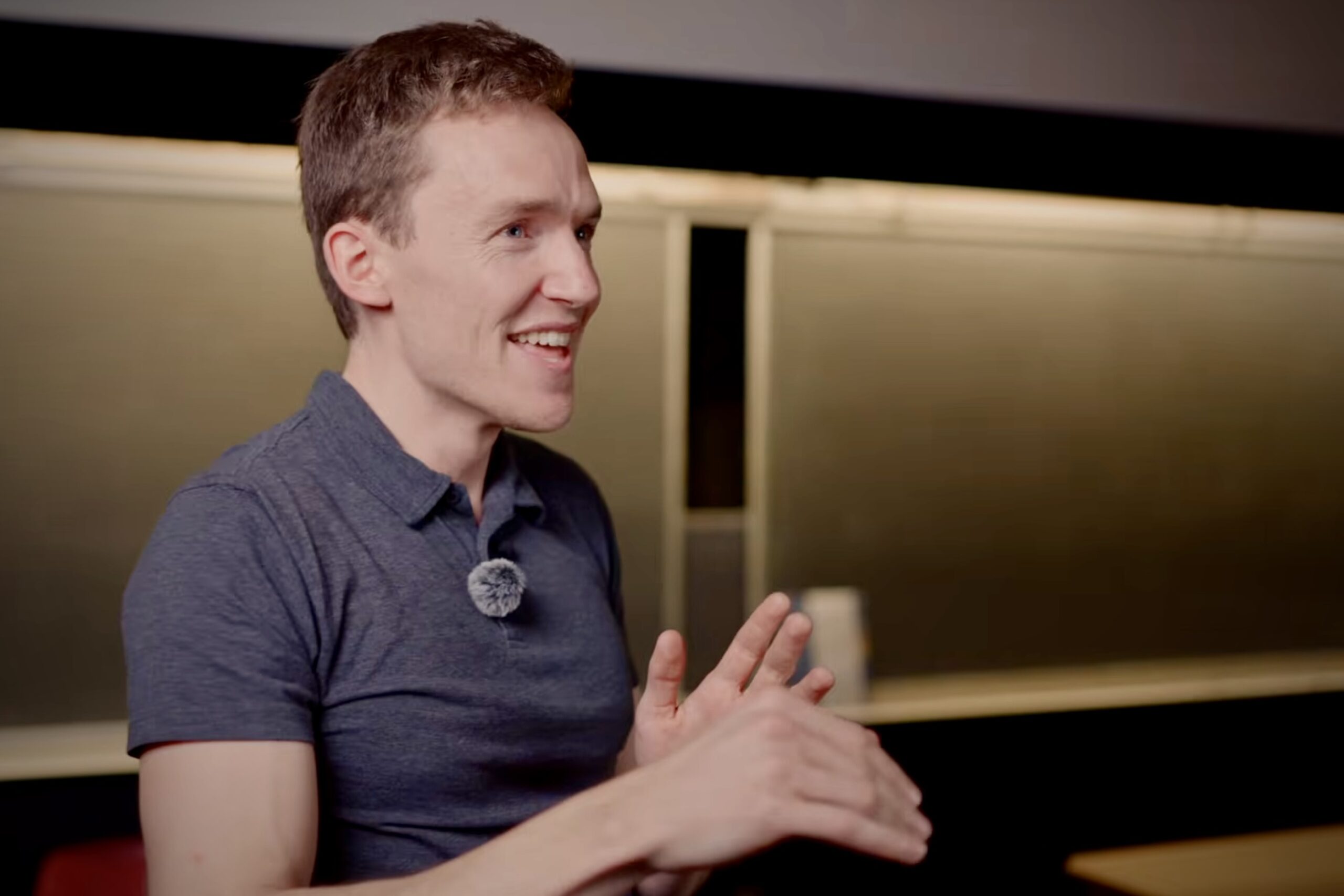
Sanderson, creator of 3Blue1Brown, entertained and educated a capacity crowd on the beauty and utility of higher-dimensional spheres.
The explosive growth of artificial intelligence platforms like ChatGPT, Claude, and Gemini has millions of users marveling at their capabilities, mostly without a fundamental understanding of what actually powers them. That lifeblood, as it turns out, is deeply rooted in advanced mathematics.
On a cold and rainy evening in mid February, hundreds of eager students and other members of the campus community crammed into Performing Art’s Media Theater to hear exactly how math factors into AI from one of mathematics’ most beloved internet ambassadors: Grant Sanderson, the creator of the hugely popular YouTube channel 3Blue1Brown.

“For a generation of students raised on Grant’s brilliant math visualizations, his campus visit was a ‘full circle’ moment,” said mathematics professor Pedro Fernando Morales-Almazan, who personally talked Sanderson into speaking at UC Santa Cruz on February 17. “Meeting a math-outreach hero in person was an unforgettable experience, especially for those whose passion for STEM was first sparked by his work.”
High-dimensional geometry
Sanderson studied math and computer science at Stanford University, and after graduating, worked for Khan Academy producing videos, articles, and exercises—primarily focused on multivariable calculus. Since the end of 2016, his primary focus has been on 3Blue1Brown and its associated projects. He has also contributed to a Netflix documentary on infinity and occasionally writes for the math and science magazine Quanta.
About five minutes into his talk at UC Santa Cruz, Sanderson demonstrated how mathematics is at the heart of AI by explaining the intersection of high-dimensional geometry and modern machine learning—the very engine that drives the platforms of Anthropic, Google, and Open AI.
For the uninitiated, thinking in three dimensions is intuitive. But conceptualizing spaces with hundreds or thousands of dimensions defies human comprehension. That’s where Sanderson’s signature animations came into play, by visualizing how high-dimensional geometry is precisely where artificial intelligence “lives.”
In the realm of machine learning, Sanderson said words, sentences, and complex concepts are translated into vectors, which are basically a sequence of numbers. These vectors are then plotted in a vast, high-dimensional space. How closely related two concepts are depends on the geometric distance and the angle between their respective vectors in this space.
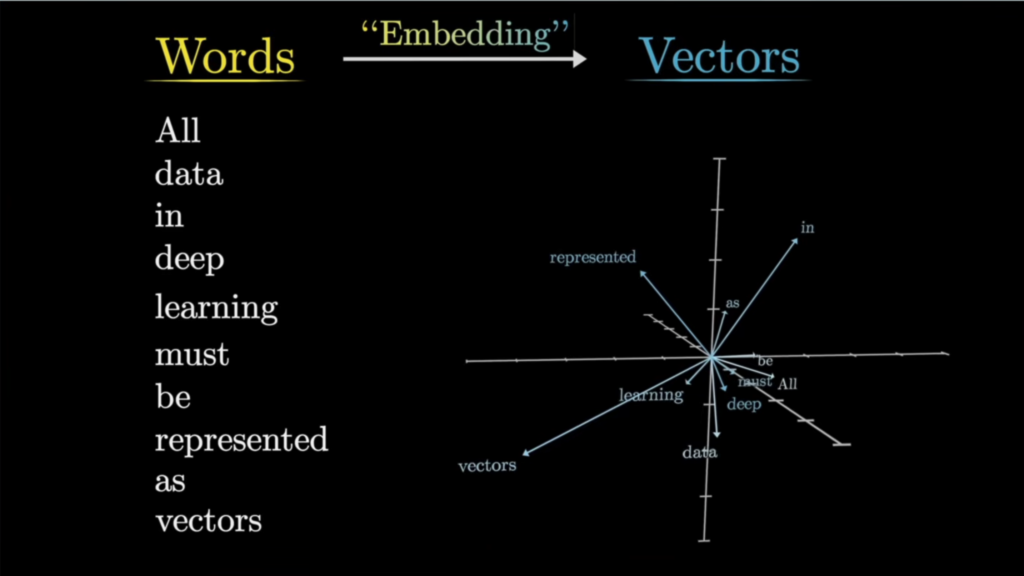
Sanderson guided the audience through the mechanics of how neural networks navigate this abstract geometry. He broke down the intricate linear algebra and multidimensional calculus that allow an AI model to predict the next word in a sentence, recognize patterns, and mimic human reasoning.
By visualizing the transformation of space—showing how networks warp and fold these multi-dimensional coordinate systems to separate and categorize data—Sanderson deftly lifted the veil on the black box of artificial intelligence. It was no longer algorithmic magic, but a logical application of pure mathematics.
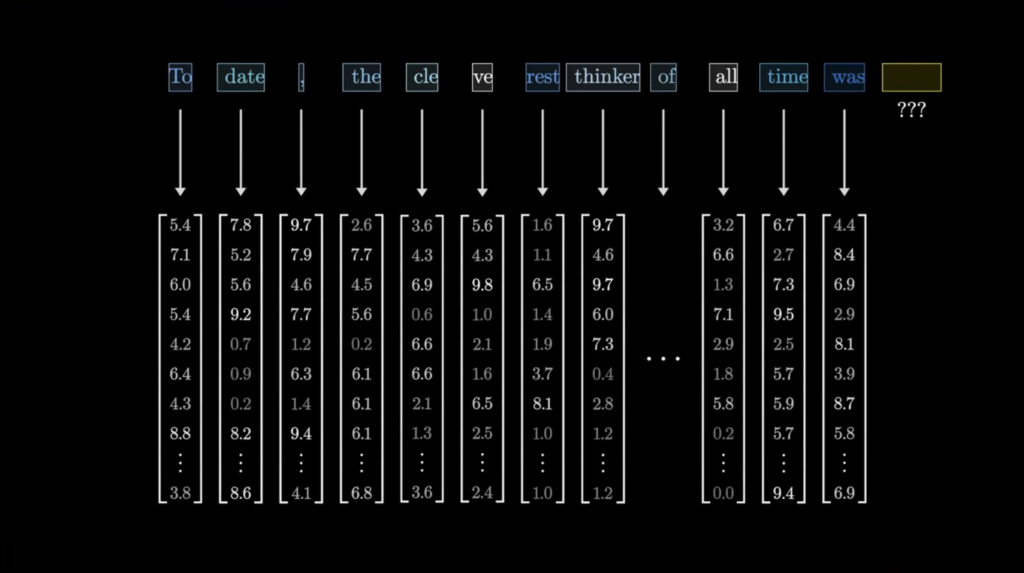
“To try to understand what these models are doing, it ends up being really fruitful to think about those long lists of numbers that the words turn into as being points in a space,” Sanderson said. “That’s all to say, high dimensions are useful.”
The charm campaign
While the presentation itself was a masterclass in making complex concepts accessible, the story of how the event came together is a testament to the hustle and dedication of the UC Santa Cruz Mathematics Department. The lecture was not planned months in advance; rather, it was a last-minute win pulled off in under 48 hours.
Just two days prior, on a Sunday, word reached Morales-Almazan that Sanderson was in the Bay Area and actively looking for a venue to host an impromptu talk. Morales-Almazan did not hesitate and reached out to Sanderson that very morning to pitch UC Santa Cruz as the ideal host.
Initially, Sanderson was leaning elsewhere, having already pinpointed another location for his presentation. But Morales-Almazan was determined, and through persistent communication, he assured Sanderson of the passion and vibrancy of the campus community.
The tenacity paid off. Sanderson was convinced and confirmed he would come down to Santa Cruz for his talk. The resulting turnout delivered on Morales-Almazan’s promises: Despite heavy rain that Tuesday evening, and incredibly short notice, the room was filled to capacity with a captivated audience—plus dozens more standing outside.
“I was part of a group of people huddled in a hallway outside this lecture hall listening in because the main hall was already full,” an attendee commented on the YouTube video of the talk.
One for the books
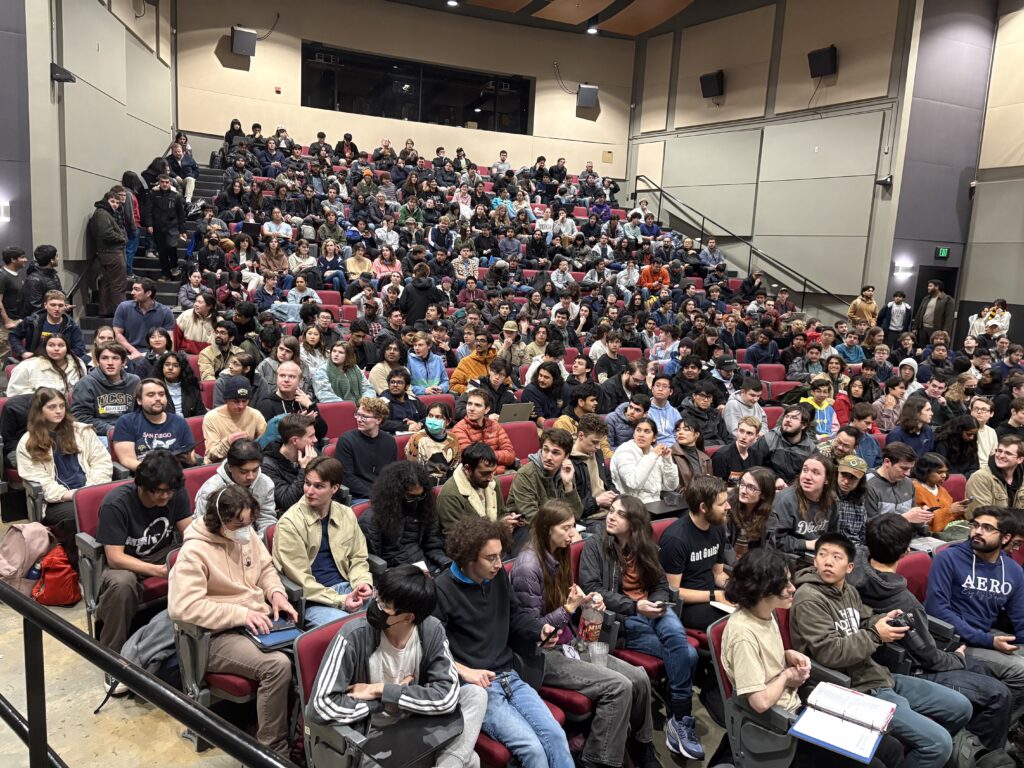
Audience members lined up afterward to meet Sanderson and get his autograph. “Mastery on a thing is great to have, but being able to convey these abstract difficult ideas to normal people like me is totally a different thing,” another commenter on YouTube wrote. “We are so happy that a person like you is out there.”
The standing ovation Sanderson received was a tribute to the elegance of mathematics and his engaging style of teaching. It was also a well-deserved victory for the Mathematics Department and Morales-Almazan’s weekend wheeling and dealing that transformed a passing tip into a memorable math immersion for the campus.
“There’s a lot of beautiful items you can come across in math. But actually recognizing that beauty sometimes requires looking at something that was very familiar—whether that’s the factorial, or the area of a circle—and putting it in the context of something more general.”
Reflecting on the evening, Morales-Almazan quoted the mathematician Richard Hamming, who said “the purpose of computing is insight, not numbers.” In today’s world of algorithms and computer operations, Morales-Almazan said mathematics provides us with a window to understand how the virtual world operates.
“The root of the word ‘mathematics’ comes from the Greek máthēma (μάθημα) meaning ‘that which is learnt,’” he explained. “Mathematical outreach and visualizations, such as Grant’s, help us to learn and understand more about the world around us, going beyond numbers and computations.”