Arts & Culture
Humanities EXPLORE Fellows bridge history, culture, and community
This year’s Humanities EXPLORE Program fellows are adventurous and ambitious, transcribing 300-year–old texts, helping to revitalize forgotten languages, exploring archives, and learning from faculty mentors. This winter, two fellows were given film cameras to preserve and share their experiences of connection, creativity, and purpose.
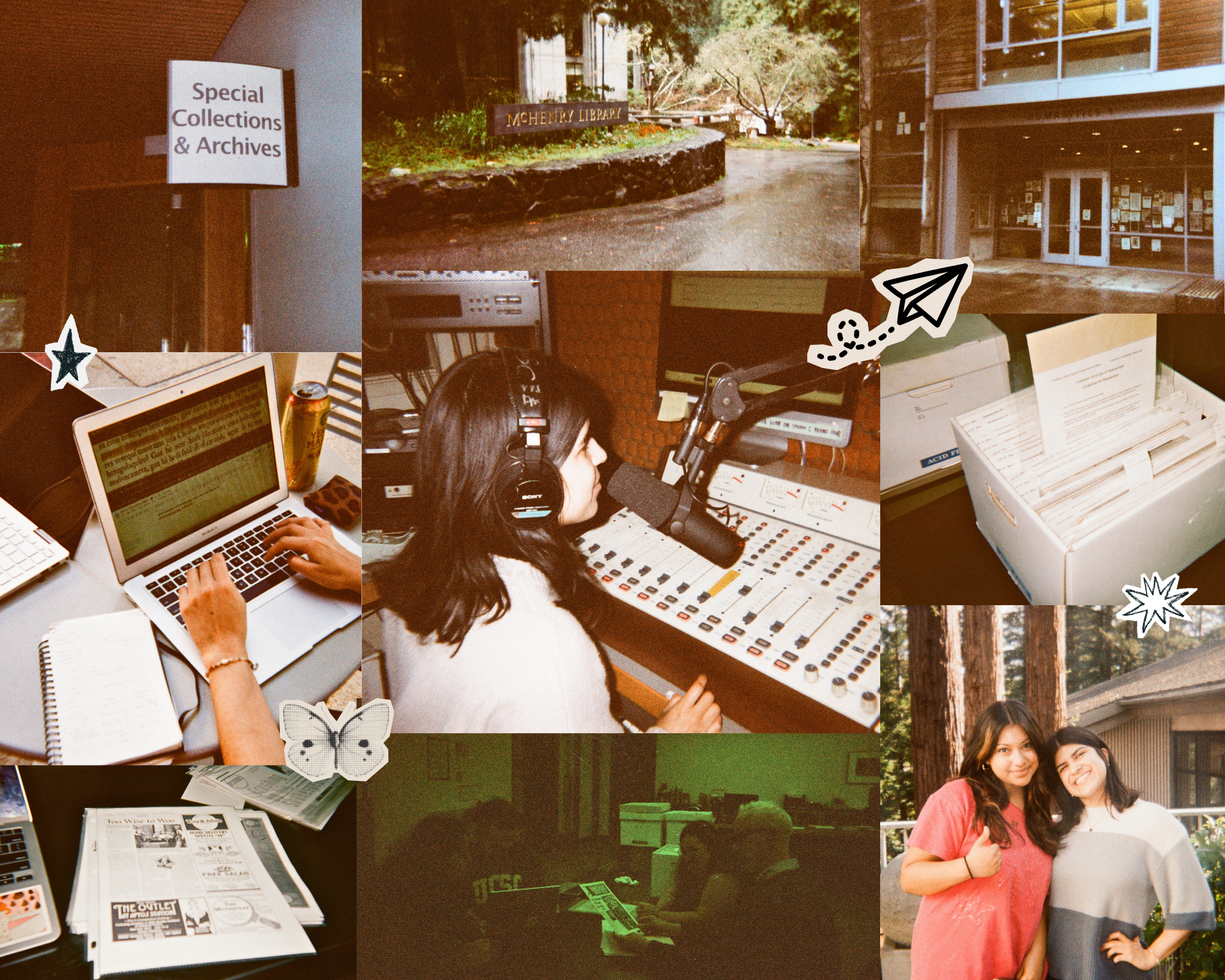
This photo collage is composed of snapshots by Humanities EXPLORE undergraduate researchers. Maddie Haddad (literature major) shares photos as a research assistant on Professor Sean Keilen's faculty-led project, Shakespeare in Santa Cruz. Fatima Sanchez (linguistics major) showcases her experience as a research assistant on Professor Christian Ruvalcaba's faculty-led project, Teguima Research and Revitalization Working Group.
This year’s Humanities EXPLORE Program fellows are adventurous and ambitious, transcribing 300-year–old texts, helping to revitalize forgotten languages, exploring archives, and learning from faculty mentors.
This winter, two fellows were given film cameras to preserve and share their experiences of connection, creativity, and purpose. Alongside these images, their words reveal the profound ways in which undergraduate research in the humanities has shaped their education at UC Santa Cruz while building bridges to rewarding careers.
They are part of a cohort of 60 undergraduate fellows from across the division who joined the EXPLORE Program to serve as paid research assistants working on more than 21 faculty projects.
Fellows regularly meet with their faculty mentors and research teams throughout the academic year. Twice each quarter, fellows from all projects are invited to cohort meetings led by program staff for reflection and professional development workshops.
An additional 14 students are expected to join EXPLORE as part of the Linguistics department’s Undergraduate Research Fellows in Linguistics and Language Science program this spring.
Maddie Haddad: Sifting through the archives of Shakespeare Santa Cruz
As part of her fellowship on the project “Shakespeare in Santa Cruz: A Performance History”, literature major Maddie Haddad, a third-year transfer student, has been helping prepare materials for the upcoming Santa Cruz Shakespeare summer festival under the mentorship of Professor of Literature Sean Keilen.
Her work at McHenry Library involves sorting through performance histories, photographs, audience accounts, and set designs from past productions of Much Ado About Nothing and Macbeth, the two plays featured in this year’s catalogue.
Her film camera photographed an image of Keilen, herself, and her colleagues sorting through performance history. “I think it captures what we do simply but thoroughly and highlights the collaborative element that we are involved in,” Haddad said.
The research involves not only gathering materials but interpreting them—drawing connections between past productions and the upcoming season, and thinking about how performance traditions evolve over time.
“This experience has taught me how to work with primary sources, construct narratives, and think more critically about how history is preserved and interpreted,” Haddad said.
The archive has revealed how literary culture is sustained not only through texts but through the collective labor of people who preserve and interpret them. The work supports her future goals of publishing and archiving. As a literature student accustomed to reading and writing, she found that the tactile work of sorting, filing, and preserving documents has added another dimension to how she thinks about scholarship.
“This experience has made me feel more connected not just to my UC Santa Cruz community, but to the Santa Cruz community as a whole,” Haddad said. “Working in the archive has shown me that literature and performance are part of a living, local history shaped by real people. It has also allowed me to feel like I am part of something bigger than myself, participating in a collective work of preserving cultural memory.”
Fatima Sanchez: Shining light on a nearly lost language in northern Mexico
Fatima Sanchez, a fourth-year linguistics student, is a research assistant fellow helping to bring new life to Teguima, a nearly lost language once spoken by the Opata people in northern Mexico. Over time, because of colonization, forced assimilation, and the destruction of Indigenous texts, the language largely disappeared.
The group she works with—the Teguima Research and Revitalization Working Group at UC Santa Cruz—is reconstructing and reviving parts of that language.
“I’ve come to understand just how long and painstaking language revitalization work really is,” said Sanchez, who is working under the mentorship of Professor of Languages and Applied Linguistics Christian Ruvalcaba.
“What makes Teguima particularly challenging is that there is very little existing documentation and no known living speakers,” she said. “Typically, linguists can interview speakers directly, but that’s not possible in this case.”
This experience pushed Sanchez to think carefully about what ethical and thoughtful revitalization looks like under these circumstances. Instead of working with living speakers, the researchers have had to approach the language like detectives.
As a visual record of her experience, Sanchez snapped a photo of her notes and her computer screen covered in transcription documents and spreadsheets. She also took a picture of the Arte, an 18th-century text that translates religious writings from Spanish into Teguima. The images capture what her work looks like from day to day: piecing together a language from historical fragments.
Sanchez’s work involves several forms of careful analysis. She transcribes historical documents written with unusual spelling systems and symbols and converts them into formats that linguists can study. She also compares Teguima words with related languages in the Uto-Aztecan language family, looking for cognates—similar words that may reveal meanings or sound patterns. In addition, she studies features such as stress patterns to better understand how the language may have been spoken.
In other words, the researchers are rebuilding a language from fragments, much like archaeologists reconstruct an artifact from broken pieces.
The working group includes linguistics researchers at UC Santa Cruz, students like Sanchez, and members of the Opata community who want to reconnect with their ancestral language.
One of the goals is not just academic study but language revitalization—helping descendants of the Opata people reclaim parts of their cultural heritage.
“Meeting Opata community members virtually was an important moment for me,” she said. “Getting to see the behind-the-scenes of their vision for language revitalization, including the Lotería project (in which we translate the 54 cards of the traditional Lotería game from Spanish to Teguima, changing the artwork to reflect Opata culture, and include pronunciations for each word) and the thoughtful decisions they’re making about how to present and represent their language and culture, was inspiring.”
The fellowship directly supports Sanchez’s career goals. She is considering graduate school in linguistics and continuing with language revitalization projects, focusing on indigenous languages and contributing to the preservation and ethical reconstruction of endangered cultural heritage.
The Humanities EXPLORE program is led by the Humanities Division with strategic support from the Humanities Institute and is funded by the Mellon Foundation, The Helen and Will Webster Foundation, the Humanities Division, The Humanities Institute, and private donors.