Campus News
Science Division awards honor staff and faculty for outstanding work and dedication
Alyssa Danielli, department manager in astronomy and astrophysics, and Carrie Partch, professor of chemistry and biochemistry, are the respective recipients of the division’s 2024-25 Outstanding Staff and Faculty Awards
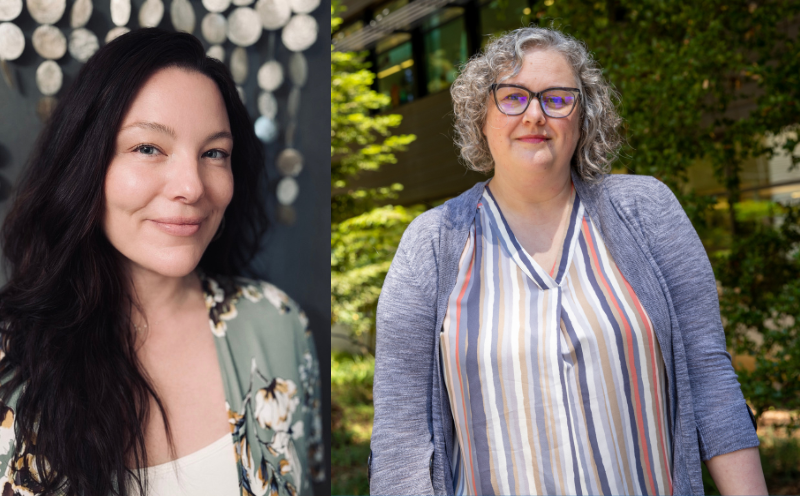
Alyssa Danielli and Carrie Partch
Alyssa Danielli, department manager in astronomy and astrophysics, and Carrie Partch, professor of chemistry and biochemistry, are being honored by the Science Division for their outstanding work. Danielli and Partch are the respective recipients of the division’s 2024-25 Outstanding Staff and Faculty Awards.
Alyssa Danielli
Danielli joined the Department of Astronomy & Astrophysics in January 2024, during a critical time when administrative support was stretched thin. Despite the challenging circumstances and limited resources, she quickly established herself as an indispensable member of the department—handling every task with remarkable competence, owing to her professional skills and personal qualities.
Soon after joining the department, Danielli was charged with coordinating the admissions process and recruitment visit for the newest cohort of graduate students. Since then, she has personally planned and coordinated department visits and orientations for the incoming cohort of graduate students. She has also played a key role in ensuring graduate students can navigate their degree requirements. In the absence of a permanent graduate advisor, Danielli handled university requirements for student qualifying exams, student funding, and graduation deadlines.
In addition, Danielli has been essential to students’ roles as teaching assistants, from matching them to appropriate classes to managing absences. She also provides critical support for all departmental events, from major outreach initiatives like public lectures, to community activities for members of the department and the University of California Observatories.
The service Danielli and her team provide across the department spans critical operational support, including ensuring postdoctoral researchers are properly appointed, onboarded, and fully integrated into the community. “Alyssa is the heart and brain of our department,” said professor and department chair Jonathan Fortney. “She makes sure that our community feels nurtured, but also ensures that deadlines are met, and that we have a productive workplace for everyone.”
Danielli said what motivates her most is the opportunity to support the extraordinary people in her department who are pushing the boundaries of discovery every day, calling their dedication “inspiring and contagious.”
“Helping create an environment where groundbreaking research can thrive, while supporting the next generation of scientific leaders in astronomy and astrophysics, is deeply meaningful to me,” Danielli said. “Being able to contribute, behind the scenes, to work that expands our understanding of the universe is both humbling and rewarding, and I feel incredibly lucky to be part of such an innovative, dedicated, and collaborative community”
Carrie Partch
Partch, a professor at UC Santa Cruz since 2011, researches the fascinating and critical question of how biological systems keep time. Her work on molecular clocks has been transformative: Partch has been one of the few researchers in the field to use structural biology and biochemistry to explain the molecular basis for the maintenance and adaptation of circadian rhythms.
She has been recognized many times over for her contributions to the molecular understanding of circadian rhythms: by the Society for Research on Biological Rhythms in 2016, the Biophysical Society in 2017, and the National Academy of Sciences in 2022. She has published over 60 peer-reviewed journal articles on research and reviews.
In July 2024, Partch was named one of 26 top scientists chosen by the Howard Hughes Medical Institute (HHMI) to be HHMI investigators—one of the highest honors for a U.S. health researcher, recognizing exceptional creativity and groundbreaking research accomplishments. Specifically, the Partch Lab strives to understand the molecular basis of circadian timekeeping by studying the structure, dynamics, and interactions of dedicated clock proteins, with the goal of discovering and developing innovative strategies to treat a broad spectrum of human diseases.
“It is likely that therapies for sleep disorders and jet lag will be developed using the molecular insights Carrie’s research group has uncovered over the years,” her nominators said. “She is an outstanding teacher and mentor, and she gives tirelessly of her time to serve our department, university, and scientific community.”
In the classroom, Partch has taught over 1,000 students in the BIOC 100 biochemistry and molecular biology series, many of whom still keep in touch with her after graduation or entering medical school. Partch also designed a graduate course on grant writing in biomedical science (CHEM 230) that helped students apply for fellowships from the NIH, bringing in almost $2 million in funding and helping to catalyze their careers.
Partch is also driven by determination and dedication to scientific discovery. In 2020, at the height of her career, she was diagnosed with amyotrophic lateral sclerosis—also known as Lou Gehrig’s disease—and had to start stepping back from the lab bench. But she continues to oversee her lab’s research, collaborate with peers on new studies, and share her insights with the public and press with the help of assistive technologies.
“This recognition from my colleagues in the Science Division here at UC Santa Cruz is a real honor—it’s been a fantastic place to do research and engage with the community.”
Partch and Danielli will receive formal recognition during a divisional meeting, have their names added to a plaque in the dean’s office lobby, and will be featured on the Science Division’s website.