Earth & Space
Ashesh Chattopadhyay wins Sloan Fellowship to build advanced AI for Earth-system modeling
Assistant Professor of Applied Mathematics Ashesh Chattopadhyay will build AI models to project extreme Earth-system events.
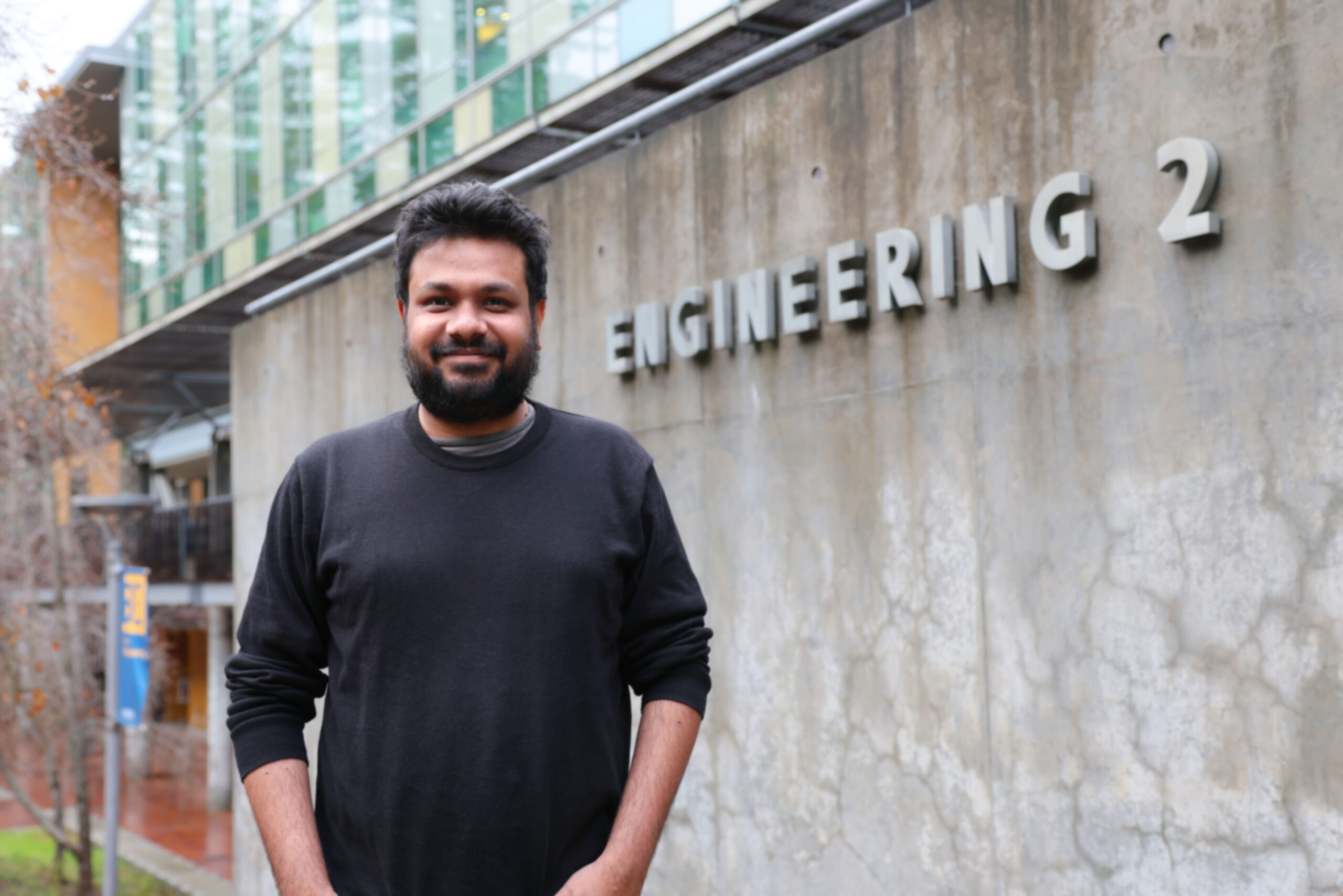
Photo by Carolyn Lagattuta
University of California, Santa Cruz Assistant Professor of Applied Mathematics Ashesh Chattopadhyay will build AI models to project extreme Earth-system events with the support of the highly competitive 2026 Sloan Research Fellowship.
Chattopadhyay’s research group at the Baskin School of Engineering focuses on theoretical advancements in AI to better understand how these models work and where they fail. This helps them build tools for modeling and simulation of large-scale scientific systems such as the Earth system.
“We need a strong fundamental theoretical understanding of these AI models before we can use them to capture unseen extremes—which are what scientists and forecasters care most about,” Chattopadhyay said.
Modeling weather and climate requires representing the complex, large- and small-scale physics that govern Earth’s atmosphere, ocean, land, cryosphere, and more. Traditional physics-based models face computational limitations because they require large supercomputing resources. They also often struggle to accurately resolve the wide range of scales involved in these physical processes, like the range from seconds to decades in time and micrometers to kilometers in space. This forces scientists to make ad-hoc approximations, which leads to uncertainty in future projections of the Earth-system dynamics.
Chattopadhyay’s research builds AI models for weather and climate that use historical observation-based weather data to avoid these approximation issues while using less computing and energy resources to operate.
However, more research is needed to get these models ready for use by forecasters, scientists, and engineers in operational and mission-critical settings. AI models of chaotic systems like weather and climate at long time scales are limited by “hallucinations,” which are projections of physically-impossible scenarios. Additionally, because these AI models are trained on past observations of the Earth system, they have a harder time projecting how it may behave under different future scenarios—a concept called the out-of-distribution generalization problem.
The Sloan Foundation Research Fellowship will support Chattopadhyay in building models that address these issues in AI for Earth system modeling. His work integrates turbulence physics, rigorous mathematical analysis, and deep learning theory for better training of AI models. The resulting tools are physically-consistent and stable, allowing for long-term projections of unseen scenarios in the atmosphere, ocean, and the coupled climate. This enables the prediction of extreme events that may occur on Earth.
The models are extremely computationally efficient, requiring less energy resources to run. They are also architecture agnostic, meaning they can work with any hardware, cloud-service provider, and operating system.
Founded in 1934 by industrialist Alfred P. Sloan Jr., the Foundation is a not-for-profit grantmaking institution that supports high quality, impartial scientific research; fosters a robust, diverse scientific workforce; strengthens public understanding and engagement with science; and promotes the health of the institutions of scientific endeavor.