Technology
Three UC Santa Cruz professors and one student recognized as Santa Cruz Works ‘Titans’
This recognition celebrates their contributions to the region’s technology, innovation, and entrepreneurship ecosystem.
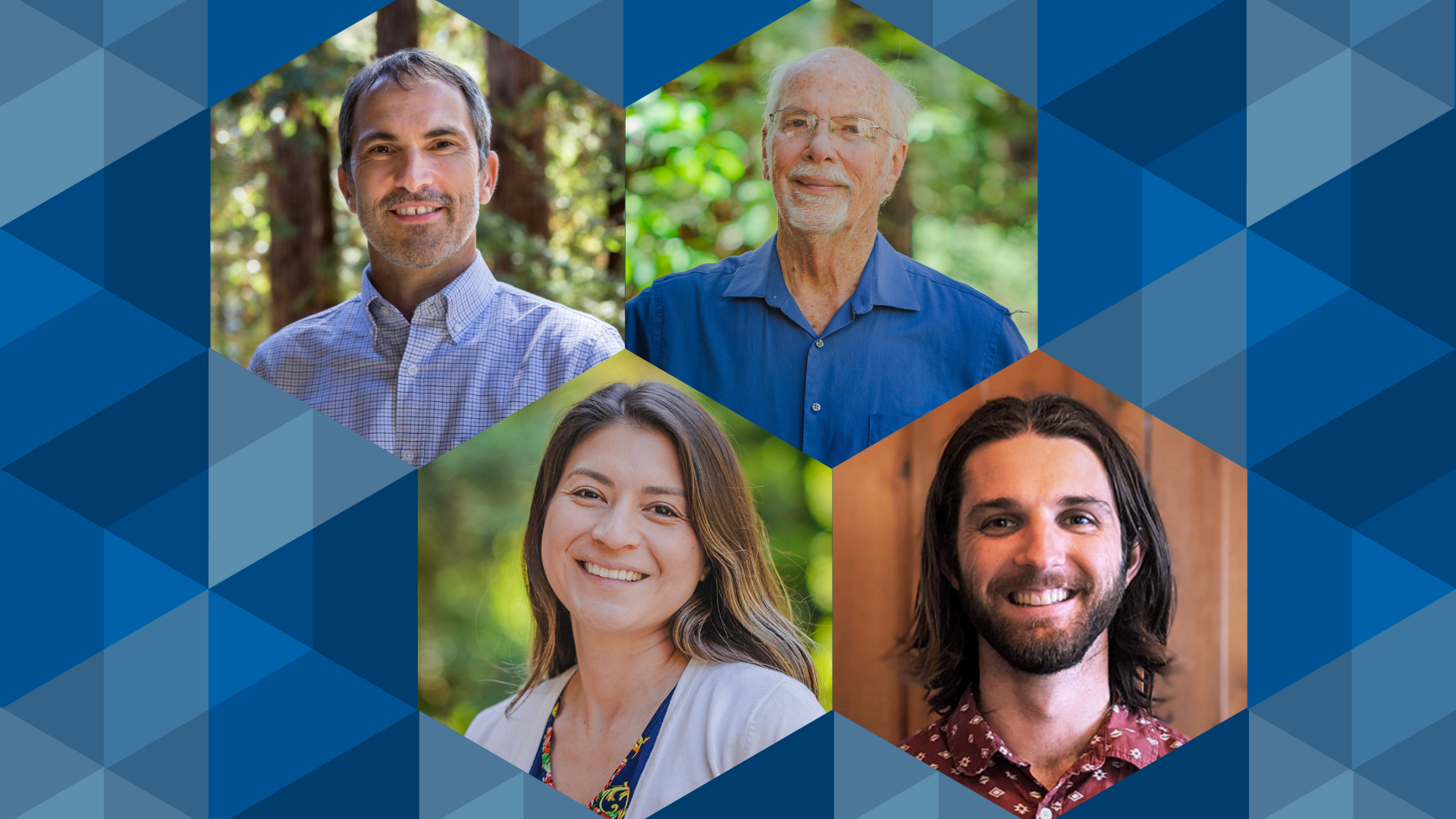
Santa Cruz Works recognized Holger Schmidt, David Deamer, Marcella Gomez, and Ash Robbins as "Titans."
Four University of California, Santa Cruz, community members have been named ‘Titans’ by Santa Cruz Works in recognition of their impact on the Monterey Bay region’s technology, innovation, and entrepreneurship ecosystem.
They are Distinguished Professor of Electrical and Computer Engineering (ECE) Holger Schmidt, Professor Emeritus of Biomolecular Engineering David Deamer, Associate Professor of Applied Mathematics Marcella Gomez, and alumnus and current Ph.D. student Ash Robbins, all associated with the Baskin School of Engineering. The Titans will be celebrated at an event at the Kuumbwa Jazz Center on January 28, 2026.
Holger Schmidt
Schmidt, who holds the Narinder Kapany Chair of Optoelectronics, is a longtime expert in the fields of optics and photonics—the physics of light and how to manipulate it for practical applications. This has included many projects in the biomedical field, like creating highly sensitive and accurate devices for disease detection and monitoring called optofluidics chips.
Schmidt is the founder of Fluxus, ultrasensitive detection technologies for researchers, doctors, patients, and industry partners. Originally a UC Santa Cruz spinoff, Fluxus was acquired by Fujirebio (an H.U. Group company) in 2022. The company aims to market and supply the technologies for medical diagnostics worldwide.
He is recognized for “pushing diagnostics and life-science measurement forward with technology that can detect tiny amounts of biological signals, including protein and RNA. His optofluidic work traces back to UC Santa Cruz innovation and has been tied to commercialization efforts through Fluxus and broader diagnostics adoption.”
David Deamer
Deamer is a longtime leader in the field of DNA sequencing, having contributed extensively to the invention of nanopore sequencing, one of the main methods used by scientists worldwide to read DNA and RNA. The concept was Deamer’s idea and was developed primarily by him along with fellow UC Santa Cruz emeritus professor of biomolecular engineering Mark Akeson and Harvard’s Daniel Branton.
The team’s work was licensed by the company Oxford Nanopore Technologies, leading to the creation of the MinION, the only hand-held device for genetic sequencing, priced at a fraction of the cost of other sequencers. UC Santa Cruz and its Genomics Institute remain global leaders in technology development for genomics.
Deamer was recognized as “widely known for pioneering nanopore sequencing concepts that enabled portable genetic sequencing in the real world. His impact extends beyond the lab: Deamer was also elected a Fellow of the National Academy of Inventors, with Santa Cruz Works highlighting how his work helped make genomics more accessible and globally deployable.”
Marcella Gomez
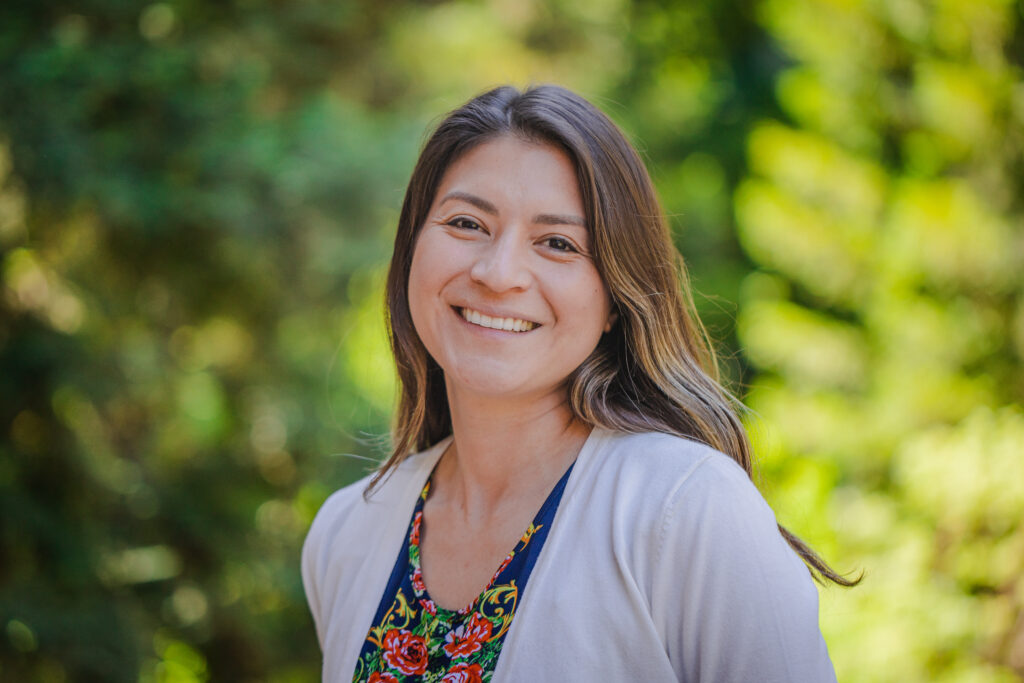
Gomez is an Associate Professor of Applied Mathematics and the Baskin School of Engineering’s Associate Dean for Diversity, Equity and Inclusion. As a first-generation college graduate and longtime advocate for broadening participation in engineering, she is passionate about improving pathways in engineering for under-resourced communities through bold campus initiatives and empowered leadership.
Gomez’s expertise lies in bio-control, and her recent research efforts include leading the AI development for a wearable device that integrates bioelectronics and machine learning to optimize the wound healing process.
Gomez was recognized for “coupling research (including AI-driven control strategies applied to areas like wound healing and cell-based therapies) with ecosystem-building through programs and mentorship that expand access for local students, including first-generation scholars.”
Ash Robbins

Robbins is a Ph.D. student in the Dynamics, Autonomous Navigation, Surface Engineering and Robotics (DANSER) Lab, led by ECE Professor Mircea Teodorescu. His work focuses on developing AI technology that interfaces with brain organoids, which are tiny models of brain tissue grown in the lab to study brain development, function, and disease.
Robbins is also the co-founder and Chief Technology Officer of Immergo Labs, a company developing VR/AR technology and other tools for physical rehabilitation.
He was recognized for his work “at the strange (and increasingly important) intersection of living intelligence and machine intelligence. In 2025 he was recognized for first-author research demonstrating ‘goal-directed learning’ in cortical organoids, while also building tools that expand access to physical rehabilitation care, especially for remote communities.”
Robbins graduated from UC Santa Cruz in 2018 with a bachelor’s in robotics engineering, and aims to complete a Ph.D. in electrical and computer engineering in 2026.
UC Santa Cruz faculty who have been recognized as Santa Cruz Works Titans include: professors Chris Beamer and Richard Ed Green (2024), Marco Rolandi, Sri Kurniawan, David Lee (2023), Dean of the Baskin School of Engineering Alexander Wolf and Executive Director of the CITRIS Initiative for Drone Education and Research Becca Fenwick (2022), Aviv Elor (2021), and David Haussler (2020).