Earth & Space
How quiet galaxies stay quiet: cool gas feeds black holes in ‘red geysers’
New paper led by UC Santa Cruz undergraduate suggests that long-dormant galaxies deemed to be dead may actually be stunted by the dynamics of supermassive black holes at their center

Illustration of the underlying astrophysical processes that suppress star formation in red geyser galaxies, according to this new study. Galaxy interactions transfer cool gas clouds that fall into these galaxies (panels 1 and 2). This cool gas slowly falls in toward the galaxy’s center, where it can help feed the central supermassive black hole and sustain its activity (panel 3). The resulting black hole feedback heats gases in the galaxy (panel 4), suppressing star formation and sustaining the red and dead galaxies that we observe today (panel 5).
Press Contact
Key takeaways
- Some “dead” galaxies are not as dormant as they seem. In some cases, slow-moving cool gas is quietly flowing inward toward central, supermassive black holes.
- This inward flow appears to help power gentle but long-lasting black hole activity that keeps new stars from forming and stunts the growth and evolution of these galaxies.
- These systems seem to cycle through gas inflow, black hole feedback, and self-regulation, allowing them to stay quiet for billions of years.
Astronomers have long puzzled over how some massive galaxies stop forming stars and remain dormant for billions of years—even when they still contain gas that could, in principle, fuel new stars. A new study of a rare class of galaxies known as “red geysers” offers fresh insight into how these systems regulate themselves, revealing that slow, organized inflows of cool gas may be feeding central supermassive black holes and sustaining the gentle feedback that keeps star formation shut down.
Red geysers make up only about 6 to 8 percent of nearby quiescent galaxies, but they have attracted growing attention because of their unusual signatures. First identified in data from the Sloan Digital Sky Survey’s Mapping Nearby Galaxies at Apache Point Observatory (SDSS-IV MaNGA), these galaxies show faint, extended outflows of ionized gas stretching tens of thousands of light-years.
“These galaxy-scale winds are thought to be signatures of supermassive black hole activity in the center,” said Arian Moghni, a third-year undergraduate studying astrophysics at the University of California, Santa Cruz. “The puzzle is how these black holes get their fuel. Previous studies had shown signatures of inflowing gases, but the source of these gases and their connection to the supermassive black hole were not well understood.”
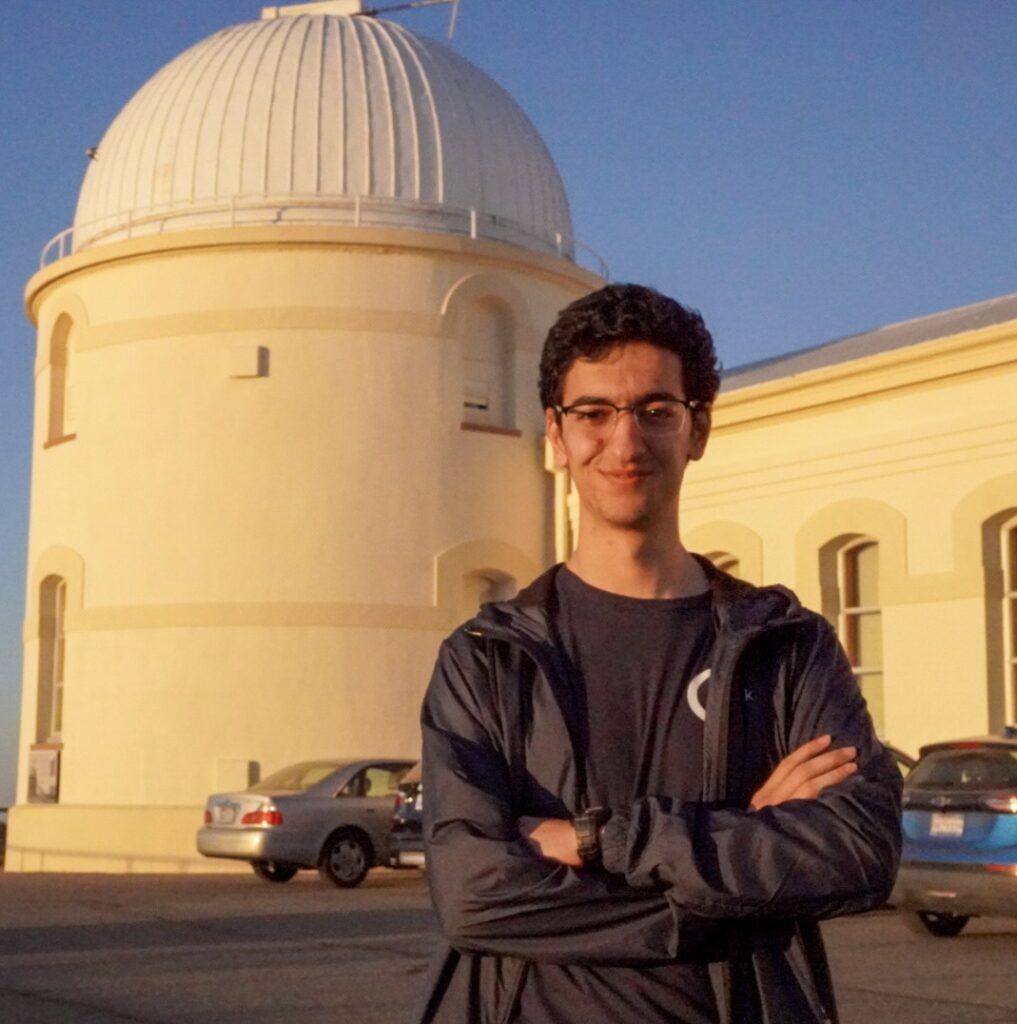
Moghni is the lead author of the study, which is under review at The Astrophysical Journal and was presented on January 8 at the American Astronomical Society’s annual meeting in Phoenix.
To investigate, Moghni and his co-authors examined how cool, neutral gas moves inside 140 red geyser galaxies observed by the MaNGA survey, which uses detailed spectroscopic measurements to map motions across entire galaxies. The team focused on a spectral feature known as the sodium D (Na I D) absorption line, a reliable tracer of relatively cool gas at temperatures of roughly 100 to 1,000 kelvin.
By modeling these spectral lines across each galaxy, the researchers measured both the speed and the degree of random motion in the cool gas. Instead of falling in and coming out, as in disk structures, the team finds that most of these gases are slowly drifting inward toward the galaxy’s center at about 47 kilometers per second, consistent with earlier studies.
Surprisingly, this inward motion is far slower than expected: the gas is moving at only about 10 percent of the speed it would reach if it were freely falling under gravity. The gas also appears to move in an unusually orderly way. Its random motions are much weaker than those of the surrounding stars, indicating that the cool gas is flowing coherently rather than being strongly stirred or disrupted.
The study also uncovered a clear connection between gas inflow and black hole activity. About 30 percent of the galaxies in the sample are detected in radio wavelengths, a sign of ongoing activity from their central supermassive black holes. In these radio-detected systems, there is significantly more inflowing cool gas—about one-third greater in projected area—than in red geysers without radio emission.
“It’s really exciting to see how closely the inflowing cool gas is linked to the supermassive black hole activity,” Moghni said. “This gas seems to be funneled in toward the galaxy’s center, where it can help feed and sustain the black hole’s activity.”
Even more dramatic differences appear when the galaxies’ environments are taken into account. Red geysers that show signs of interactions with nearby companions or evidence of past minor mergers host much larger reservoirs of inflowing gas than isolated systems. In interacting galaxies, the area covered by infalling cool gas is, on average, about 2.5 times larger than in red geysers that appear to be alone. This finding points to galaxy interactions as a key mechanism for replenishing the gas supply.
“Minor mergers and interactions are an efficient refueling process,” Moghni said. “They deliver cool gas that falls in and feeds the black hole, which can then allow them to continue to suppress star formation for long timescales.”
Taken together, the results support a cyclical model of how red geysers—and perhaps other quiescent galaxies—maintain their dormant status. Gas driven inward by interactions and internal processes settles toward the galactic center, where it powers low-level black hole activity. That activity then generates feedback capable of suppressing new star formation. Over time, the cycle allows massive galaxies to remain largely inactive, even if the raw ingredients are available.
By directly tracing the motion of cool gas across entire galaxies, the study provides rare observational evidence of this delicate balance in action. It also highlights the value of large, spatially resolved surveys such as SDSS-IV MaNGA, which enable astronomers to connect black hole activity, gas dynamics, and galactic environments in unprecedented detail.
Moghni’s co-authors include Kevin Bundy, associate professor of astronomy and astrophysics at UC Santa Cruz; Kyle Westfall, associate project scientist at Lick Observatory; and university researchers at Johns Hopkins, Arizona State, San Diego State, and UC San Diego.