Arts & Culture
New book chronicles the life of an enslaved man on the run in the 1700s
David George was born enslaved in Virginia in 1742, but he never gave up on his fight for freedom. Running by night, fording rivers and crossing borders, George embarked on a decades-long odyssey in and out of captivity that carried him thousands of miles. Those repeated getaway form the heart of The Escapes of David George: An Odyssey of Slavery, Freedom, and the American Revolution (St. Martin’s Press), a forthcoming book by History Professor Gregory O’Malley.
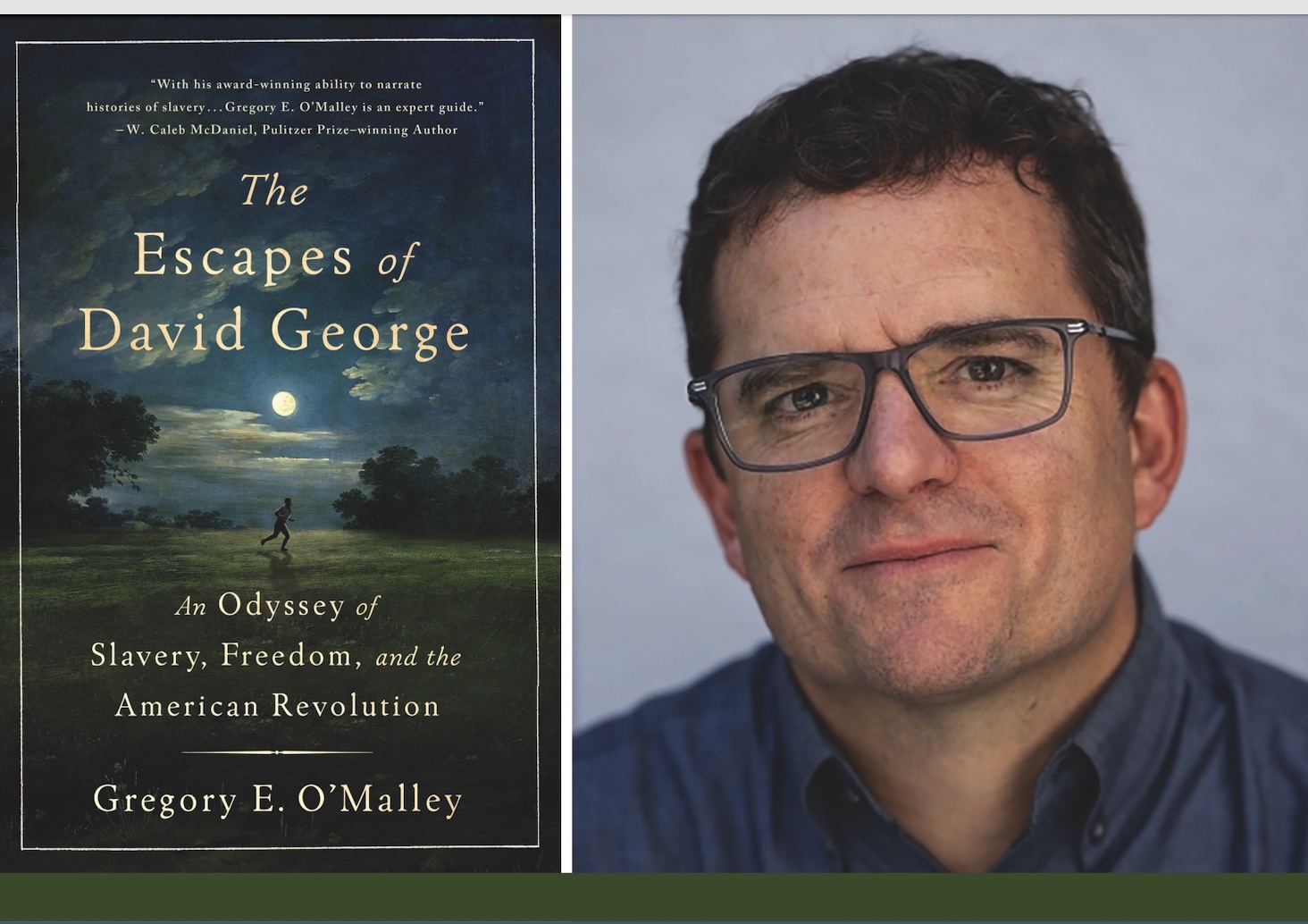
History Professor Gregory O'Malley will read from his new book, The Escapes Of David George, at Bookshop Santa Cruz on Feb.2
David George was born enslaved in Virginia in 1742, but he never gave up on his fight for freedom.
At age 19, he slipped away from a brutal enslaver, fleeing the plantation around midnight and heading southwest. Running by night, fording rivers and crossing borders, George embarked on a decades-long odyssey in and out of captivity that carried him across multiple colonies and thousands of miles.
Those repeated getaways, from frontier farms to escaping captivity in the Muscogee Creek nation, form the heart of The Escapes of David George: An Odyssey of Slavery, Freedom, and the American Revolution (St. Martin’s Press), a forthcoming book by History Professor Gregory O’Malley.
The book launch takes place at Bookshop Santa Cruz on Feb. 2. Advance registration is available for this free event, which is sponsored by The Humanities Institute.
O’Malley’s book is already receiving widespread acclaim. Henry Louis Gates Jr., a renowned scholar and host of PBS’s Finding Your Roots, praised it as “a gripping, novelistic study of David George’s life and travels.”
The Escapes of David George is a departure from O’Malley’s first book, Final Passages: The Intercolonial Slave Trade of British America, 1619-1807 (University of North Carolina Press, 2014) which charts the major routes of the intercolonial slave trade, using largely impersonal sources such as traders’ letters and port records.
In most cases, names are not listed in those journals. Even basic identifying details about the enslaved people aboard the ships have not survived.
The new book is far more intimate. Drawing on archival materials, including one of the earliest surviving first-person accounts of a fugitive enslaved person in North America, O’Malley reconstructs a remarkable life.
In the process, he forces readers to rethink their notions of freedom and the values underlying the American Revolution itself because David George made his final escape from slavery by running to the British Army during the Revolutionary War.
“As we approach the 250th anniversary of the Declaration of Independence, it felt like the right moment to look at the Revolution from a very different perspective,” O’Malley said. “What did freedom mean to someone who was enslaved? For David George, the rhetoric of liberty sounded very different than it did for white revolutionaries.”
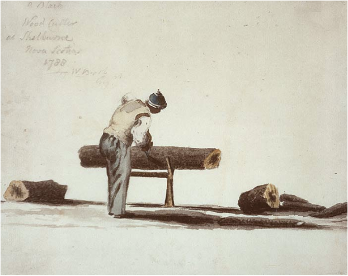
A life on the run
O’Malley first encountered David George’s story in a 10-page account published in the Baptist Annual Register in the 1790s. Two white ministers recorded George’s oral testimony in London in 1792, after he had survived slavery, war and exile.
The account is brief and fragmentary, but it predates most other published narratives of enslaved runaways by generations.
“Publishing fugitive narratives through the antislavery movement was very much an antebellum phenomenon – Frederick Douglass in 1845, Solomon Northup in 1853, and Harriet Jacobs in 1861,” O’Malley said.
David George first ran away in 1762 or 1763. His document reveals the scale of what George endured at a time when there was no Underground Railroad, no free states and no organized abolition movement — only fleeting opportunities, personal judgment calls and constant danger.
“There were individuals who thought slavery was wrong, and that may have helped him in certain moments,” O’Malley said. “But there was no organized movement among white people to oppose slavery when he first ran away in the 1760s.”
Notably, the surviving account does not dwell on the details of George’s escapes. Instead, George speaks at length about religion, family and community. He recounts brutal violence in his childhood but focuses more on how he became a Baptist preacher, married, raised children, and built congregations even while enslaved.
“One of my arguments is that he was also trying to escape slavery on a spiritual and social plane,” O’Malley said. “He couldn’t find a permanent way out before the war, and that makes his story of building a family and congregation under slavery incredibly instructive for understanding how enslaved people survived such a dehumanizing institution.”
Picking sides in the Revolutionary War
The American Revolutionary War created a new, perilous opening for George and his family.
In 1779, George sought refuge with the British Army, which offered emancipation to enslaved people who fled rebel slaveholders as a strategy to weaken the patriot cause. George’s last enslaver, the fur trader George Galphin, was aligned with the Revolution. When British forces neared his plantation, George led dozens of members of his congregation in a daring mass escape to reach the redcoats.
“From David George’s perspective, the rebelling Americans were not on the side of freedom,” O’Malley said. “Living behind British lines after their escape, David George and his family feared every advance of American forces that brought the danger of re-enslavement. That’s uncomfortable for American mythology, but it’s essential to reckon with.”
George spent the remainder of the war behind British lines, fearful of American victory.
At one point, stricken with smallpox as American forces advanced, he persuaded his wife to flee with their children and leave him behind to die.
As O’Malley writes in the book:
“Believing David would die anyway, the family honored his wishes with the heartbreaking decision to flee. They left him with simple food and the makings of a fire. “I had about two quarts of Indian corn, which I boiled,” he remembered, but even that did not last. “I ate a little, and a dog came in and devoured the rest.” Out of food, sapped by the pox, and beset by enemies and a hungry dog, George had good reason to think, “I should have died.”
But he was wrong.”
George survived, evaded capture and eventually reunited with his family.
When the British lost the war, George and several thousand other formerly enslaved people evacuated with them, leaving the United States for Nova Scotia. Life there was harsh and discriminatory, but George expanded his work as a Baptist minister, preaching throughout Nova Scotia and New Brunswick.
After a decade, he emigrated again — this time to Sierra Leone, an experimental British colony in Africa, founded on anti-slavery principles and the only place in the empire where slavery was illegal.
Journals kept by the colony’s British governor describe long conversations with George, including debates over religion, conducted as near equals — glimpses of the confidence and authority he developed through decades of survival.
George died in Sierra Leone as a free man and religious leader.
After nearly a decade of work on the book, O’Malley hopes that readers will come away with a deeper understanding of the many ways enslaved people resisted slavery, not only through dramatic escape but through perseverance, faith, family and community.
“David George’s life shows that the meaning of the Revolution was a matter of perspective,” O’Malley said. “He associated the Revolution with slavery rather than liberty.”
As he writes in the book, David George “is not a household name, but his exploits rival those of Revolutionary War heroes for daring and commitment to liberty. … The escapes of David George were plural because his will to resist captivity was bottomless, yet colonial America offered no logical place for a fugitive to go.”