Arts & Culture
Art confronts climate: A creative force in the environmental conversation
Groundbreaking art and science collaborations are reimagining how we understand—and survive in—a warming world.
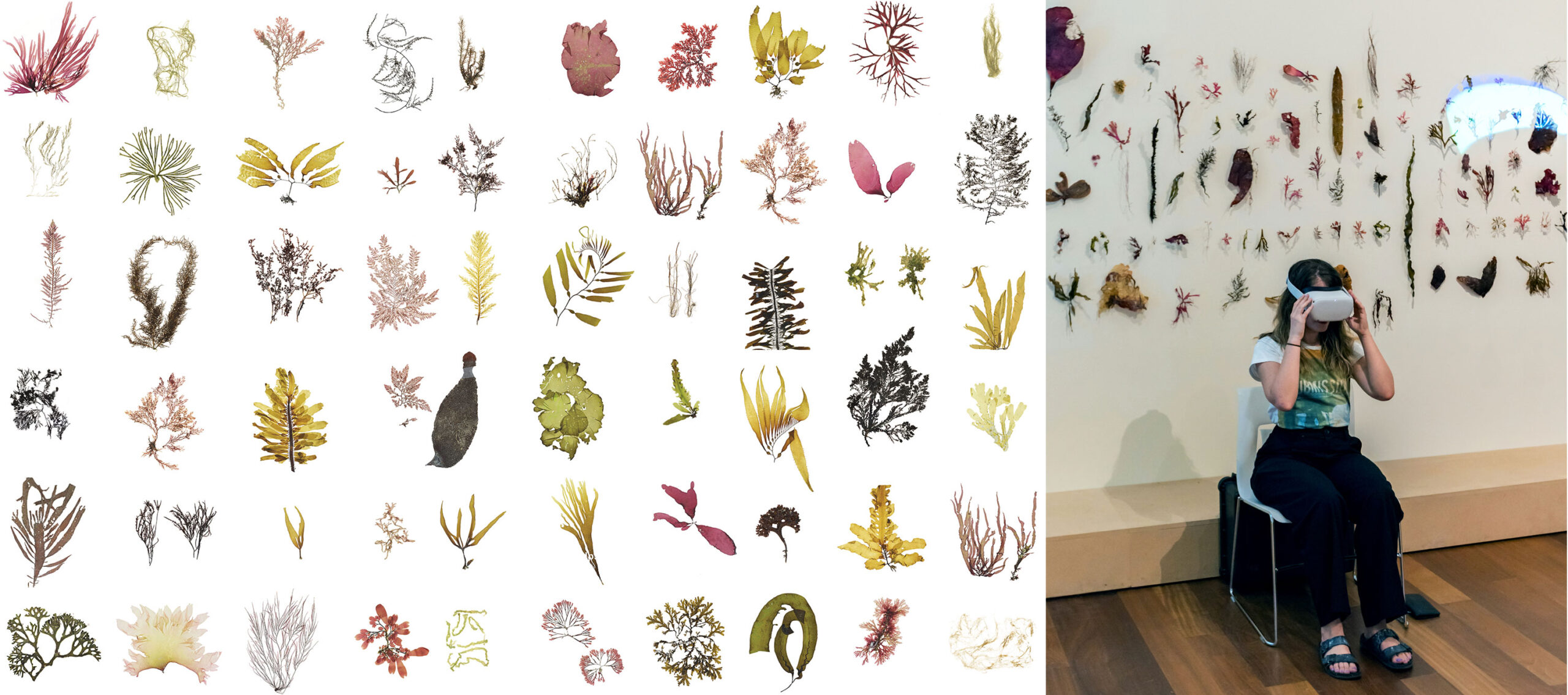
Jennifer Parker, 100 Years of Seaweed & Kelp, Marine Algae Wallpaper, Cameron Art Museum, Wilmington, North Carolina
Nestled in a redwood forest atop a hill overlooking the Pacific Ocean, UC Santa Cruz stands out not just for its remarkable setting, but for its unconventional approach to research and higher education. Since its inception 60 years ago, the university consistently strives to support socially-engaged collaborations between traditionally distinct disciplines.
“I think it’s the Santa Cruz spirit,” said Jennifer Parker, professor of art and founding director of OpenLab, a collaborative research center supporting interdisciplinary innovation in the arts, sciences, and technology. “This campus has always celebrated its difference,” she said. “There’s a freedom in shaping something new, rather than fitting in.”
Where some institutions might have shirked that reputation, UCSC leaned in, rewarding professors for creative, interdisciplinary research and education and encouraging student activism. The result can be seen in UCSC’s rich ecosystem of art and science collaborations that are addressing some of the biggest challenges facing society today. That includes climate change, the effects of which Santa Cruz is already feeling, with forests on fire, streets flooding, and roads washing away into the sea.
Facing a challenge as big as the climate crisis requires new ways of thinking and seeing. Though their disciplines are conventionally seen as distinct, artists and scientists alike ask questions, make observations, and interpret findings. Where science systematically and empirically investigates to draw conclusions, art engages and moves people through felt expression. Art can transform raw data or an abstract idea into a tangible, viscerally understandable experience. Together, art and science can drive collective action and reshape our understanding of how we interact with the world around us, and each other.
From a 15-foot augmented reality sculpture of a global ocean current to imaginative visual interpretations of marine mammal vocalizations, here are some of the visionary art and science collaborations flourishing at UCSC.
Jennifer Parker and Karolina Karlic
When UCSC’s Genomics Institute building opened in 2019, Parker and Karolina Karlic, associate professor of art, merged their passions for socially engaged art to create Intersecting Data Fields, an installation and gallery space in the new building. Using photography — an important tool for both science and art that transforms the way we see the world — the two envisioned a site-specific installation together where Karlic made portraits of the Institute’s scientists and photographed objects that had personal significance to them. Together, Parker and Karlic collaborated on the conceptual framework for the project where Parker’s sculptural pieces and Karlic’s photography converged, hanging throughout the halls of the building. The works explore the impacts of the Institute’s research and the diversity of the people doing it.
Parker launched OpenLab to dissolve barriers between disciplines, giving artists opportunities to tell stories that spark curiosity and build empathy for ideas like environmental change. With a practice rooted in sculpture and new media, she ran the experimental Mechatronics research group from 2009-2016, integrating mechanical, electronic, and information technologies to create multimedia art. One of Parker’s current projects is The Algae Society, a bioart and design lab composed of an international group of artists, scientists, and designers creating work — like a stop motion animation inspired by two scientists’ desert ecology and algal research in Joshua Tree National Park, or blown glass sculptures of intricate seaweed forms reimagined by AI — to expand people’s understanding of the interdependence of all life on this rapidly changing planet.
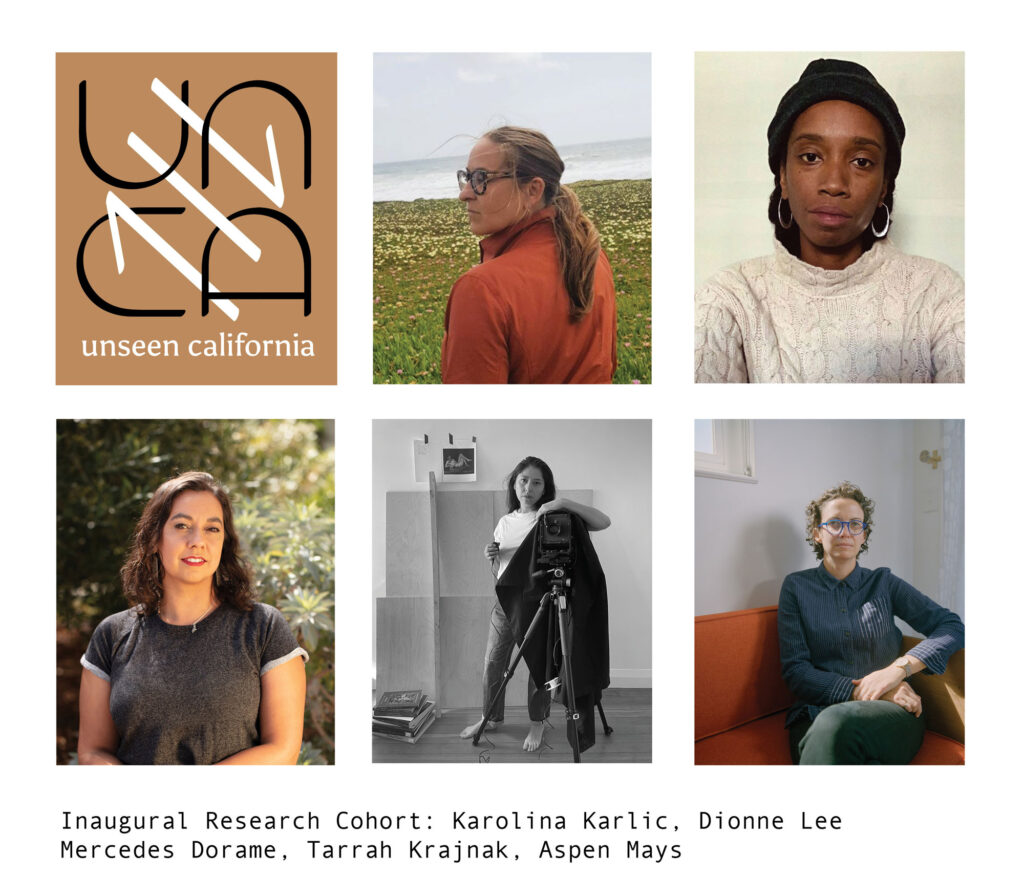
Karlic, who is also the art and science director of the Kenneth S. Norris Center for Natural History, aims to bring art and science research together to explore our relationship to place in the post-Industrialized world. As the founding director of Unseen California, she leads a research initiative and artist in residence program that integrates arts, sciences, and humanities to explore environmental and social issues across California. Based in the UC Natural Reserve System, the largest network of field stations in the world, Unseen California supports field-based arts research, teaching, public programming, and the creation of site-specific artworks that highlight the state’s cultural and ecological landscapes.
California’s creative capital spans from fashion and film, to agriculture, and technology. “It’s enormous, and I think we’re just starting to recognize that,” Parker said. “The role that art plays within a research institute as creative capital for understanding knowledge is huge.”
Karlic has already seen the impact of this shift in interdisciplinary thinking on students using archives and ecological field research to redefine what arts field research can be. As the director of the Graduate Studies Environmental Art + Social Practice MFA program, she has also seen a growing support network of faculty in the Environmental Studies, Ecology and Evolutionary Biology, and Humanities who want to engage with the arts in a more direct manner.
Art is more than just a commodity that belongs in galleries, Karlic said. “I think of these interdisciplinary collaborations as a way of changing the siloed ways of thinking current western culture is structured and addressing some of the most pressing questions of our time with a multitude of perspectives which are in my opinion our only way forward .”
micha cárdenas
An augmented reality video game, a science fiction novel, a 3D-printed conceptual particle accelerator — micha cárdenas’ work transcends mediums, disciplines, and boundaries. As the director of Critical Realities Studio, a hybrid studio/lab for critical theory and art practice, and professor of performance, play and design, and professor of critical race and ethnic studies, cárdenas’ multidisciplinary work focuses on virtual and augmented reality, critical race and ethnic studies, environmental justice, digital arts and media, gender studies, and transgender theory. The questions that unite cardenas’ practice and guide her work come from studying not just science and theory, but also activism.
cárdenas was inspired to create her latest project after reading a 2022 scientific paper stating that just 1.5 degrees Celsius of global warming above pre-industrial levels would set off a series of catastrophic ecological tipping points. “It was something I just wanted to shout from the rooftops,” said cárdenas. “It’s important for artists to be doing work about climate change or engaging with different questions in science because most people are not reading scientific journals,” she said, “and I wanted everyone to know that we are on this very dangerous precipice.”
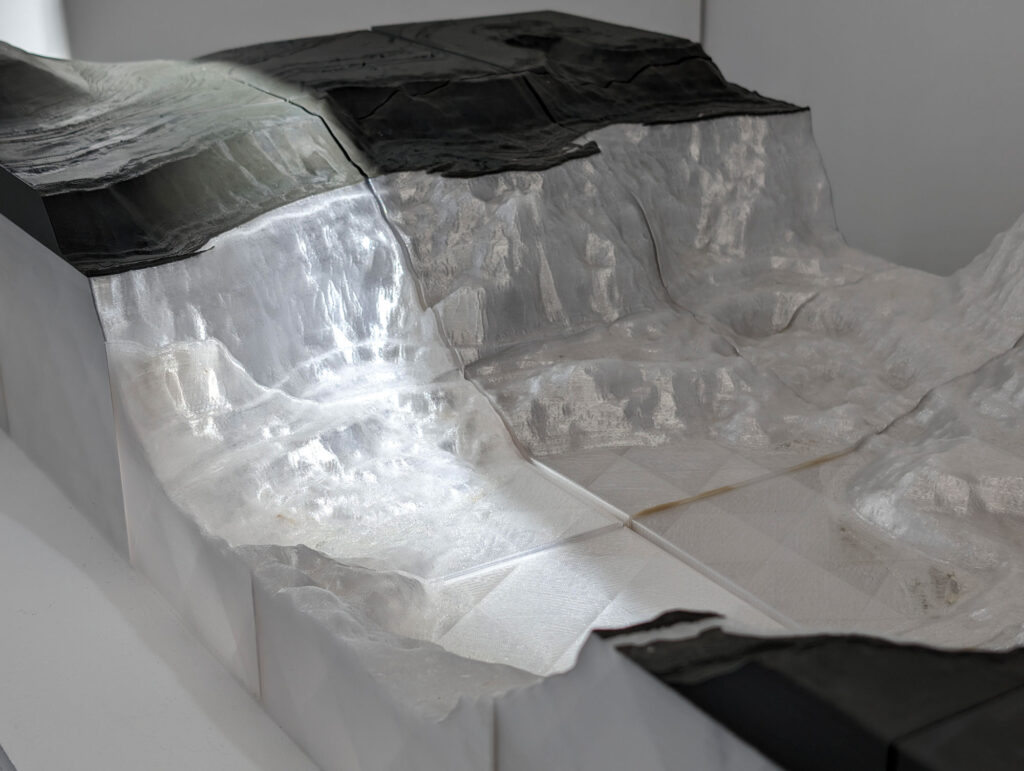
In 2023, cárdenas created The Probability Engine: Using Augmented Reality and 3D Printing to Envision Futures of Resilience to Sea Level Rise — one of 15 projects to receive a pilot grant from the Center for Coastal and Climate Resilience which funds research projects, collaborations, and creative works that address coastal climate-related impacts and solutions. The Probability Engine uses augmented reality to imagine possible realities based on the various degrees of temperature above pre-industrial levels. “With the probability engine, I’m asking, how do we envision futures of climate justice that can help us build resilience, in particular here on the California coast?” she said.
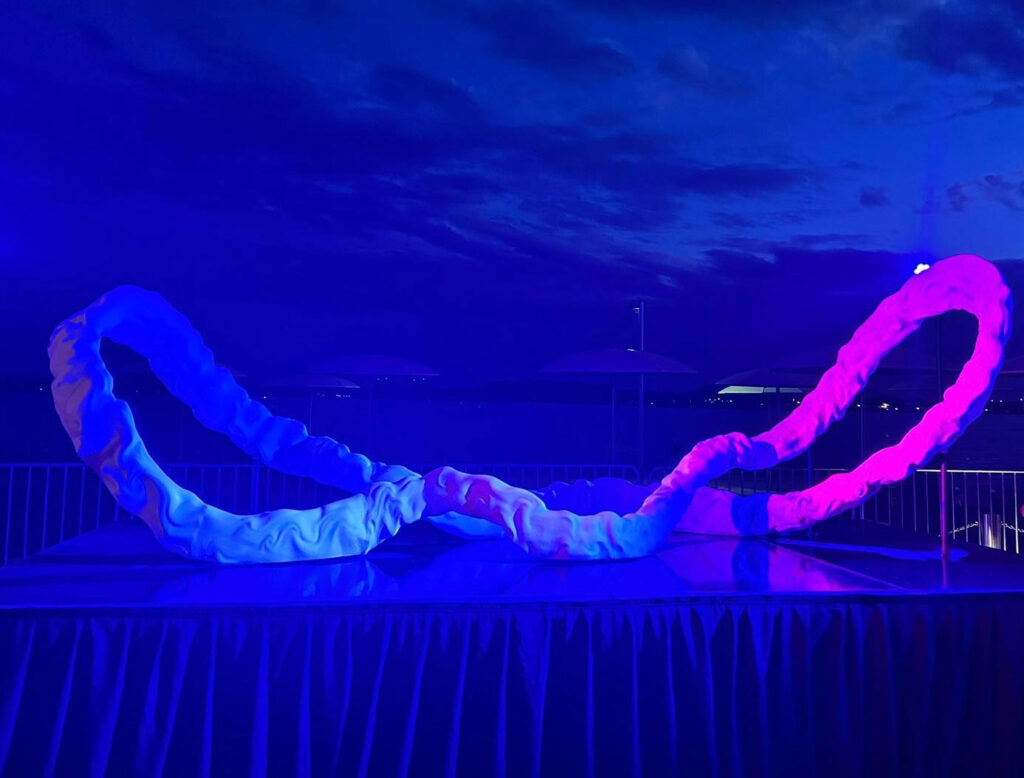
One work in the series is Atlantic Overturning, a 15-foot tall undulating sculpture depicting the Atlantic Meridional Overturning Circulation (AMOC), a vast global current that defines global temperatures, carrying warm water from the South to the North hemisphere, and is on the verge of collapsing and reversing as soon as this year. The sculpture debuted last Fall at Toronto’s Nuit Blanche, the city’s annual all-night contemporary art festival that attracts more than 1 million attendees, according to attendance reports, which is a lot of people who are probably encountering this vital issue for the first time, cárdenas said. It was exhibited at the Seymour Marine Discovery Center in October.
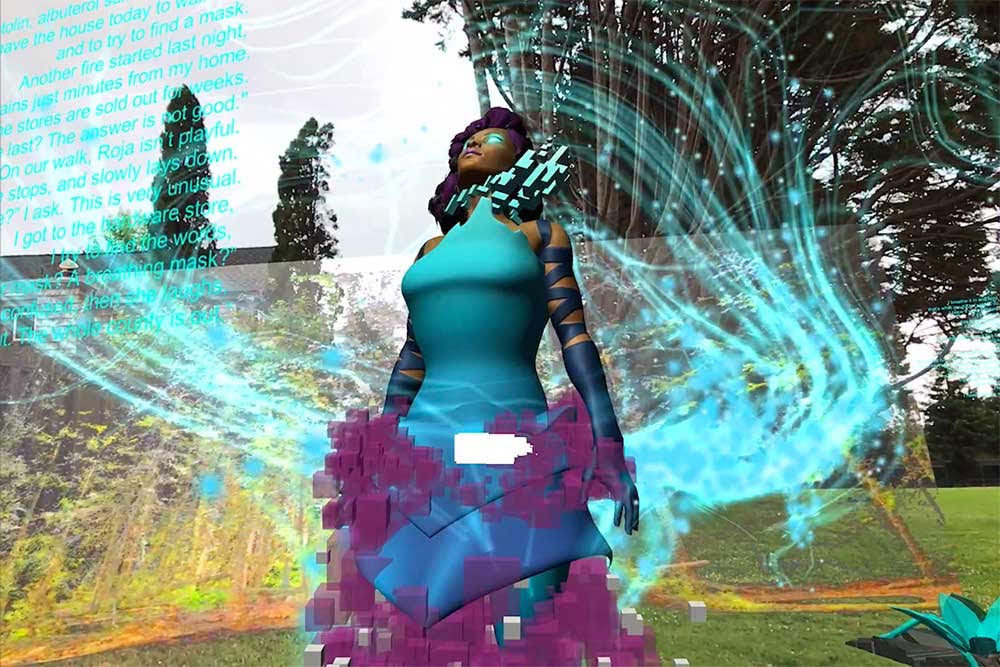
Sin Sol similarly interrogates the impacts of climate change via an augmented reality video game cárdenas designed, wrote, and directed. The game won the 2020 Impact Award at the Indiecade festival of independent games. Guided by a trans latinx AI hologram, players can find, see, and hear a story told through poetry about living through climate change-induced wildfires. The work came out of cárdenas’ own experience living through wildfires in Seattle and thinking about how wildfires disproportionately harm certain groups of people, like trans people, immigrants, and disabled people.
cárdenas draws on the lineage of UCSC alum and faculty emeritus Donna Haraway who founded the field of feminist science studies and asked important questions about science itself, like who decides what questions are allowed to be investigated, and what questions get funded?
“Often, science reflects the hegemonic values of society,” said cárdenas. “As an artist approaching science, I can bring different values, like queer and trans liberation or gender and racial justice, to how I think about science, and not be restricted by the influences science is usually restricted by.”
Ari Friedlaender and Rachel Nelson
Professor Ari Friedlaender teamed up with director and chief curator of the Institute of the Arts and Sciences, Rachel Nelson, to create An Aesthetics of Resilience, a multi-year interdisciplinary initiative working with artists from local and Indigenous communities in California to explore how scientists study and communicate the impacts of climate change through the lens of marine mammals. The project includes research, artworks, and a series of exhibitions, the first one exhibited at the IAS in Spring 2025, and is supported by a $2 million grant from the California Climate Action Seed Grant.
The Institute of the Arts and Sciences is an interdisciplinary hub that brings together artists, scientists, and scholars to engage with urgent social and environmental issues. Through exhibitions, public events, acclaimed and emerging artist residencies, and collaborations with UCSC faculty and students, the IAS fosters creative, cross-disciplinary approaches to research and public engagement.
“Science hits a bit of a ceiling if we keep it in our scientific communities,” Friedlander said, “and if we’re interested in studying animals and ecosystems that need protection, we need to be able to communicate our science and the things that we think are important to broad audiences.”
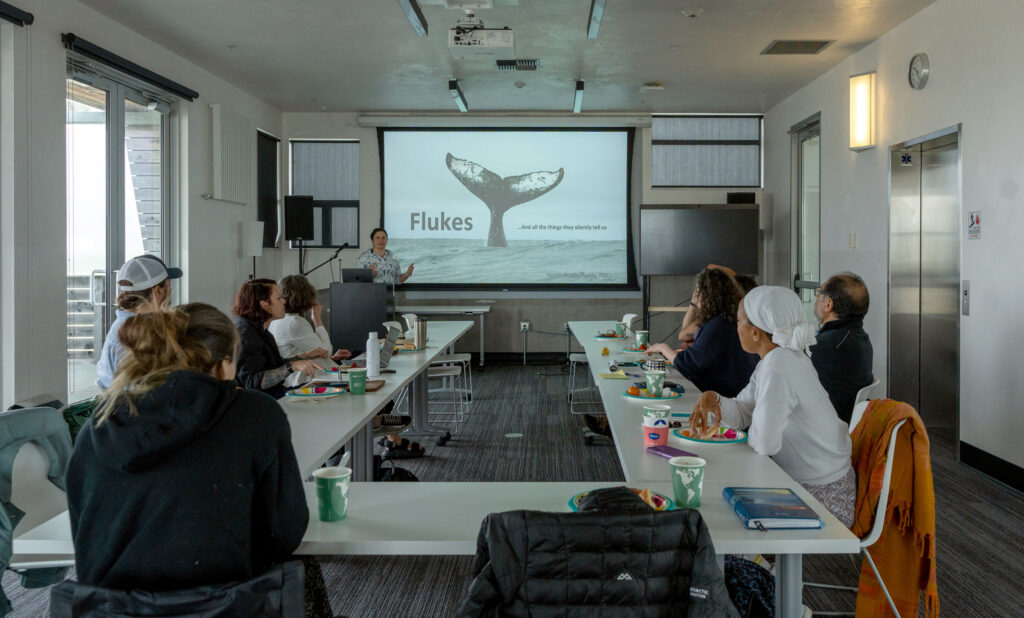
Part of the grant supports Friedlander’s lab in conducting three distinct research projects focused on marine mammals and climate change. PhD student Chloe Liu is working with an Indigenous community in Prince William Sound, Alaska, using underwater microphones to track the timing and distribution of marine mammals based on their vocalizations. This research will help the community understand where animals are throughout the year, how changing environmental conditions impact their movements, and what that means for their ability to hunt and fish these traditional food sources.
Postdoc Natalia Botero-Acosta is tracking migrating humpback whales to better understand how whales use the California coastline, how their migration corridors overlap with human activities like vessel traffic and noise pollution, and how climate change may be affecting their habitats. The third project, led by postdoc Logan Pauline in collaboration with researchers across California, will collect and analyze tissue samples from sea otters, California sea lions, and humpback whales to assess the impact of environmental contaminants on marine ecosystems and the species that depend on them.
Friedlander and Nelson are collaborating with several artists, like Imani Jacqueline Brown, Christine Howard Sandoval, and Carolina Caycedo, who are working with the scientists to create art that reflects the research findings. The result will be a series of exhibitions at IAS.
To Friedlander, An Aesthetics of Resilience demonstrates that there are very tangible ways art and science can work together to create something greater than the sum of its parts. Working with artists allows scientists to unlock from traditionally rigid experimental design structures and ask new and different kinds of questions, he said. “At UC Santa Cruz, we have a lot of freedom to to try new things, to experiment, and to not think of these diversifications as a watering down, but as enhancement of our collective impact.”