Climate & Sustainability
From Space to Soil, Alexie Leauthaud Bridges Cosmology and Environmentalism
UC Santa Cruz astronomer Alexie Leauthaud is bringing her cosmology expertise to climate action through Seed Spoon Science, a community-based gardening program focused on environmental justice and sustainability.
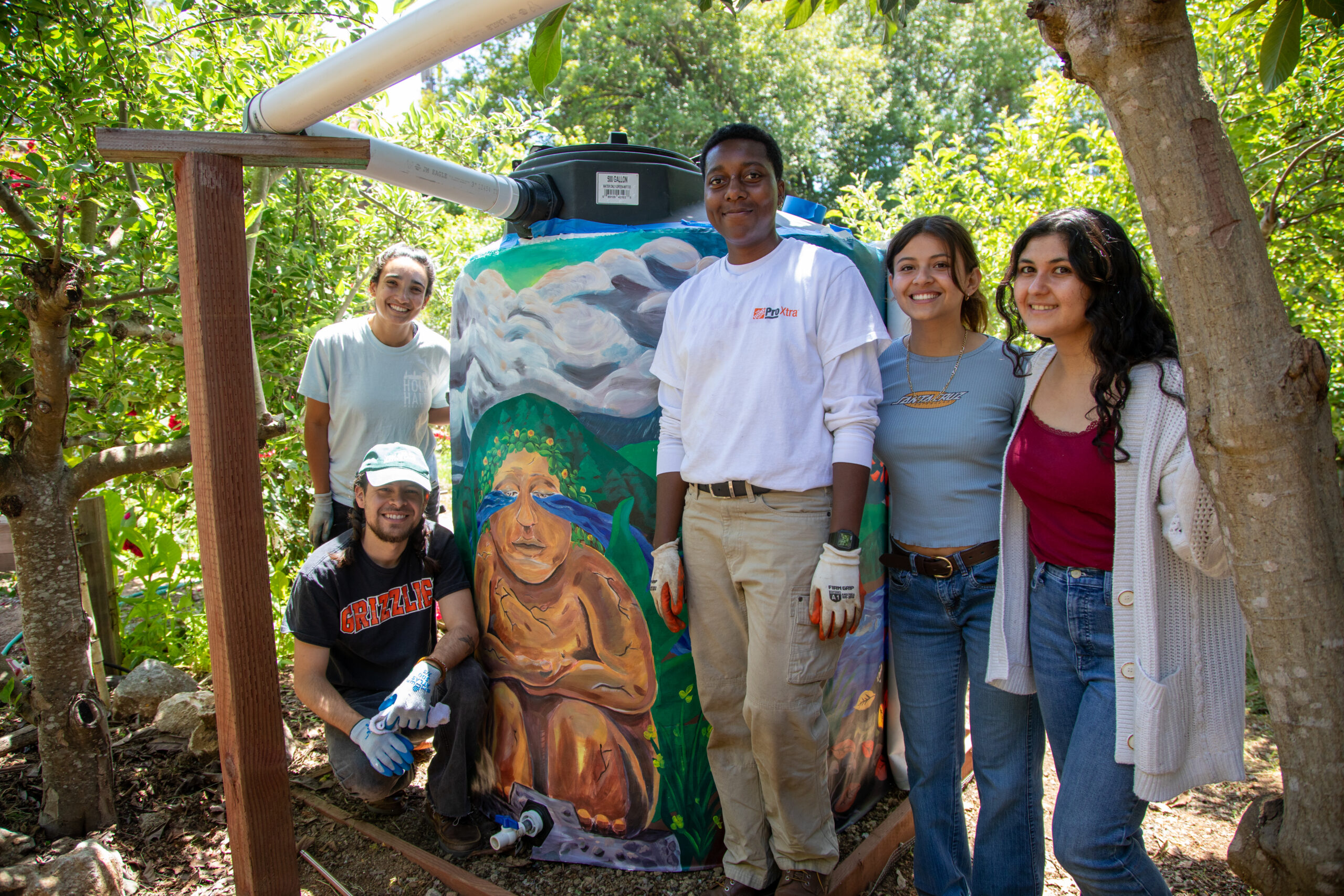
This 500-gallon tank will irrigate the UC Santa Cruz Village garden with rainwater during the region's dry season. It was designed, built, and adorned with a painted mural by students as part of an interdisciplinary pilot project funded by the university's Center for Coastal Climate Resilience. (Photos by Carolyn Lagatutta)
Alexie Leauthaud has spent most of her career looking toward distant galaxies and envisioning the edge of the universe. But in recent years, Leauthaud — an observational cosmologist and professor at UC Santa Cruz — has turned her gaze to planet Earth and the dirt beneath her feet.
In her work as a cosmologist, Leauthaud studies the nature of dark matter — the unseen, gravitational glue holding the universe together — and dark energy — the invisible force inflating the universe like an ever-expanding balloon. She is currently a principal investigator on the Merian Survey, using observations of dwarf galaxies to study dark matter, and a researcher and co-spokesperson for the Dark Energy Spectroscopic Instrument (DESI), which explores the effect of dark energy on the expansion of the universe.
After fleeing her home in the face of a natural disaster, Leauthaud was inspired to merge her scientific expertise with her lifelong love of gardening to help combat climate change. Her first environmental justice program, Seed Spoon Science, engages college students from underrepresented backgrounds in community-based gardening projects. One of the program’s initiatives provides home gardens to families in and around Santa Cruz, California.
Leauthaud shared more about the genesis of the program, and how she applies her training as an astrophysicist to her environmental work. This interview has been edited for length and clarity.
What made you want to start working on environmental projects in addition to your work as a cosmologist?
Summer 2020 was a pivot point for me. We had unprecedented fires across California. Locally, we had the CZU fires, but they originated from a giant storm that threw down lightning bolts and ignited many hot spots across California. Parts of the university were evacuated and the fire came within miles of us. That whole experience of seeing the fires, driving for many hours straight through California, through this dark, sooty landscape, just really hit home the magnitude of the challenges that we face due to climate change. Around that time, there was also a call issued from the Packard Foundation to support community-engaged research , so I put those things together and submitted a proposal which they decided to support, and has gradually led me down this path.
Seed Spoon Science operates a community garden on campus. Can you share more about the garden and what that has meant to the campus community?
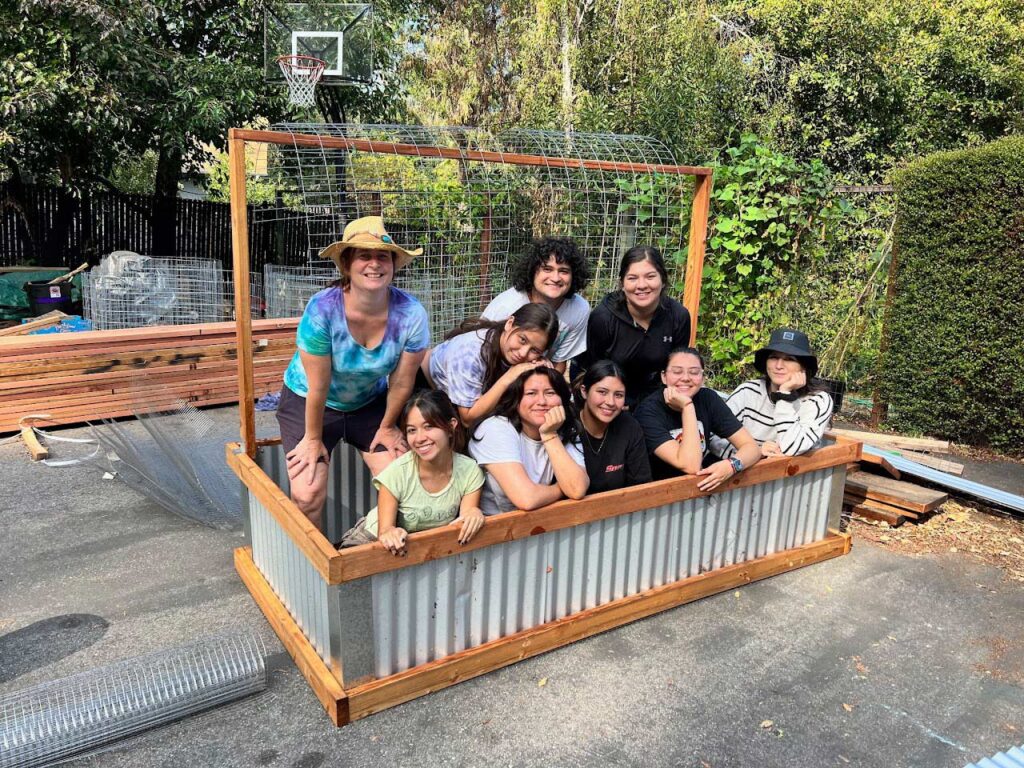
We’ve reinvigorated a garden on campus, called Terra Viva, and it’s located in the Village, which is a residential complex that includes many non-traditional students. The garden is cared for by volunteers from throughout the campus community — we have a wide range of students who come and engage on scheduled work days, which is wonderful because one of our goals for the Terra Viva garden is really to build an inclusive space for all students.
Some people get really into working the garden, and it can really transform people. For example, we do a lot of work on compost, and we had a compost engineering challenge last year. The winner of that challenge is now studying waste engineering at University of Washington. I think everyone who works in the garden comes out of it with maybe something a little bit different, but I think it does have a positive impact, and I’d love to see more effort at the university level on this kind of experiential learning.
How has your training as a cosmologist informed your approach to environmental projects?
Well, there’s a lot of similarities with my astronomy work. The astronomy that I do involves very complex phenomena — they’re not simple things that you write down with a simple equation. It’s very similar with gardening. It seems deceptively simple, but when you start to dig into it, it’s extremely complex with a lot of variables: what variety you’re planting, what your soil is, what your climate is. So I’ve been applying my science knowledge to that challenge and trying to think about optimizing ways of helping people get better results using these scientific methods.
What legacy do you want to leave as a scientist?
If you asked me this question before 2020, I would give a different answer. Before 2020, like most scientists, I was most focused on generating very detailed, specialized science and furthering our understanding by small increments. But more recently, the new me will say that I’m much more interested in a bigger picture perspective of where we are in terms of life on Earth and our place in the universe. We inhabit this one, very unique planet, and we are not going to move to Venus or Mars. We are stuck here on this planet.
Astrophysicists come very uniquely prepared with this very large scale picture of these constraints. My goal now is to communicate that and to engage a much more global thought process of how we might acquire the wisdom that will be required to sustain life on Earth, and to really acknowledge the hard boundaries that we face. We are really at a critical turning point — we’re fundamentally altering the Earth system in ways that we are probably unlikely to be able to control, so it’s a critical, pivotal moment. The angle I take now is this high-level, bigger picture perspective of: How are we going to try to sustain life as we know it today, on this one small planet?
Beyond bringing your scientific training to your environmental projects, are there other ways the two pursuits intersect?
I think it’s very important for everyone to remember that no one is isolated from these effects — they will impact everyone everywhere, including our work in astrophysics. A few years ago, the telescope that we used, the Mayall telescope, was almost burned down in a fire. So DESI was close to shutting down out of necessity. Furthermore, the telescopes that we use at UC Santa Cruz, at the Lick Observatory, came extremely close to burning down. In addition, studies are finding that climate change will affect the quality of our observations by changing the atmosphere. We like to have a nice, clear, calm atmosphere to look out to space, and that’s predicted to become more difficult to come by.
Wearing my hat as an astrophysicist, I also believe it’s important to engage in these issues, because they will undermine the kind of science that we do. My goal is that my children and everyone’s children can live in a society where we have the luxury to fund astrophysics. So that’s where I think we need to strive, and that’s why, as an astrophysicist, it’s part of my responsibility to try and ensure that future generations can continue to study the universe with the same luxury that I have enjoyed.
Are research universities currently positioned to foster the sort of work necessary to address these problems?
We are very good at generating very specialized research, but we need to get better at generating broad vision and interdisciplinary work because the kinds of problems we are facing — they’re called wicked problems — cannot be solved with a highly specialized approach. They require incredible, high-level vision and understanding. We do need specialized departments, but the thing that we’re missing is the broader perspective. I think we should try to strive for more unity, and more collaboration and discussion, and really view universities as a whole, as opposed to these individual, isolated institutions. If we can recognize our collective power, I think we stand stronger.
How would you describe your home garden?
Right now, it’s extremely messy because I’ve been on sabbatical for a year. So it is an overgrown garden. I’m looking forward to reconnecting with my garden, but I also know that messy gardens are actually the best kind of gardens for biodiversity. Insects, lizards, frogs, they all thrive in messy gardens. So I’m not going to go back and slash it all to the ground. I’ll trim it up a bit and put some more produce in, but I embrace messy gardens.