Health
David Deamer and David Haussler elected Fellows of the National Academy of Inventors
The recognition is the highest professional distinction awarded to academic inventors.
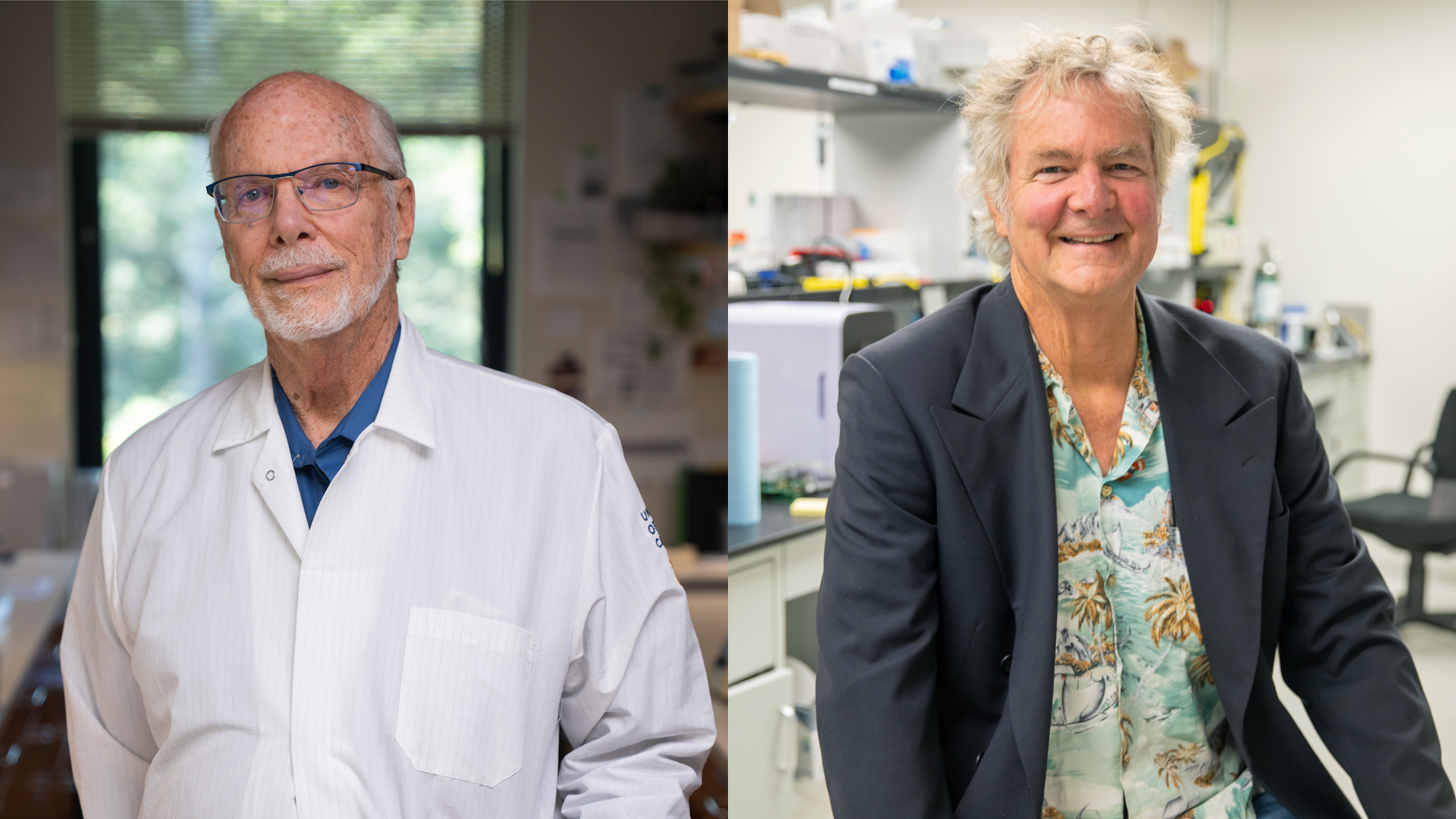
David Deamer (left) and David Haussler (right).
Two UC Santa Cruz Baskin School of Engineering faculty have been named Fellows of the National Academy of Inventors, the highest professional distinction awarded to academic inventors. They are David Deamer, professor emeritus of biomolecular engineering, and David Haussler, distinguished professor of biomolecular engineering and scientific director of the UC Santa Cruz Genomics Institute.
Deamer’s research contributed extensively to the invention of nanopore sequencing, one of the main methods used by scientists worldwide to read DNA and RNA. The concept was Deamer’s idea and was developed primarily by him along with fellow UC Santa Cruz emeritus professor of biomolecular engineering Mark Akeson and Harvard’s Daniel Branton.
Over decades of experimentation, the group proved their method worked: DNA can be read by forcing it through a nanometer-sized hole charged with an ionic current. Their work was licensed by the company Oxford Nanopore Technologies, leading to the creation of the MinION, the only hand-held device for genetic sequencing, priced at a fraction of the cost of other sequencers.
Deamer’s ongoing research investigates the cellular beginnings of life on Earth four billion years ago, particularly the origin and evolution of membrane structure and RNA formation in shallow water environments.
Haussler’s research and technology development lies at the interface of mathematics, computer science, and molecular biology, and he is credited with early work in machine learning and extensive contributions to the field of genomics. Haussler played a pivotal role in the international Human Genome Project, which resulted in the first assembly of the human genome in 2000. Haussler, then-graduate student Jim Kent, and their team made history by releasing the first working draft of the human genetic code publicly on the internet, ensuring that this essential biological resource be accessible to all.
Haussler and Kent went on to develop and publish the UCSC Genome Browser, a publicly available, web-based tool for visualizing genomic data that to this day is used by hundreds of thousands of researchers within academia and industry every month. Even after 25 years, the Browser is continuing to evolve, enhancing the types of data it handles and taking advantage of AI.
Haussler’s ongoing experimental work investigates the molecular evolution of DNA, RNA, and protein sequences, with a recent emphasis on human brain evolution and early human brain development. His lab grows human brain tissue from stem cells to study the causes of neurological diseases. They are focused on creating faster, cheaper, and smarter internet-connected tools for studying human health and disease.
The NAI Fellows program highlights academic inventors who have demonstrated a spirit of innovation in creating or facilitating outstanding inventions that have made a tangible impact on the quality of life, economic development, and the welfare of society.
UC Santa Cruz this year launched a campus chapter of the NAI, becoming only the second UC campus to do so. The chapter offers mentorship, resources, and capacity-building opportunities for faculty, staff, and students interested in invention and entrepreneurship. Members can attend NAI annual meetings, contribute to the organization’s journal Technology and Innovation, and collaborate with inventors around the globe.