Earth & Space
Advanced telescope instrument for observing planet formation to be created at UC Santa Cruz
World’s first facility-grade ‘astrophotonics’ instrument to be deployed at Lick Observatory
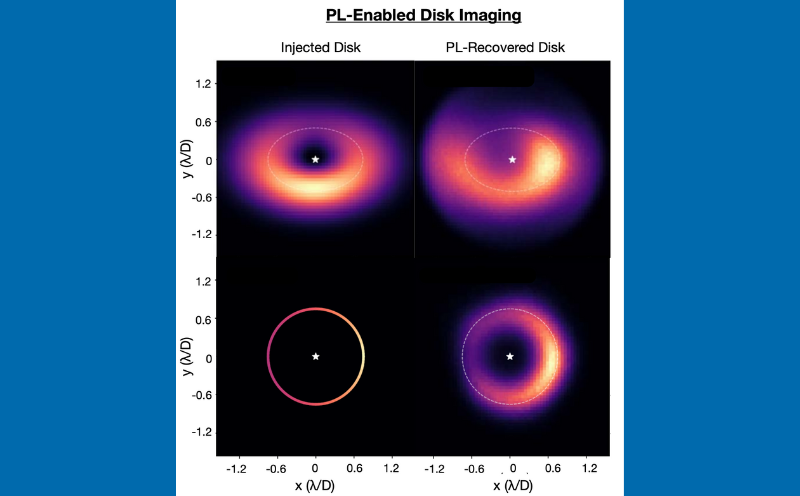
Simulated planets forming out of protoplanetary disks surrounding young stars to be observed using the new instrument. The left column shows the true signal, and the right column shows images reconstructed by the instrument.
Astronomers at the University of California, Santa Cruz, and UCLA will develop a next-generation instrument for detecting and studying the formation of planets around nearby stars, supported by a $2 million gift from the Kavli Foundation and individual philanthropy.
At UC Santa Cruz, associate professor Kevin Bundy will lead the design and creation of the first-ever facility-grade astrophotonic instrument, which will be deployed at Lick Observatory’s Shane 3-meter Telescope. The device will help reveal planets that would otherwise be hard to observe by more effectively suppressing the overwhelming light from nearby stars—a significant challenge for current research.
The funding will continue Lick’s long tradition of bringing new technologies to astronomy in recent decades. “This would mark the first facility-class astrophotonic instrument in the world,” Bundy said. “Lick is only one of two telescopes on Earth where cutting-edge astrophotonic technology is regularly tested.”

Bundy is an observational astronomer specializing in mapping the distribution, properties, and internal structure of galaxies in order to address key questions about their formation and assembly history. He is a leader of instrumentation projects for large telescopes, working in the field of astrophotonics to develop new tools that can dramatically enhance the capabilities of future instruments.
As a technology, photonics hearkens back to lasers and masers of the 1960s. Like electronic devices, which rely on electrons, photonic devices manipulate photons, which are particles of light. Arguably, the most prominent application of photonics occurs in telecommunications, where vast fiber-optic networks ferry data all over the planet.
Over the last 15 years or so, astrophotonics has sought to expand this core technology to improve astronomical observations. The photons involved in astrophotonics come from deep space, having traveled quadrillions upon quadrillions of miles before entering instrument fibers on Earth. Directing and manipulating this cosmic light is significantly easier in astrophotonic equipment, improving precision and decreasing costs while enabling new capabilities for astronomical instrumentation compared to conventional gear.
Bundy’s counterpart at UCLA is Pradip Gatkine, an assistant professor of physics and astronomy who specializes in developing astrophotonic chips. The project will be funded by a new award from the Kavli Foundation in the amount of $3.7 million over four years that aims to accelerate discovery in planetary and stellar science by supporting the creation of innovative and impactful technologies for mid-size observatories.
By equipping proven observatories with next-generation instruments, Kavli’s Instrumentation for Astrophysics program seeks to extend the scientific reach of telescopes in the range of 2 to 5 meters, deliver new scientific insights, and demonstrate technologies that could be adopted by larger, flagship observatories.
Over the last few years, Bundy and other UC Santa Cruz researchers have been developing a platform called Astrophotonic Advancement at Lick Observatory (APALO). This project will improve the platform by building and integrating photonic devices, while enhancing the adaptive-optics interface and enabling full observatory support.
In addition to Bundy, the APALO leadership team includes astronomy and astrophysics professors Rebecca Jensen-Clem and Steph Salum, as well as postdoctoral scientist Emiel Por. At Lick, staff astronomer Ellie Gates and principal telescope technician Dan Espinosa have also been instrumental. The APALO concept was the Ph.D. thesis of astronomy and astrophysics graduate student Matt DeMartino.
The Kavli Foundation partnered with philanthropist Keven Wells on the award.