Earth & Space
In Memoriam: Joel Primack
Distinguished emeritus professor was a towering figure in theoretical physics and cosmology, a visionary educator, dedicated mentor, and passionate advocate for the role of science in society
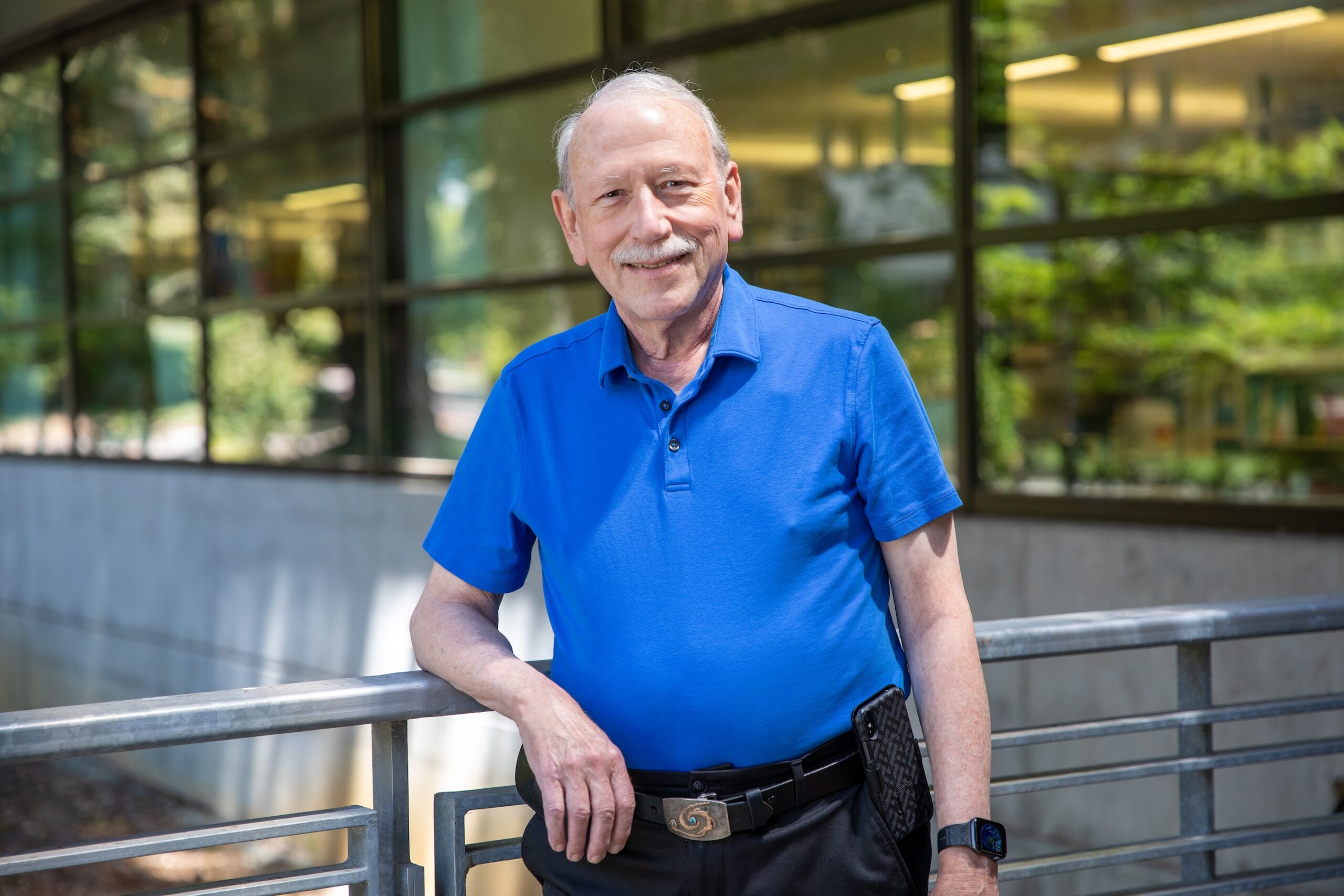
Joel Primack co-developed the theory of cold dark matter—the standard modern theory of structure formation in the universe. (photo by Carolyn Lagattuta)
Joel Primack, a renowned physicist and cosmologist at the University of California, Santa Cruz, whose most influential scientific feat was co-developing the theory of cold dark matter—the standard modern theory of structure formation in the universe—died on November 13, 2025, after a long and courageous battle with pancreatic cancer. Primack, also widely recognized for being a publicly engaged scientist and creating opportunities for future scientists to do the same, was 80 years old.
The author of more than 500 scientific papers that have garnered more than 56,000 citations, Primack provided profound insights into the formation and distribution of galaxies, revolutionizing our comprehension of the large-scale universe. After helping to create what is now called the “standard model” of particle physics as a graduate student, Primack began working in cosmology in the late 1970s, quickly becoming a leader in the new field of particle astrophysics.
In 1982, he and a colleague were the first to propose that the lightest supersymmetric partner particle is a natural candidate for the dark matter particle. In 1984, he led a collaboration of four scientists who laid out, for the first time, the full timeline for structure formation in the universe—positing that infinitesimal quantum fluctuations born right after the Big Bang later grow to form galaxies and clusters of galaxies spanning thousands to millions of light years in size.
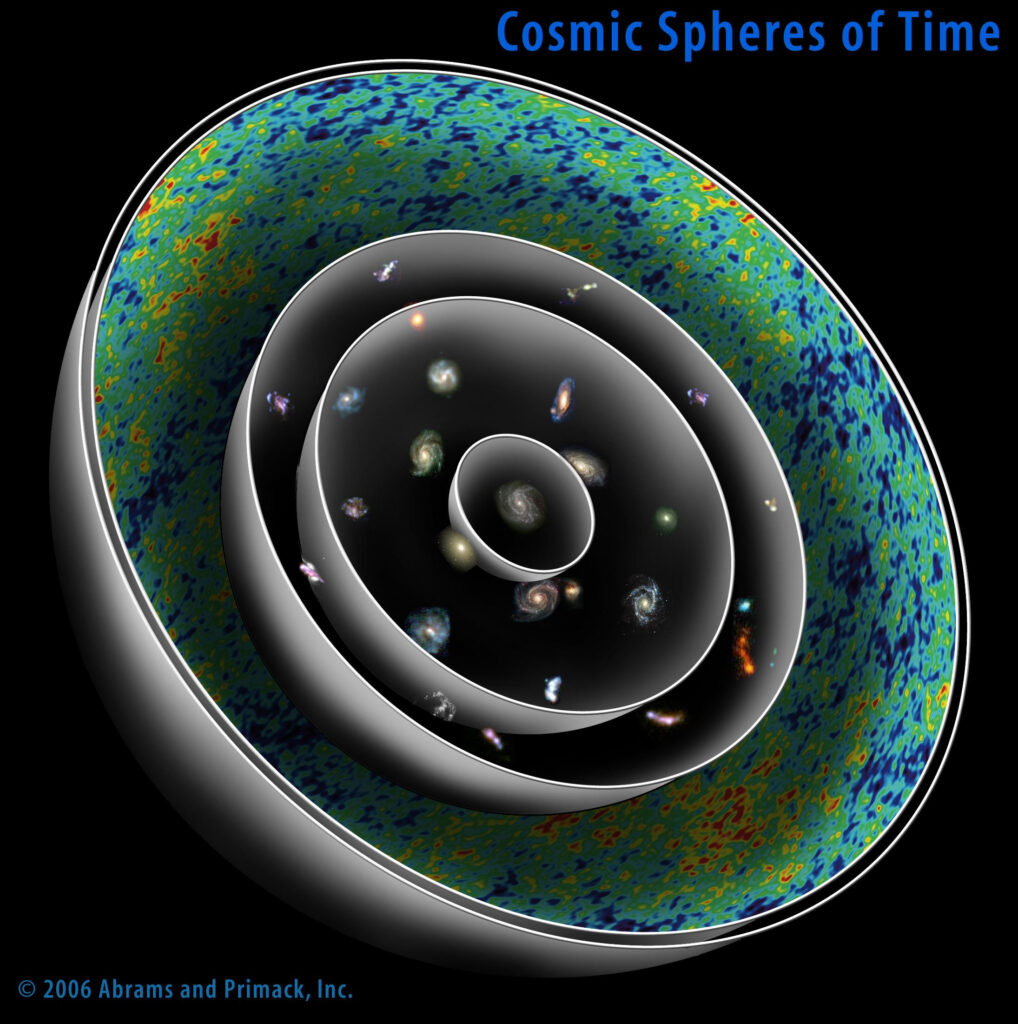
That model of the universe’s formation, later honed by hundreds of cosmologists including Primack himself, stands as cosmology’s working paradigm today for why our universe made galaxies—a key step on the road to life.

“Joel Primack was a scientist of extraordinary vision and a person of uncommon kindness, generosity, and integrity. His work expanded our understanding of the universe, and his deep commitment to mentoring, inclusion, and public service strengthened our campus community,” said UC Santa Cruz Chancellor Cynthia Larive. “His influence on astrophysics, on science policy, and on the lives of countless students and colleagues was profound. We have lost an exceptional scholar and a deeply good human being.”
Informing policy, ethics, and public understanding
His prolific scientific research was matched by his many contributions to the global community of scientists, the science-policy world and society at large. Despite being told by his department head that he would never get tenure unless he focused entirely on science, he ignored the warning and continued to do the political work he believed in. Primack created opportunities for scientists to engage in government policy, helped lawmakers make evidence-based decisions, and improved the public’s understanding of science.
Primack originated the first congressional fellowship program for scientists. The program, which grew out of a series of workshops he launched as a graduate student at Stanford University, became the American Association for the Advancement of Science’s (AAAS) Science and Technology Policy Fellows Program. For more than half a century, that program has brought the expertise of thousands of scientists and engineers into the federal government.
Primack was also instrumental in the creation of other key forces in science-policy engagement. He was a founder of the Union of Concerned Scientists, helped to create the American Physical Society (APS) Forum on Physics and Society, and proposed the APS program of studies on public policy issues. In addition, he contributed to the founding of the National Science Foundation’s Science for Citizens program, and created and provided initial leadership for the AAAS Program on Science and Human Rights, which rescued several scientists from authoritarian governments that threatened their work or lives.
Primack co-authored the book Advice and Dissent: Scientists in the Political Arena (1976) with Princeton physicist Frank von Hippel. He also used science engagement as an opportunity for improving international relations, serving as a U.S. delegate to several Pugwash Conferences. For all those reasons and more, AAAS awarded Primack its Philip Hauge Abelson Prize in 2024.
Primack was made a AAAS Fellow in 1995 for his pioneering work to establish the congressional fellows program, and for his commitment to expanding the use of science in policymaking throughout government. He also served on the board of the Federation of American Scientists, leading its 1988 effort to end the Soviet Union’s nuclear reactor-powered satellite program.
A lasting legacy on campus
In the wake of his passing, those closest to Primack received an outpouring of sympathy and grief—many finding it difficult to sum up the scale and breadth of his contributions. But colleagues spoke, not only of Primack’s towering stature as a scientist, but of his incredible kindness and generosity as a human being.
“Joel Primack was an extraordinary human being along many axes,” said UC Santa Cruz Science Division Dean Bryan Gaensler. “I treasured our interactions on so many topics, and can’t believe he’s gone.”
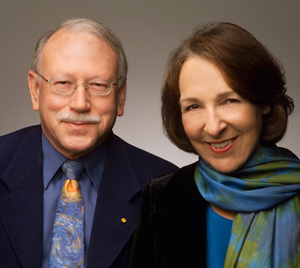
With his wife, Nancy Abrams, Primack was deeply interested in the importance of cosmic knowledge in shaping modern human values and envisioning humanity’s future. For more than a decade, Primack and Abrams co-taught the UC Santa Cruz course Cosmology and Culture, which developed a new visual language for picturing the universe and our place in it.
Through many lectures and two books—The View from the Center of the Universe: Discovering Our Extraordinary Place in the Cosmos (2006) and The New Universe and the Human Future: How a Shared Cosmology Could Transform the World (2011)—Primack and Abrams brought their strikingly novel and inspiring ideas to college campuses and public forums around the world.
A physics professor at UC Santa Cruz since 1973, Primack taught everything from introductory freshman courses to advanced graduate curriculum in quantum field theory and cosmology. He also supervised scores of graduate students and postdoctoral researchers, serving as an outspoken supporter of his mentees and their careers.
Primack was a member of the Santa Cruz Institute for Particle Physics. He also served as a campus leader, chairing university committees on educational policy, computing and telecommunications, as well as directing the UC system’s High-Performance Astro-Computing Center (UC-HiPACC).
An exceptional life
Born on July 14, 1945, in Santa Barbara, Calif., Joel Robert Primack graduated class valedictorian from Princeton University in 1966 and earned his Ph.D. in physics from Stanford in 1970 under leading theoretical physicist and U.S. arms-control expert Sidney Drell. Primack then went on to serve as a Junior Fellow at Harvard, one of the most prestigious early-stage postdoctoral fellowships in the world.
In addition to the Abelson Prize, Primack received many other major honors, including the Alexander von Humboldt Foundation Senior Award, the American Physical Society’s Leo Szilard Lectureship Award for promoting the use of physics for the benefit of society, the physics society’s Julius Edgar Lilienfeld Prize for outstanding contributions to physics and exceptional skills in lecturing to diverse audiences, and the J. Robert Oppenheimer Award. In 2017, he was elected president of the scientific research honors society Sigma Xi.
Despite transitioning to emeritus status in 2014, Primack remained deeply engaged. Just days before his death, Primack was “actively participating in his many collaborations,” another renowned UC Santa Cruz astrophysicist, Sandra Faber, said in a note to close colleagues on November 13. “Joel was a giant in the field of cosmology and galaxy formation,” wrote Faber, one of Primack’s co-authors on the 1984 paper on cold dark matter. “His passing leaves a gap that cannot be filled.”
To his wife, Nancy, Joel’s death was “like the Great Library of Alexandria burned a second time.”
Primack is survived by Nancy, their daughter, Samara Bay, and their 10-year-old grandson Wilder, who live in Los Angeles. More information about a memorial service and ways to remember Primack’s extraordinary life is forthcoming.