Student Experience
2025 iGEM team investigates solution to common food toxin
The undergraduate research team won a silver medal at the 2025 international jamboree.
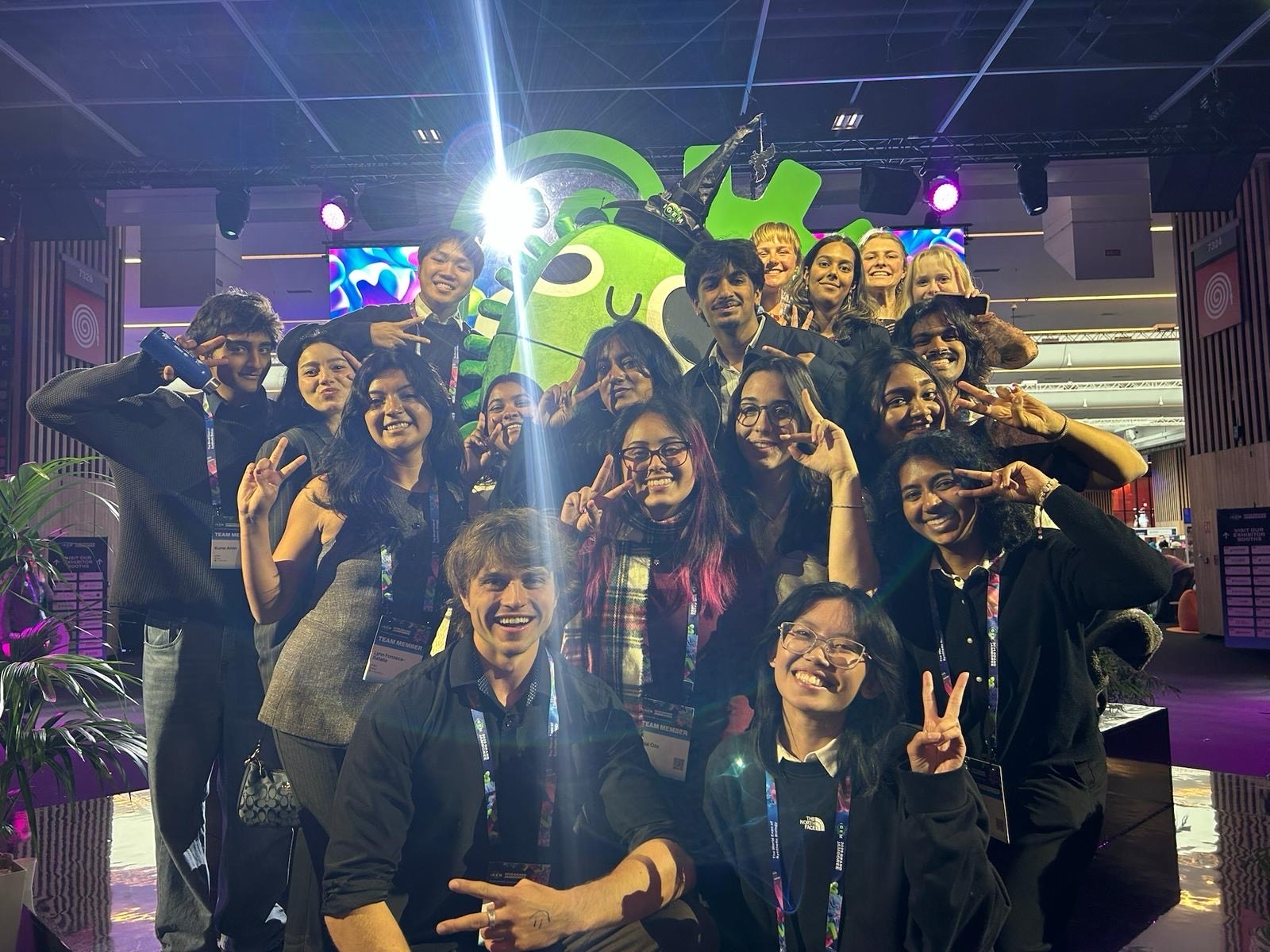
The 2025 iGEM team at the International Jamboree in Paris.
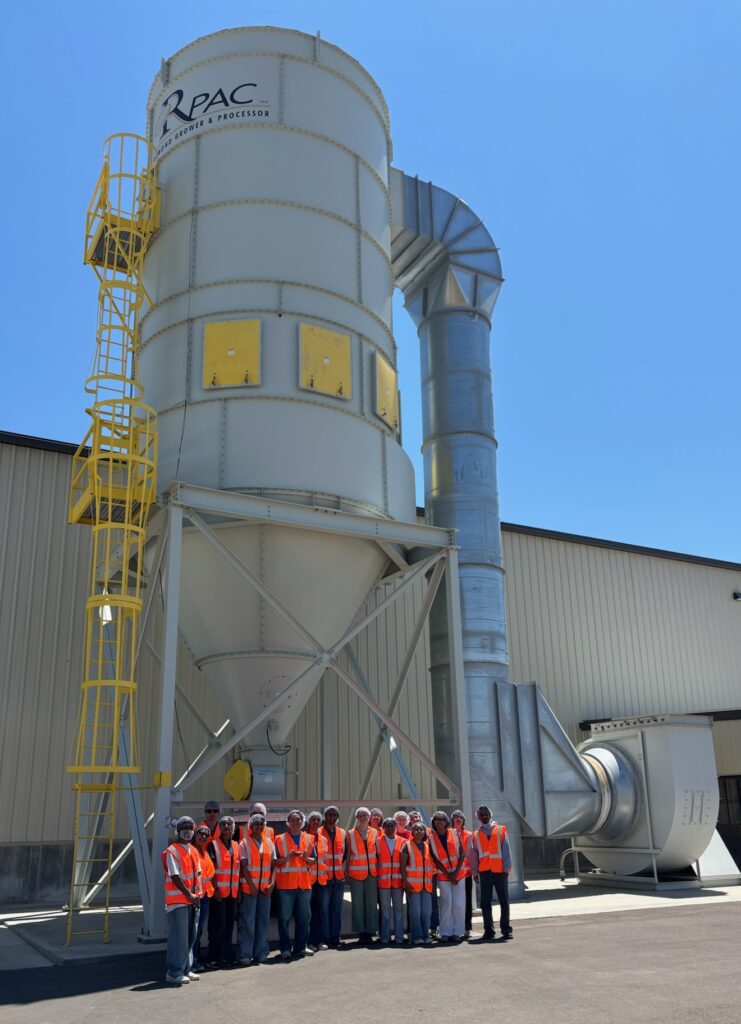
At an apple processing facility in Watsonville, the 2025 UC Santa Cruz iGEM team took a deep dive into mycotoxins in food, learning about the implications on both workers in the plant and food consumers. Like past iGEM cohorts, the team was dedicated to choosing a synthetic biology project with real community impact.
The 18 undergraduate students on the team spent a year developing “safeTEA,” a novel method for removing the highly toxic aflatoxin B1 (AFB1) from water-based solutions. Their work culminated at the 2025 Jamboree in Paris, where, among 5,000 students from around the world, they won a silver medal for their efforts.
Along the way, iGEM team members gained deep, hands-on experience with wet and dry lab skills, leadership, project management, science communication, and more. Associate Teaching Professor of Biomolecular Engineering (BME) David Bernick, who mentors teams each year, credits the strong team dynamic to their success on a complex project with many moving parts.
“It’s a year-long immersion process in research and investigation and uncovering the unknown and failing—it’s all those things,” Bernick said. “We always have a strong technical focus, but this year, we also had a really strong interpersonal focus, and that allowed the opportunity for extraordinary effort to really come out.”
Human practice
Led by team co-captains Aditi Bhat (BME) and Bella Meyer (BME) and advised by Bernick, the student team spent the first several months of their iGEM experience deeply researching their project idea. They aim to identify and address not just a scientific puzzle but a real need—a legacy passed down over the years among UC Santa Cruz iGEM teams.
“I think the unique aspect of the UCSC iGEM program versus a lot of other ones around the world is our focus on having a tangible impact,” Meyer said. “Trying to create an impact-oriented project with limitations in resources, I think, is a unique aspect that requires a lot of creativity, but ultimately fosters more collaboration and innovation, because we’re not just being handed money or a project, we’re actually doing all of it ourselves from the ground up.”
With this ethos in mind and an idea to target food contamination, the students chose their project after extensive conversations with various stakeholders, including Martinelli’s, a non-alcoholic cider and juice company based in Watsonville, and RPAC Almonds, an almond-processing facility in Los Banos. Conversations at these two companies allowed them to identify an intervention that would be practical and useful for the needs of real people.
In a process that iGEM calls “human practices” the team consulted with other faculty and staff members at UC Santa Cruz, along with public health clinicians, bioethicists, epidemiologists who worked with the communities affected by mycotoxin contamination and aflatoxins. They refined their project, arriving at a focus on the carcinogenic toxin AF1B. This mycotoxin is found in fruits, nuts, rice, and grains and causes damage to the liver and kidneys, is linked to birth defects and cancer, and can be fatal—especially to children.
‘Helix’ structure
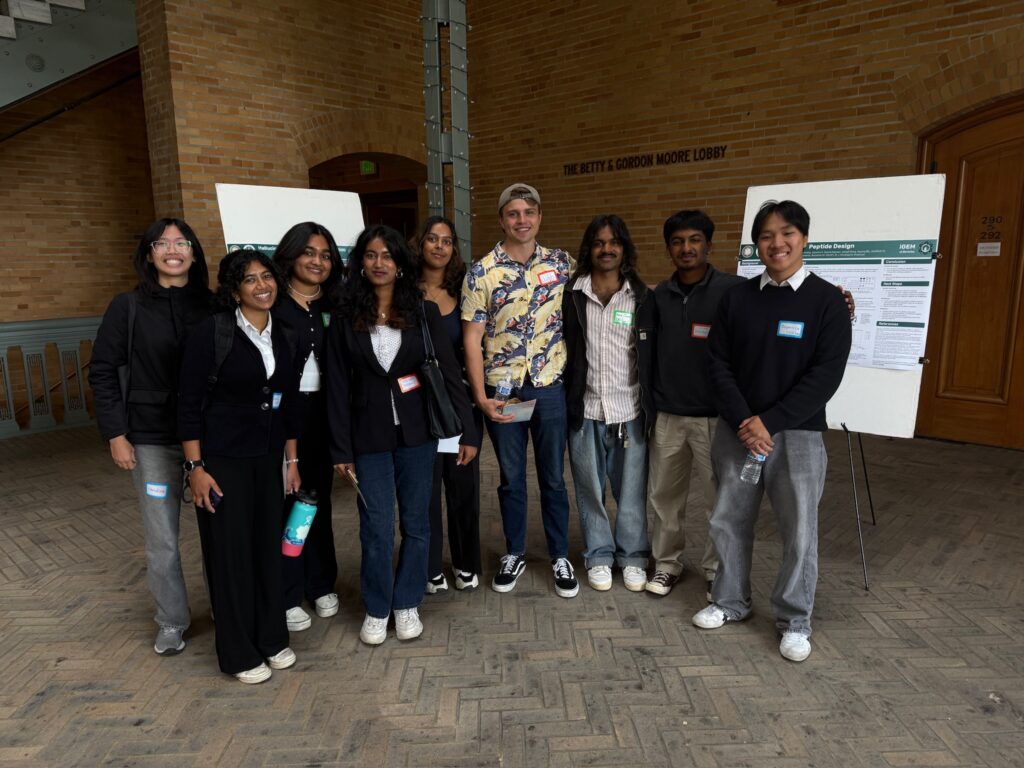
Over the summer the team dove into full time work dedicated to their project, sometimes pulling extremely long days in their dedication to experimental results. This year, the iGEM team adopted a new project management process they called “Helix,” which divided the team members up into smaller groups to become experts on detailed, interdependent aspects of the project.
Navigating this new team structure was a major learning experience, with much to be discovered about communicating between the small teams and keeping everyone in sync. The team captains presented this project management system during a live stage talk at the Jamboree in Paris, reflecting on their experiences with how to organize for “intentionally-designed interdependence.”
“We wanted to create a way to accelerate our learning,” Meyer said. “The big thing with iGEM is pivoting, because, as an undergrad team, and this is our first experience with research for many of us, things just naturally come. The more that we were able to uncover different aspects of our project through the interdependent subgroups, the more we were able to better manage these pivots and respond incredibly quickly.”
“This system is really adaptable, and I think it allows us to get more in-depth into our project and get to deliverables at a faster pace than we’ve seen other IGEM teams do,” Bhat added. “We think it would be a really good program management system for future iGEM teams, or future student-led projects in general—and it’s also seen in the workforce as well.”
SafeTEA
This work style was well-suited for their project which necessitated several detailed components. The team’s goal was to create a new detoxification method to target aflatoxin contamination in aqueous (water-containing) solutions. They specifically target aflatoxin-B1, which is associated with cancers, birth defects, and even death. Acute and chronic exposure can have lifelong impacts for communities that face contamination issues.
The team wanted to create a scalable way to provide access to decontamination technology, meaning it could be used by an individual farmer or an industrial food-processing complex. They also wanted a system that could be regenerative, meaning it could be used over and over—a crucial feature for resource-constrained communities.
To do so, they developed a plasmid-based system that, when matured, releases a product they called “seagulls.” These are the two aptamer arms, which are short single stranded pieces of DNAs that bind to a target molecule to remove the toxin from a liquid solution.
While the team was not able to produce a fully-functioning system in the limited time frame for the competition, their experimental results show the promise of a plasmid that can be consistently regenerated, meaning it can be easily produced. When exposed to lactose, the plasmid releases aptamer arms that mature and bond to the toxin, which can then
be filtered out using cellulose-based products such as cotton or paper.
While there is more testing needed to show that the whole system can work together, they got promising results that the molecular machinery needed to create the aptamers would function.
The team also successfully contributed a novel algorithmic method for adding spacers to DNA, something that was essential for ensuring the DNA design did not interfere with the aptamer’s ability to bind to its target. Their algorithm, called “NOODL,” is now available for future IGEM teams to use, with a plan to publish the method for general use soon.
The 2025 UC Santa Cruz iGEM team members are: Kunal Amin (Bioinformatics), Delaney Boman (BME), Nishad Chavan (BME), Anavi Deshmukh (BME), Amanda Ferguson (BME), Lynn Fonseca-Batalla (BME), Srishta Hazra (BME), Ally Hoogs (BME), Anisha Jaiswal (Bioinformatics, Microbiology), Christine Lau (BME), Benjamin Liu (BME), Tejal Oza (BME), Srushti Patil (BME), Judah Tapert (BME), Aleek Tekehyan (BME), and Vaishnavi Venuturimilli (Bionformatics).