Climate & Sustainability
New study finds fishing-fleet movements can reveal marine-ecosystem shifts
UC Santa Cruz researchers show how vessel-tracking data mirrored tuna roaming beyond their typical territory due to unusually warm ocean temperatures
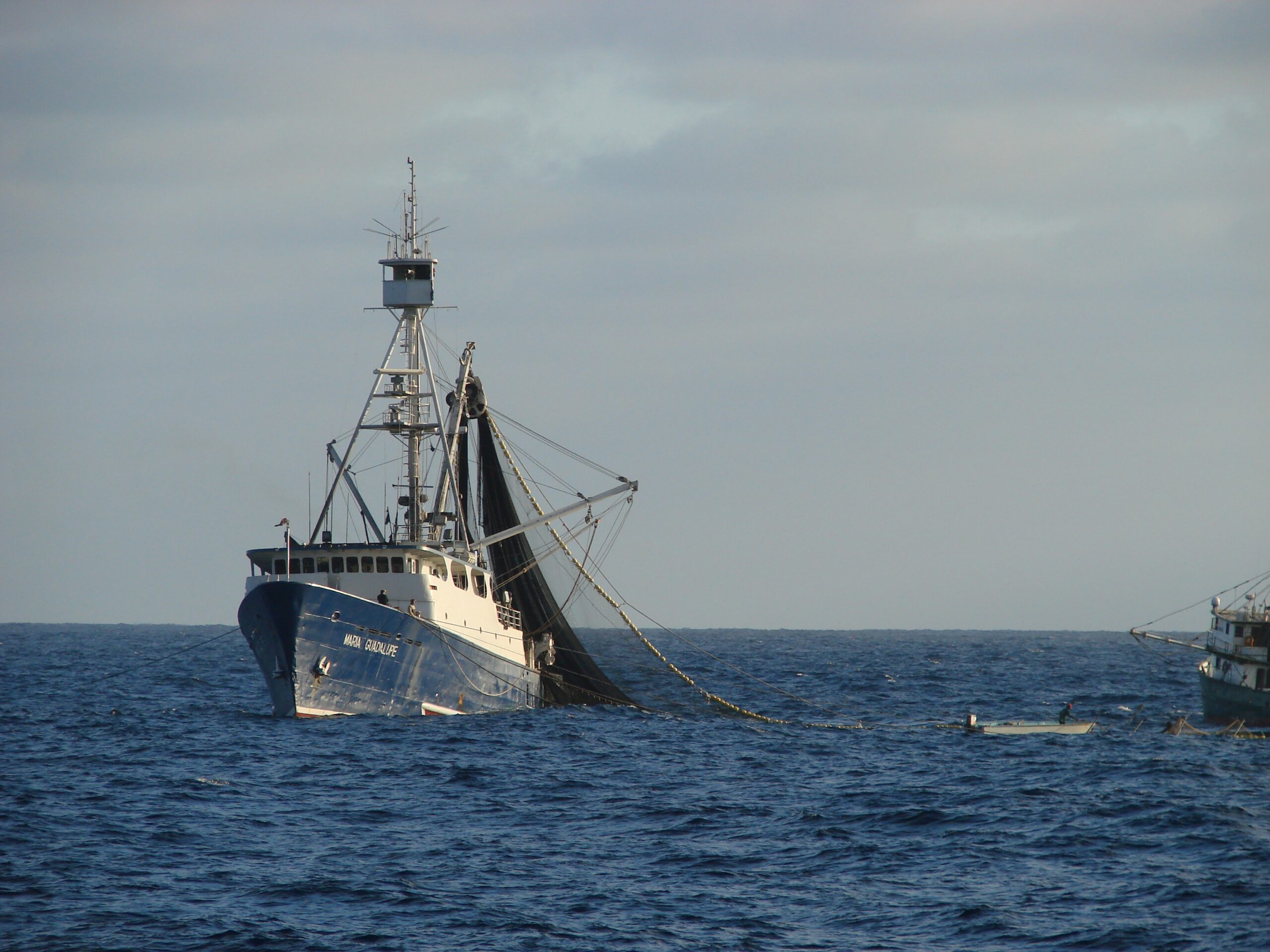
A bluefin purse seiner in the Pacific Ocean, off the coast of Mexico. (Credit: Andre Boustany)
Press Contact
Key takeaways
- This study introduces the concept of fishing fleets as “ecosystem sentinels,” which are living sensors that indicate changing conditions in a natural habitat.
- Researchers found that near-real-time data from the global Vessel Monitoring System can detect climate-driven ecosystem disruptions, such as fish fleeing warming waters, much earlier than traditional indicators.
- Vessel-tracking data were six times better at predicting tuna distribution shifts than sea-surface temperature measurements. Earlier detection could quicken fishery management response time and avoid harm to local economies anchored by commercial fishing.
Scientists at the University of California, Santa Cruz, who have already used the vast troves of geolocation data from vessel-tracking systems to pinpoint where whales and other large marine animals are endangered by ship traffic and industrial fishing have now discovered that such data can reveal where ocean heatwaves are affecting the behavior of ecologically and economically valuable species.
In a new study published on December 22 in the Proceedings of the National Academy of Sciences (PNAS), UC Santa Cruz researchers describe how satellite-tracking data on fishing fleets from the global Vessel Monitoring System (VMS) reflected low albacore abundance in the north Pacific due to a marine heatwave in 2023.
That year is important because that’s when unusually warm ocean temperatures dispersed albacore more widely and made them cost-prohibitive to target. The following year, state governors requested a federal fisheries disaster be declared to provide economic assistance to the albacore fishery in light of the low harvests in 2023.

In their study, the researchers say that the poor fishing season may have been detected sooner if the near real-time VMS data had been recognized back then as a way to monitor for anomalies in marine conditions. And that, the study’s authors emphasize, is their most significant finding: that fishing fleets can serve as ecosystem sentinels.
“We have so much data on fishing vessel activity,” said lead author Heather Welch, an associate specialist at UC Santa Cruz’s Institute of Marine Sciences (IMS). “These data are traditionally used for surveillance, and it is exciting that they may also be useful for understanding ecosystem health.”
Human ecosystem sentinels
The concept of “ecosystem sentinels” as living sensors of changing conditions in their surroundings has gained traction among researchers seeking to better understand the impacts of humans and climate change on natural habitats that are difficult to directly observe. The concept has been applied to animals ranging from birds to whales, and at UC Santa Cruz, the sentinel strategy may best be embodied by the elephant seals of Año Nuevo.
“Animals have been forewarning risk going back to the canary in the coalmine,” said Elliott Hazen, adjunct professor of ecology and evolutionary biology. “So when sentinels help us get out in front of ecosystem change, that both helps protect species and can save time and money.”
But if marine apex predators make for ideal ecosystem sentinels, the team behind this new study say fishermen fit that bill perfectly. They are highly tuned to changes in their environment, especially because those fluctuations can seriously impact their bottom line. “Fishermen can have wide-ranging movements allowing them to effectively sample large portions of the seascape,” their study states. “Importantly, fishermen are conspicuous and their activities are actively monitored via several near real-time, high-resolution data streams including vessel tracking systems, satellite mapping, and shoreside landing receipts.”
Ocean warming’s toll on fisheries
More precise ecosystem monitoring could also help avert fishery collapses that hurt local economies and communities. Over the past few decades, long-term warming due to climate change and short-term spikes associated with El Niño and marine heatwaves have led to clashes among competing fleets, strain on fish-processing infrastructure, and over-harvesting. For instance, a 2012 heatwave in the Gulf of Maine drove lobsters into shallow waters, leading to a record catch that outpaced processing capacity and consumer demand. Lobster prices fell to 70% below normal and the market crashed.
In another case, failure to recognize the impact of long-term warming on Gulf of Maine cod about a decade ago resulted in catch quotas that overestimated population levels and ultimately led to overfishing. The authors say that insights from fishing fleets as ecological sentinels may help accelerate management action to lessen the socio-economic and ecological harms of ocean warming.
Albacore and bluefin, the species at the heart of this study, are migratory temperate tunas that are seasonally targeted by West Coast fishermen during the summer and fall. Both species have been observed shifting northward and inshore during warm water conditions. In their analysis, the researchers found that VMS-tracked fleet movements mirrored the movements of the tunas. For example, the tunas and the fishery shifted north during a 2014-2016 marine heatwave, but remained in their normal distributions during subsequent heatwaves in 2019 and 2023.
A new approach for a changing climate
This new study found that VMS was six times better at predicting shifts in tuna distribution than sea-surface temperature anomalies–a measurement traditionally used by researchers to correlate changing environmental conditions to ecological disruptions. Climate change is disrupting the relationship between environmental indices and ecosystem state, explained co-author Allison Cluett.
“As warming produces unexpected ecological responses to environmental variability, real-time observations of ecosystem health—such as those provided by fishing vessels—are increasingly important,” said Cluett, an assistant project scientist at IMS.
However, the authors acknowledge that confounding factors such as fishery-management actions like closures or quota changes can interfere with the strategy of employing fishermen as ecosystem sentinels. “Noise isn’t a reason to disregard this incredibly rich volume of data,” Welch said. “But it does mean we need to carefully review inferences from fishery sentinels to prevent noise from causing harm.”
Other members of the research team at UC Santa Cruz included Michael Jacox, Joshua Cullen, Rachel Seary, and Steven Bograd.