Arts & Culture
Using speculative fiction to fill the silences of Colonial history
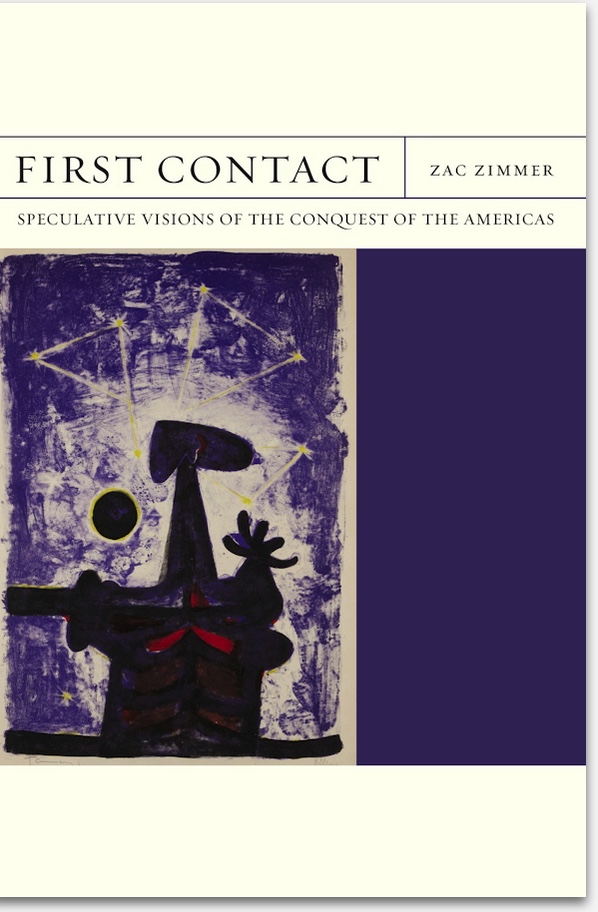
In his acclaimed new book, First Contact, Associate Professor of Literature Zac Zimmer draws on the power of speculative fiction to revisit, question and upend stories and tropes about early contact between European explorers and Indigenous populations.
When Associate Professor of Literature Zac Zimmer sifted through European archives documenting the Conquest of the Americas, he kept noticing what was missing from the official record.
Those who seek a full accounting of what happened in early colonial encounters—and who’d like detailed accounts from Indigenous people who lived through those violent times—are met with glaring absences and telling silences.
“Early colonial encounters are a particularly rich area for speculative exploration,” said Zimmer, who is affiliated with the Spanish Studies, Legal Studies, and Latin American & Latino Studies programs. “That’s because archival materials from the 16th century are incomplete, and those gaps are not random. They reflect deliberate silences imposed by colonial power.”
Surviving documents were often produced by legal authorities, translators, or inquisitors, shaping what was recorded and actively suppressing what was not, Zimmer noted.
Many of those erasures were carried out with acts of destruction. During the Spanish inquisition, many original source materials from indigenous people, including Mayan codices, were burned.
Faced with such missing pieces in the historical archive, Zimmer drew on the power of speculative fiction (SF) – a genre that incorporates futuristic and fantastical elements – to revisit, question and upend stories and tropes about early contact between European explorers and Indigenous populations in his acclaimed new book, First Contact: Speculative Visions of the Conquest of the Americas.
In a laudatory review in the Los Angeles Review of Books, John Rieder, author of Colonialism and the Emergence of Science Fiction, writes that First Contact’s primary strength and originality comes from Zimmer’s use of speculative fiction as a lens to peer into the past.
“Speculative fiction, or SF, allows for understanding colonial encounters both as they occurred historically and as they might have happened otherwise,” Rieder writes. “In order to sort through the array of recorded truth, recorded falsehood, and unrecorded truth, the aura of inevitability that the colonial accounts give the victors’ narrative has to be dispelled, making room for the stories of the others in those encounters.”
Imagining other worlds
Zimmer was highly selective about the sci-fi texts he used to illuminate the past and, in his view, “unlock unrealized historical possibilities.” He focused on books that, in his view, take a fresh look at the Conquest rather than regurgitating myths about Columbus or other explorers and simply transposing them to outer space and other settings.
Instead, he turns to imaginative works that are, in his words, “grounded in historical truth, even while they decry the lies which that history tells.” Part of his argument is that “SF can teach its readers and audiences … how to use the tools of worldbuilding to truly imagine other worlds…”
One such work is Tísner’s Paraules d’Opoton el Vell (“The Words of Old Man Opoton”), published in Catalan in 1968 and translated into Spanish by Tísner in 1992. (‘Tísner’ is the pen name of the Catalan author Avel·lí Artís-Gener.)
The novel presents a dramatic reversal of history: the Aztecs sail across the Atlantic and invade Europe in 1489—three years before Columbus’s landfall. Like the Catholic conquistadors who marauded through the Americas, the Aztecs are motivated in part by religious fervor. Convinced that Europe is the site of Aztlan, their mythic place of origin, they flood its shores.
Landing in Galicia in northwest Spain—home to the terminus of the Camino de Santiago—they follow the route on a crooked path in search of the missing Quetzalcoatl, the Plumed Serpent. One of the book’s great achievements is its ability to inhabit the minds of the conquering Aztecs as they puzzle over and mock the seemingly arbitrary nature of European place names and Western systems of timekeeping, Zimmer noted.
Zimmer also turned to the work of Carmen Boullosa, who imagines a time-traveling Moctezuma journeying through time to bustling Mexico City in the 1980s and being overwhelmed by what he sees. He also delved into various “Jesuits in Space” novels.
Historical myth-busting
Through the uses of these fictional texts, Zimmer challenges the supposed inevitability of the Conquest, which rests on notions of inherent European superiority over Indigenous peoples. He points to the randomness and contingency of history—how chance, error, and snap decisions can reshape historical outcomes.
The book also critiques what Zimmer and other scholars call “the Myth of Firstness.” Annette Kolodny’s In Search of First Contact and Jean O’Brien’s Firsting and Lasting explore how early U.S. colonial narratives established settlers as “the first people” in a region while depicting Indigenous communities as “the last” remnants.
This trope of “first conqueror,” “first settler,” or “first to discover” appears repeatedly. Even Columbus was not the first European in North America—Zimmer mentions evidence of a Norse presence near Newfoundland.
“Also, our understanding of Indigenous navigation at that time remains underdeveloped due to sea level rise that complicates archaeological study,” Zimmer said. “But what we can see is that the claim to firstness is fundamental to colonial mythmaking.”
Zimmer spoke about the many ways UC Santa Cruz nurtured his book project, noting that The Humanities Institute granted him research leave to write the book and funded part of his research-related travel.
He also found a supportive hometown audience in the Center for Cultural Studies, which is administered by THI, where he presented an early draft and received what he described as extraordinary feedback from people who believed in the project at its early stages.
In doing so, those colleagues supported Zimmer as he searched for new ways to peer into the past ‘without being bound to strict accuracy or fidelity to the archival record,” he said. “You can find ways to transform archival silence into imaginative voices.”
“But the goal is not to simply invent whatever you think should have happened,” Zimmer said. “The challenge becomes finding a reference point—a standard against which you measure what you’re creating—so that the art contributes meaningfully to telling the truth about what happened, while still being enjoyable, insightful, and captivating.”