Campus News
Get to know our researchers
Meet some of the passionate people leading our impact and innovation. Public support and federal funding make this work possible.

Did you know that UC Santa Cruz is an R1 research institution? That means we’re recognized by the Carnegie Classification of Institutions of Higher Education for having among the highest levels of research activity anywhere in the country. Our world-class facilities and culture of creativity and collaboration go a long way toward supporting that innovation. But at the end of the day, behind each new research advancement or insight is a passionate, dedicated team of people who made it all happen.
Our researchers are committed to making the world a better place. The knowledge they’re pursuing will help to improve lives today and leave behind a healthy planet and thriving societies for the next generation. That commitment to public benefit is a big part of who we are at UC Santa Cruz. Check out the stories below to learn more about what motivates our researchers and the amazing work they’re doing.
Emily Brodsky: Getting ready for the next big quake
Earth and planetary sciences professor Emily Brodsky is a geophysicist who focuses on natural catastrophes like earthquakes, landslides, glacial floods, and volcanic eruptions. The Pacific Northwest and Alaska face significant risk from these hazards, she says, and the U.S. should expect to one day experience a magnitude 9 earthquake. Brodsky has been studying earthquakes and volcanic eruptions in Chile to understand the mechanics of geologic hazards and how that can inform prediction efforts in the United States.
Jenny Reardon: Guiding ethical technology development
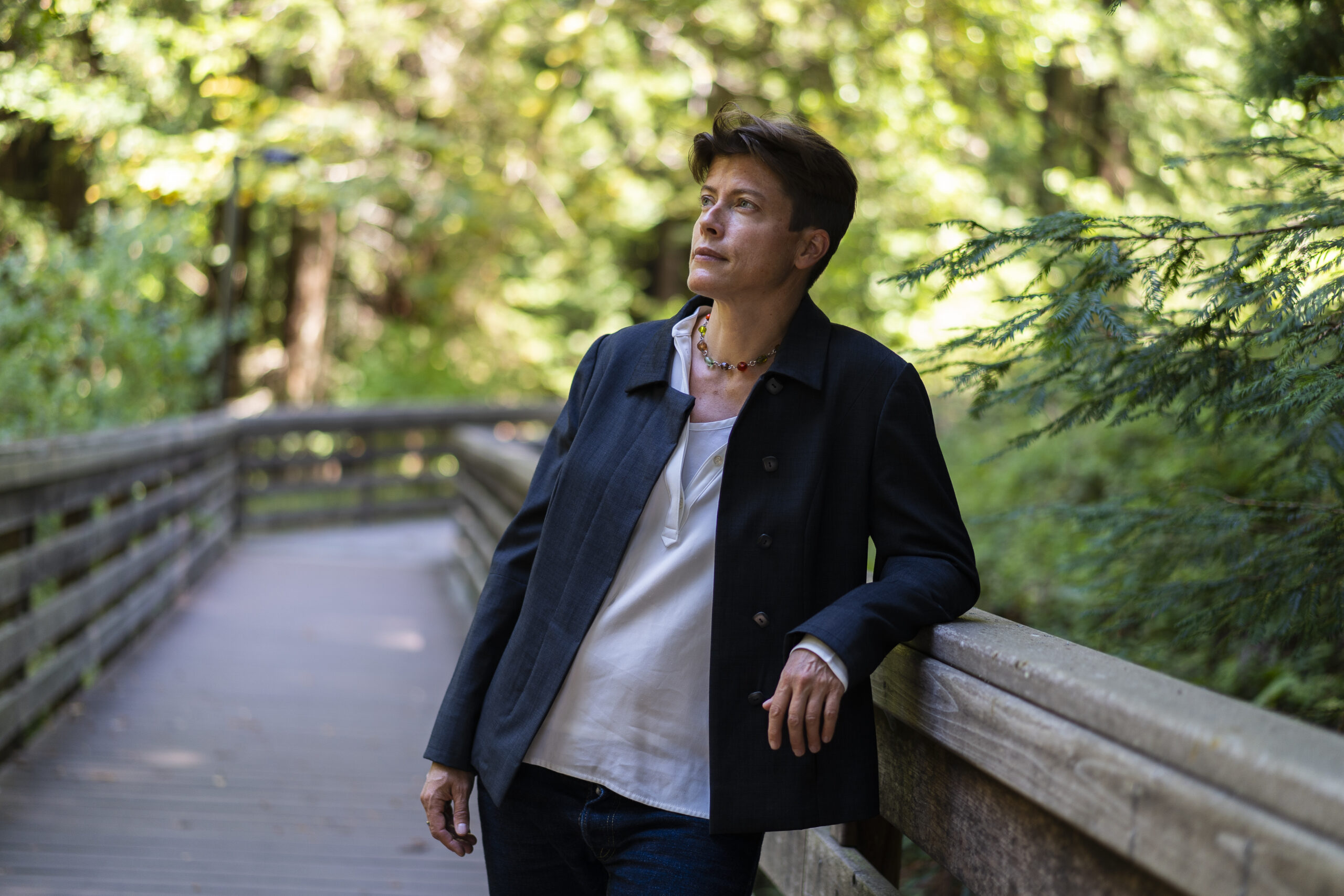
As fields like artificial intelligence, genomics, and neuroscience develop at breakneck speeds, there are many open questions about what impacts these emerging technologies will ultimately have. Will they help build better lives for people around the world? Or could they have devastating unintended consequences? In recent years, scientists in these fields have partnered with ethicists and social scientists to consider the societal implications of new research. UC Santa Cruz Sociology Professor Jenny Reardon, founding director of the Science & Justice Research Center, is at the forefront of establishing best practices for these collaborations.
Kat Gutierrez: Helping communities share their history

Assistant Professor of History Kat Gutierrez has been working with the local Filipino community in the Pajaro Valley to archive and share the often overlooked history of the Manong Generation, who came to the area as agricultural workers in the 1930s. Funding from a National Endowment for the Humanities grant allowed her team to refine a public exhibition called Sowing Seeds with the input of community-based experts, scholars, artists, and curators. Gutierrez says that funding was essential and demonstrated to community partners that their stories matter—not just locally but nationally.
Jason Eshraghian: Addressing the environmental impact of AI
Assistant Professor of Electrical and Computer Engineering Jason Eshraghian and his team are reimagining how artificial intelligence can operate—by taking cues from the human brain. In contrast to traditional AI systems that are always “on,” the human brain conserves energy by activating only when needed. That concept is central to SpikeGPT, the team’s spiking neural network for language generation. Modern AI systems can easily use on the order of $1 million a day worth of energy, but the UC Santa Cruz team’s deep learning model achieves comparable performance while using just 13 watts—the equivalent of a household light bulb.
Jennifer Maytorena Taylor: Documenting small-town American life

Professor of Social Documentation Jennifer Maytorena Taylor, founding faculty director of the Social Documentation Lab, is an award-winning filmmaker of feature and short documentary films with a background in multimedia journalism and public broadcasting. Taylor’s work often explores the nuances of rural and small town communities navigating conflicts around politics, culture, and ideology. She received National Endowment for the Arts funding for her critically acclaimed feature documentary, For the Love of Rutland, which covers a small blue-collar town grappling with deep change in an era of refugee crises, the opioid epidemic, and ideological and cultural polarization.
Public support helps make all of this work possible. Each of the UC Santa Cruz researchers above has received past federal funding for their work, which enabled key advances. Faculty often involve students in their research, which provides crucial training opportunities too. Public investment in research is an investment not just in today’s innovations, but also in the future of our country’s workforce, developing and inspiring top talent who will help keep the United States at the forefront of discovery and impact.
If you believe in this work, please take a moment to show your support for the University of California and the public value it provides for our country.