Social Justice & Community
Students support local antipoverty efforts through internship program
UC Santa Cruz’s Center for Economic Justice and Action provided paid student internship opportunities with local nonprofits through a program funded by the Monterey Peninsula Foundation.
The Monterey Bay Area region is home to a wealth of natural beauty and a relatively strong economy, but many of its residents are still experiencing high levels of poverty. Rising rental rates, in addition to the cost of food, childcare, and transportation, leave some locals struggling to make ends meet. Widening income gaps impact the region’s most vulnerable communities, from farmworkers to college students, who rely on local organizations to help them access basic needs resources and plan for the future.
Antipoverty work provides a social safety net to these residents through direct service providers that connect people with food, education, and other types of support. These organizations also serve as a hub for community organizing and empowerment, partnering with residents to raise awareness about community issues and find solutions to fix them.
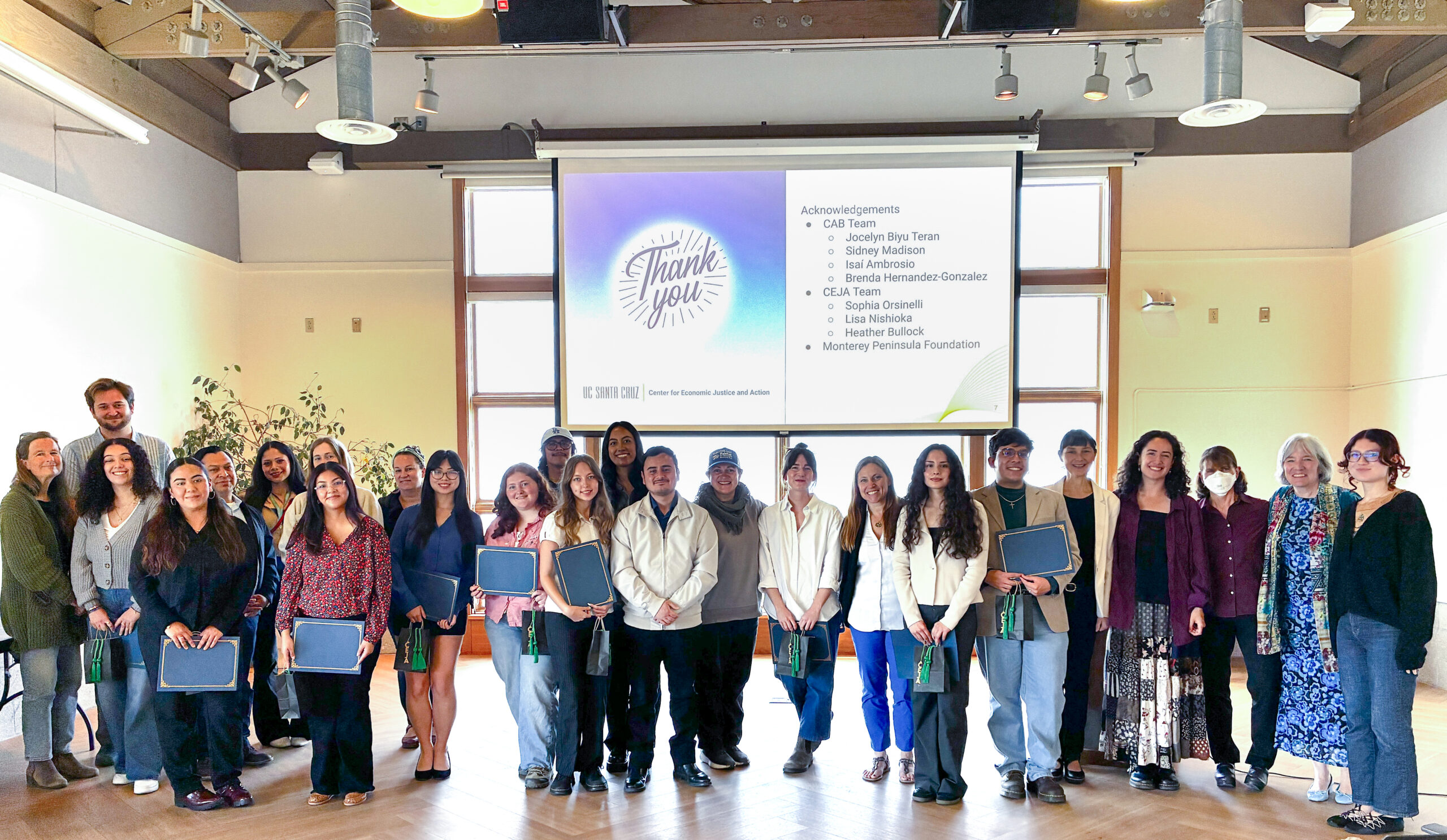
However, many non-profit organizations struggle to start new, in-depth projects that help them grow their capacity, due to the amount of time and care that their role as direct service providers requires. Over the past academic year, 12 student interns from the Center for Economic Justice and Action’s Economic Justice and Community Corps tackled priority projects like evaluation, planning, program development, and outreach with community partners to amplify their efforts and advance their missions.
Local non-profit partners—including the Community Action Board of Santa Cruz County, Habitat for Humanity Monterey Bay, Homeless Garden Project, Second Harvest Food Bank, and Ventures—identified projects for undergraduate interns. In teams of two, the students dedicated 10 hours per week to enhancing their non-profit partners’ capacities, while receiving support from mentors at both their partner organization and the center. Each student intern in the program received a $5,000 scholarship to support their work, thanks to funding from the Monterey Peninsula Foundation.
“This program is important because it engages UC Santa Cruz students to bring their knowledge and strengths to the community by tackling special projects and building their organizational partners’ capacity in ways that they would never normally be able to do,” said Heather Bullock, faculty director for the Center for Economic Justice and Action. “As a community-engaged center that is committed to both research and programming that alleviates poverty, reduces economic inequality, and advances basic or essential needs, we’re aiming to train the next generation of anti-poverty advocates, practitioners, and researchers to excel in whatever direction they go in.”
Empowering community leadership in Pajaro

Students America Gonzalez and Liliana De La Cruz worked with the Community Action Board of Santa Cruz County (CAB), a local nonprofit dedicated to eliminating poverty and creating social change through advocacy and essential services. With the help of an organizational mentor, Gonzalez and De La Cruz helped develop educational workshops and materials for the Proudly Pajaro community group, a community-led initiative that identifies and supports rising local leaders to implement climate justice and resilience projects and community planning efforts. Part of this work has included a leadership development course, where community members could identify specific issues and find solutions to fix them.
“Our leadership course came out of a couple of years of working in Pajaro after the flood, through which it became clear that there are residents who have a lot of interest, potential, and skills in being leaders for their community and working to advocate for changes that need to happen to prevent something like this from happening again,” said Sidney Madsen a postdoctoral fellow working with the Community Action Board. “The students’ impact enabled us to be responsive, situating and contextualizing the questions that residents raised about their communities, and creating materials in response. For example, Liliana created a brochure about tenant rights, which we would not have had the capacity to create and distribute before.”
For their part, students also gained a lot from the experience. Gonzalez said she enjoyed hearing directly from the community about emerging issues. The experience of supporting CAB reaffirmed her belief in the importance of community work, and she picked up knowledge and skills along the way that have prepared her to become a leader in this sort of work in the future.
“I was able to learn about community empowerment, different models of leadership, and nonprofit organization dynamics and functions,” she explained. “I gained many project management and development skills and learned how to turn ideas into real-world actions to further community goals.”
Building financial security for local families
Students Saúl Ordaz and Keila Cantellan led a logic modeling project for Ventures, a Watsonville-based organization that runs three programs related to financial literacy and income and wealth building. Together, the students worked to identify synergies among the organization’s programs and connect programmatic inputs and outputs with the larger mission of Ventures. This allowed the organization to better understand the strengths and potential areas of growth for their programs and identify new opportunities for the future.
Ordaz said he really enjoyed his work on the project, including collaborating with fellow intern Cantellan to problem-solve and learn new skills. And he greatly appreciated the support that Ventures staff provided throughout the process.
“My direct supervisor was very warm and supportive and worked hard to break down the process of creating a logic model but also provide information about the non-profit sector itself,” Ordaz says. “I really enjoyed being able to learn from someone who has so much experience and was willing to share their knowledge.”

Improving food access across Santa Cruz County
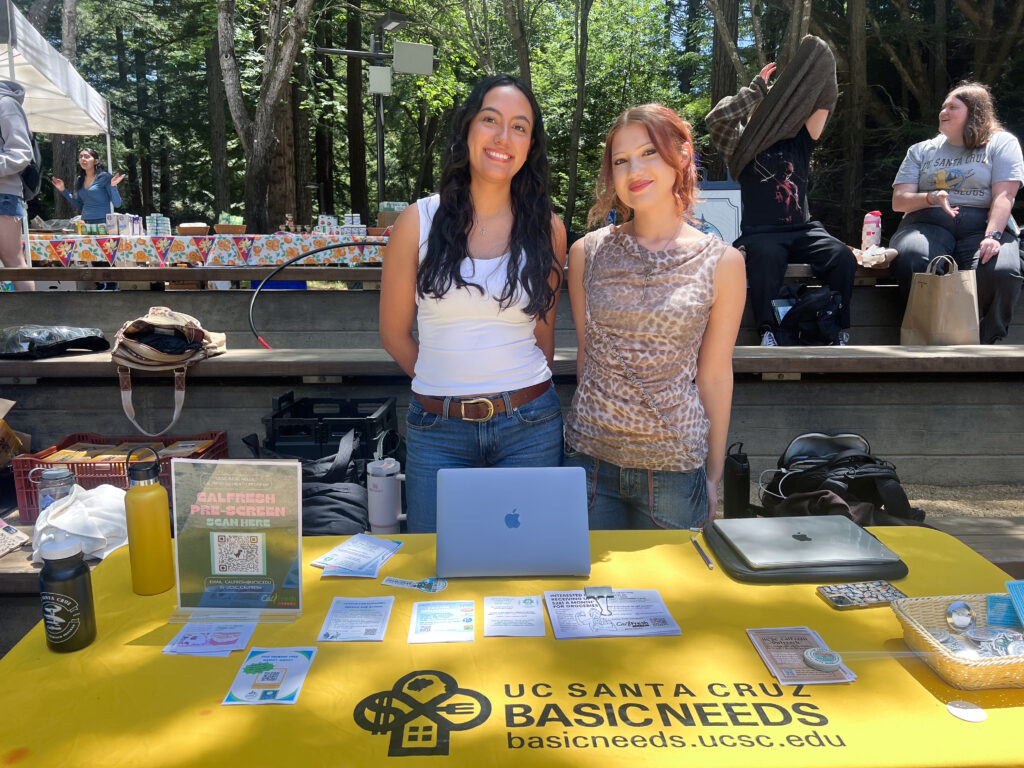
Students Claire Dobbin and Nancy Ledezma Albarran assisted the Second Harvest Food Bank of Santa Cruz County, which works to increase food access for low-income residents by sourcing and distributing food to local food pantries and community sites. Dobbin and Ledezma Albarran worked on a project aiming to “map the gap” of services provided across the county.
They analyzed data on locations and hours of operation for the organization’s network of food distribution centers and compared that with census tract data on food insecurity. The results helped to identify opportunities for Second Harvest to improve accessibility and efficiency of its food resources.
Dobkin said the experience of working with Second Harvest was inspiring, and she encourages others to get involved with making a positive impact in their own communities.
“It’s sometimes hard, when you see everything going around in the world, to know how you can help and make a difference, but I think starting with your community can be a really great way to make that difference,” she said. “And it can really help your own mental health too.”