Arts & Culture
Making metaphysics matter: Two new UC Santa Cruz Philosophy professors bring big questions down to Earth
Metaphysics has never had a “fun” reputation. Many people—if they’ve even heard of the M-word— tend to associate it with woozy, abstract lectures about time and space. But with the arrival of Philosophy Professor and new Department Chair Sara Bernstein and Philosophy Professor Daniel Nolan, two internationally respected experts in metaphysics, the UC Santa Cruz Philosophy Department is bolstering its strengths in this realm and setting out to change perceptions.
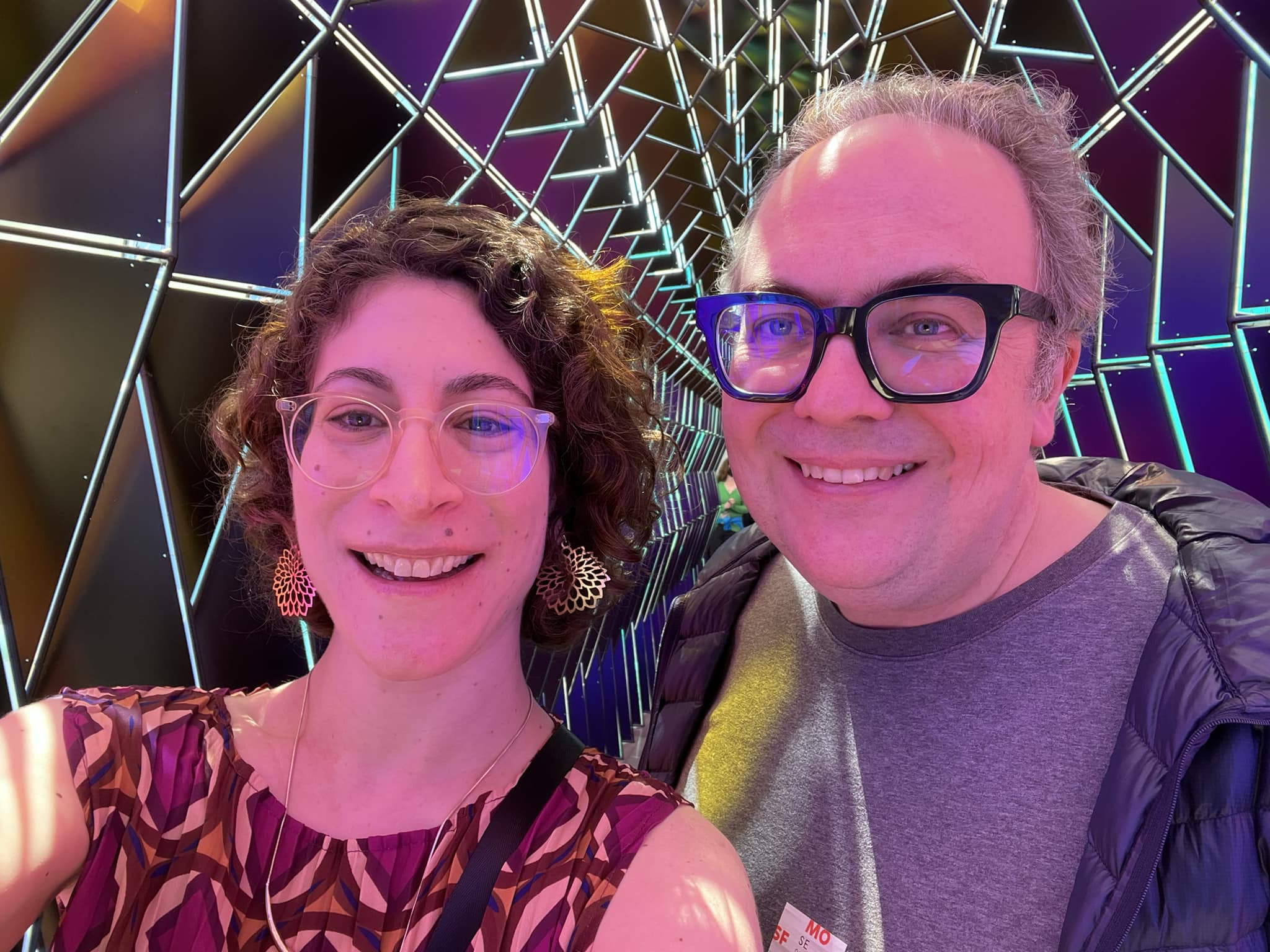
Philosophy Professor and new Department Chair Sara Bernstein and Philosophy Professor Daniel Nolan
Metaphysics has never had a “fun” reputation. Many people—if they’ve even heard of the M-word— tend to associate it with woozy, abstract lectures about time and space that spiral into confusion and never quite land on Terra Firma.
But with the arrival of Philosophy Professor and new Department Chair Sara Bernstein and Philosophy Professor Daniel Nolan, two internationally respected experts in metaphysics, the UC Santa Cruz Philosophy Department is bolstering its strengths in this realm and setting out to change perceptions.
Even the definition of metaphysics is open to interpretation and debate. This term, broadly speaking, refers to a branch of philosophy that delves deeply into big, sprawling questions concerning the basic nature of reality and existence, examining such slippery—but all-important—concepts such as causation and the nature of space and time.
“Metaphysics encompasses the basic building blocks of what we know and what we think we know,” Bernstein said.
Whether debating the moral stakes of time travel, the metaphysics of memes, or why clowns can feel creepy, Bernstein and Nolan bring a deeply human perspective to big questions about identity, causation, and social reality.
Approaching metaphysics from different angles
Before coming to UC Santa Cruz Bernstein and Nolan were faculty at the University of Notre Dame’s acclaimed Philosophy Department, the largest in the country. They have complementary research interests, but their own distinct specialties. Bernstein specializes in what she describes as “the metaphysics of the social world.”
Bernstein uses philosophy as a lens to examine contemporary social constructs, including widely accepted rules concerning the identities of group formations, from corporations to baseball teams.
“What exactly is a corporation?” Bernstein asks her students. “If we swap out all the people who work in that company, is it still the same corporation? What exactly is a baseball team? Why can we swap out all the members yet people will still be loyal to that team and still cheer it on. I ask questions about social categories.”
Bernstein will be teaching a class on the metaphysics of the social world in the spring, and also looks forward to teaching a class on the metaphysics of time travel, which promises to be a challenging and entertaining thought lab for students.
“This helps us think about a wide range of metaphysical issues regarding space and time as well as some cool ethical issues,” Bernstein said.
Nolan often examines the realms of history and anthropology in his metaphysical studies.
For instance, he has delved into the histories of social constructs over time, including the overlaps and divergences in marriage practices and the definition of marriage itself over time and across the globe. “If you look at the anthropological literature, if you look at history, marriage practices diverge really widely, or at least things that historians and anthropologists call ‘marriage’ vary widely,” Nolan said.
As an example, he referred to the “ghost marriage,” a traditional ritual in parts of rural China and some diasporic Chinese communities, where two deceased individuals are “married” in a symbolic ceremony.
Such ceremonies will forge ongoing social connections between the families of the deceased. Nolan said the existence of this rare—but still surviving—ceremony challenges widely held assumptions about marriage. If ‘ghost marriages’ can qualify as actual marriages, it raises issues regarding consent, or even the necessary presence of two living people.
Metaphysical real-world scenarios
Bernstein can point to many real-life cases where metaphysical concepts—like causation—have had concrete effects on people’s lives.
One example she discusses is an actual court case involving two drug dealers, each of whom supplied a potentially lethal dose of a drug to a man who later died from an overdose.
Legally, a defendant is eligible for a sentence enhancement only if their drug sale was a “but-for” cause of the victim’s death—that is, the victim would not have died but for that individual’s actions. The problem in this case was that both dealers gave the victim potentially lethal doses, making it unclear whether either of them, individually, meets the “but-for” causation test.
This ambiguity in causation complicates legal responsibility, even though both dealers may seem morally blameworthy, Bernstein said.
Such cases show that humans use metaphysical thinking every day without necessarily realizing they are doing it, Nolan said. He referred to concerns about “original” and “authentic” historical objects in the rarefied world of collectors, including antique car enthusiasts.
As Nolan points out, these enthusiasts are presented with deeply metaphysical puzzles about what it means for an object to be the same over time, especially when its parts are swapped or replaced.
He pointed to debates that might break out over a 1927 classic automobile. Over the years, parts inevitably wear out, get damaged, or are lost. To keep the car running and looking original, owners might replace wheels, engines, upholstery, or even entire sections of the frame.
But at what point does the car stop being the original 1927 vehicle and become something else entirely—a replica, a new creation, or a kind of “Frankenstein’s car”?
Collectors fiercely debate these questions. This debate isn’t just academic; it influences the car’s value, its eligibility for competitions, and how enthusiasts relate to it emotionally.
Nolan explains, “There are all these unexpected cases where things that can seem only of theoretical interest all of a sudden become very important to what somebody actually cares about.”
Career applications for students
Bernstein and Nolan can also cite hard data showing just how much philosophy courses can help students in future careers.
They point to the fact that The Law School Admission Council (LSAC), which administers the LSAT, and data compiled by the National Center for Education Statistics (NCES) and other education analysts, consistently show that philosophy majors score among the top on the LSAT.
“Philosophy majors have such high scores because they are used to evaluating conditionals and counterfactuals and various causal sorts of claims,” Bernstein said. “Philosophy teachers teach you how to disagree and… why you are disagreeing.”
Bernstein said that philosophy skills are very helpful in almost any job that involves working closely with groups of people, from newspaper careers to work in the corporate world.
“Being able to articulate what you’re thinking and understand what they are thinking is essential,” Nolan said. “In all of those jobs, you need to hear people who disagree with you, and articulate your own ideas, can help you make headway instead of just sitting there butting heads. While philosophy sometimes has a reputation for being abstract or ‘head in the clouds,’ those are incredibly useful skills in any profession.”