Climate & Sustainability
Finding the most natural solutions to climate change
From a young age, Rae Taylor-Burns knew she wanted to help solve the planet’s most pressing issue.
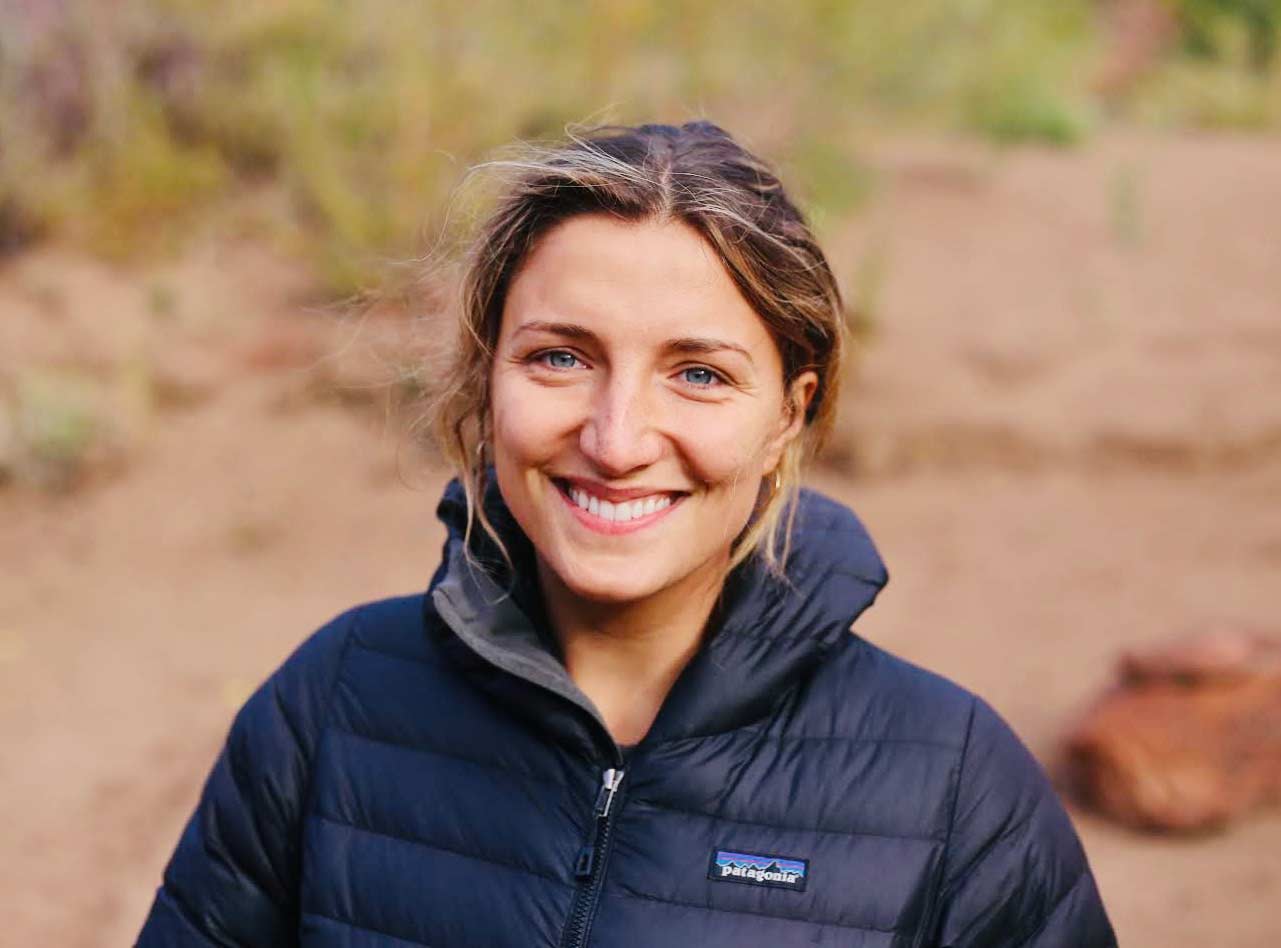
Rae Taylor Burns. Photo by Brian Canova.
Since first learning about global warming at a young age, Rae Taylor-Burns has been on a mission to find solutions. As a graduate student and now postdoctoral fellow with the Coastal Resilience Lab at UC Santa Cruz, Taylor-Burns delivers on her goal by looking for new ways coastal communities can contend with climate change.
Her 2024 paper, published in Nature, quantifies the value of marsh restoration as a defense against sea level rise along the densely populated shores of San Mateo County in California’s San Francisco Bay Area. She found that restoring marshlands provides an estimated $21 million in economic benefit presently. That value jumps up to $500 million with 1 meter of sea level rise.
Her most recent Nature publication, released in May, evaluates “horizontal levees” — traditional levees with a sloping wetland border — as a way to protect the Bay Area from rising seas. Her research shows that levee breaching can be reduced by up to 30% with this hybrid natural and human-made levee design.
With support from the UC Santa Cruz Center for Coastal Climate Resilience and the Ocean Risk and Resilience Action Alliance, Taylor-Burns is still dreaming up new climate answers. We recently caught up with Taylor-Burns to ask more about her work and how she stays inspired.
This interview has been edited for length and clarity.
When were you first inspired to pursue climate science?
I went to this elementary school that didn’t follow a traditional curriculum per se. A huge part of the school year for fourth graders was an independent research project, and you could pick any topic you wanted. This was around 2000, so we were using encyclopedia books for research. The topic I picked was global warming.
I don’t even know how I heard of global warming in the first place or how that idea came into my head. I was 10 years old or so, doing this research project on global warming, and it was very disturbing. I felt like I was learning that the world as I knew it would end. No one had told me this before. How was it that there was this impending catastrophe, and everyone was acting like everything was fine?
Did anyone encourage you along the way?
I grew up in a family that cared about the great outdoors. My dad, especially, would take us camping when I was a little kid and tried to make sure I had good experiences in nature.
I definitely always loved science, math and physics. When I was in high school, I had this awesome physics teacher who wrote his own textbook. He was focused on problem solving and the process of finding solutions. That class helped me gain confidence. He was a really good teacher at a formative time.
How did you find your research focus in ocean sciences?
After I finished college, I moved to California and worked in energy efficiency tech. But I always wanted to do something related to oceans and conservation, so that brought me to grad school. Through my master’s at UC Santa Barbara, I had an internship with the Central Coast Wetlands Group in Moss Landing. While there, I learned about climate adaptation research at the US Geological Survey and UC Santa Cruz, and I applied to the PhD program.
Once I started my PhD in ocean sciences, one of my advisors was a research geologist at the USGS who had done a lot of research assessing flood risk from climate change in California. As I was figuring out what I was going to do for my thesis, I came across a lot of Mike Beck’s and Borja Reguero’s work looking at the risk reduction benefits of coral reefs and mangroves. I wanted to combine that approach with the research that USGS was doing on flood risk in California to see how California habitats could reduce flood risk from climate change. That’s how I created my dissertation — merging two different ongoing projects.
What was your first study published in Nature all about?
It was a chunk of my PhD, with The Nature Conservancy as a funder and a partner. They helped us convene this great group of stakeholders, including local planners from San Mateo County. We worked with them to try to understand what marsh restoration in the county would look like, if they had all the resources in the world.
We tried to distill what we learned from them and translate it into parameters in the model. We changed the symmetry, we changed vegetation cover, and we breached different levees in the model, all with the goal of understanding how flood risk would change with countywide marsh restoration.
Our findings were that marsh restoration would decrease flood risk in the area. Under current climate change conditions, the number was $21 million per year of reduced risk. That number increased as sea levels rose, which means the benefit of doing this type of habitat restoration would increase over time as climate change progresses. Personally, I was surprised to see that.
Why were you surprised?
Marshes are really sensitive to sea level rise. There’s all this research looking at how marshes are expected to recede and slowly drown. As sea levels rise, plants will move higher on the landscape and, where they are underwater for too much of the day, they’ll die. In the model, we accounted for this vertical retreat of vegetation. But despite that change, the structure of the marsh still provided benefits. I was expecting that in the future, with higher water levels, all the habitat and benefits would be gone. But that actually wasn’t the case.
What is the impact of this research?
I think this type of work helps build the evidence base and a regional consensus that investing in habitat is valuable — and protecting the services that we get from habitat is valuable. Everything that I did was focused in one part of San Francisco Bay but could be expanded regionally across the area, and I think people are talking about that. It’s like a bread crumb, leading a large group of people toward investing in nature-based climate solutions.
How did this research lead to your most recent study?
Both of these studies were heavily influenced by the San Francisco Estuary Institute, which put out this very informative and useful document that they called the Adaptation Atlas. It identified which parts of the San Francisco Bay shoreline might be compatible with different types of nature-based climate adaptation. When we designed both of these studies, the marsh restoration work and the one on horizontal levees, the institute had already identified these as good options. We plugged their recommendations into a hydrodynamic model to understand how much risk would actually be reduced.
What about your work are you most proud of?
When I started my PhD, I was given a lot of freedom to come up with what I wanted to study for my thesis, and I really am proud of what I came up with. I feel like it’s answering a question that a lot of people are interested in. It’s bringing together different groups that hadn’t previously worked together in a synergistic way.
When I went to get my PhD, I was only interested in doing science if it was going to be useful to somebody and help someone make better choices — applied science. I didn’t want to just pursue this graduate degree for the sake of knowledge. That’s not what attracted me to it. For me, it’s science for the sake of solving important societal issues, and I feel like my work ended up doing just that.