Campus News
New UCSC Programs Help K-12 Students Prepare For College
Students who participated in East Side’s Saturday College took their final exams in early May. This young woman is taking a test for her SAT preparation course. Saturday College also offered a special component for parents, who were invited to learn how to access information about higher education on the World Wide Web during the […]
 Students who participated in East Side’s Saturday College took their final exams in early May. This young woman is taking a test for her SAT preparation course.
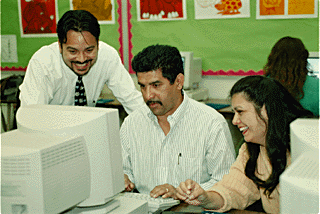 Saturday College also offered a special component for parents, who were invited to learn how to access information about higher education on the World Wide Web during the seven-week course. Parents also received information about financial aid, career planning, and requirements for attending the University of California. The programs were planned with the help of the school’s Parent Advisory Board, who encouraged other parents to participate. Ed Aguilar of the Early Academic Outreach Program (in photo, left) conducted the computer sessions with parents.
 East Side teachers of English and math met with UCSC faculty to discuss a number of issues important to both groups, including what students need to know to attend college and how they can be helped with the transition from high school. The educators also discussed possible collaborations for the future.
 A student enjoys a light moment at Saturday College.
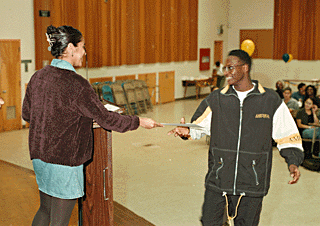 The nearly 50 ninth, tenth, and eleventh graders who participated in Saturday College received certificates of completion during an awards ceremony in early May. A number of students also received special awards and prizes for outstanding achievement.
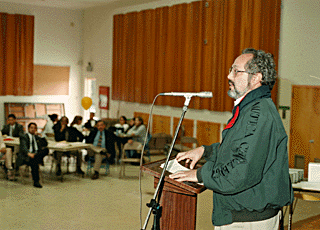 Francisco J. Hernandez, vice chancellor for student affairs at UCSC, addressed the parents, students, teachers, and others gathered for the recognition ceremony.
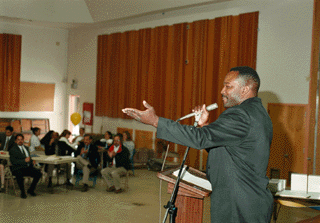 Dwayne Cantrell, UCSC’s Early Academic Outreach Program (EAOP) coordinator for the San Jose area, acted as master of ceremonies at the award ceremony. He shared his duties with Claudia Morales, an EAOP coordinator for UC Berkeley.
Now that University of California policy and state law have eliminated the use of race, gender, and ethnicity as factors in the admission of students, UC Santa Cruz is launching a number of ambitious efforts to help students of all backgrounds become eligible for the university.
One of these efforts is a partnership modeled on a successful collaboration between UCSC and a San Jose school district.
Last fall, UCSC teamed up with the East Side Union High School District to improve college participation rates of students from East San Jose. This fall, UCSC plans to launch a similar partnership with a high school district in Merced.
"Research shows that early academic outreach efforts can make all the difference," said Francisco J. Hernandez, vice chancellor for student affairs at UCSC. "A lot of these kids have the potential to be the first in their families to attend college. It’s our job to help make them aware of their educational options and to help them make decisions that will keep those options open for them."
UC Santa Cruz has embraced the idea of collaboration and used it to create a new model for reaching out to students, said J. Michael Thompson, associate vice chancellor for enrollment management and director of admissions.
"The essence of the partnership is that we go to the schools and ask what they need to help their students, and we go about providing it to them," said Thompson. "Together with the schools, we have developed a new model for what we think a successful outreach program should look like."
At East Side Union High School District, teachers and UCSC faculty have been exchanging ideas and supporting each other; students have been tutored intensively in English and math; and parents have been learning about the requirements and rewards of higher education for their children.
The partnership has already started paying off for East Side students, said district superintendent Joe Coto.
"It’s raising the aspirations of our students and having a very positive effect," he said. "They’re thinking it’s possible to go to a more prestigious university, like UCSC."
A successful outreach program like the one at the East Side district is now seen to contain three key elements, Thompson said:
- collaboration between university faculty and high school teachers
- academic enrichment and support for students, including tutoring and a Saturday academy
- activities and presentations designed to motivate and provide support.
In addition, parents are also given an opportunity to learn about higher education through Saturday classes, workshops, and discussion sessions.
"In the past, outreach programs have concentrated mostly on providing motivation and support to students," said Thompson. "Now, we’re seeing each aspect as equally important in helping students become eligible and competitive for the university."
Don Rothman, director of the Central California Writing Project at UCSC, helped set up support for the teaching of writing at the East Side district and is working to establish a similar collaboration with the Merced Union High School District.
"I’m confident we will end up creating a new conversation–a professional dialogue–about the teaching of writing, and that’s good," Rothman said. "Eventually, we need to get those kids, who are now in fourth grade and who will be seniors when UC Merced opens, ready, eligible, and competitive so they can get into the university."
Rothman’s Central California Writing Project brings teachers to UCSC every summer to learn methods for teaching writing. Rothman is already plotting how to use the program to enrich partnership schools. For example, he envisions bringing Merced teachers together with others who have been through the summer institute so that they can learn from each other.
"That’s how we’re going to improve the schools," Rothman said. "Through partnerships and professional collaboration. It’s not from people coming in from the outside telling people how to do things."
One of UCSC’s recent collaborative projects has been with fourth-grade students at Aromas School in Monterey County. The fourth graders wrote a bilingual book, Kids Around the University, detailing the college experience from a kids-eye view. UCSC helped them publish their manuscript in book form and plans to distribute the book to fourth-grade classrooms in Monterey and Santa Cruz Counties.
UCSC is also increasing its work with older children. The campus has received $160,000 from the UC Office of the President to expand the services its Early Academic Outreach Program (EAOP) offers to high schools on the Central Coast. It plans to increase its work in the towns of Seaside and Salinas in Monterey County with some of that funding.
"These new partnerships deepen the services EAOP has offered and expand the academic development component of the outreach," said EAOP director Allen Fields. The outreach program has counseled and motivated underrepresented students in schools from Monterey to Fresno for the last 20 years.
"This kind of outreach is something we’ve wanted to do for a long period of time," he added. "What we really needed were additional resources and support from the Office of the President and the legislature to get the resources that we needed to expand the services that we believe are going to make a difference."
The Chancellor’s Educational Partnership Advisory Council is acting to coordinate the campus’s outreach efforts. The group is chaired by Social Sciences Dean Martin Chemers and made up of faculty, staff, and administrators with a particular interest in outreach.
At the request of the UC Office of the President, a subcommittee of the council selected six high schools in the Monterey Bay and Santa Clara areas with which UCSC will begin working in the fall.
These are: Overfelt High School in Santa Clara County, San Benito High School in San Benito County, Aptos High School in Santa Cruz County, and North Monterey High School, Edward Alvarez High School, and Salinas High School in Monterey County. It has not yet been decided what forms of support UCSC will offer to these schools.
Members of the UCSC community are involved in a myriad of activities which are too numerous to list comprehensively. They include:
- America Reads: UCSC students receive training from the Education Department and work 10 hours per week with K-3 students at schools in Santa Cruz and Watsonville to help children learn to read and write. UCSC joined with the national program this fall.
- Central Coast Science Project: Engages K-12 teachers in hands-on science activities designed to improve their understanding of science content. Faculty and scientists from UCSC science departments and research institutes team up with experienced public school teachers to teach workshops.
- Indonesian Dance and Puppetry Program: Provides lecture-demonstrations on Indonesian dance, music, culture, and society to K12 schools in Santa Cruz County. Part of the Cultural Council of Santa Cruz County’s SPECTRA program.
- Partners in Education: Researchers and student teachers from UCSC join students and teachers from Manzanita Elementary School in Seaside to take electronic field trips on the electronic superhighway. They also plug into the National Oceanic and Atmospheric Administration and other weather-information databases.
- Seaside Junior High School Math/Science Institute: Underrepresented middle school students learn math and science concepts at this summer residential program sponsored by UCSC Summer Session in collaboration with the Monterey Peninsula Unified School District. Year-round followup includes mentorship and tutoring.
- Step to College Program: High school seniors attend a class on campus, mostly free of charge, through Concurrent Enrollment.
- Summer Academic Program for High School Students: A five-week residential program for high school students between their junior and senior years, sponsored by UCSC Summer Session. The students live on campus and earn college credit taking university-level summer courses at UCSC.
- UCSC-Starlight School Program: UCSC and the Pajaro Valley Unified School District jointly operate the Starlight Elementary School in Watsonville. The school helps teachers develop professionally and will eventually become a center for research.